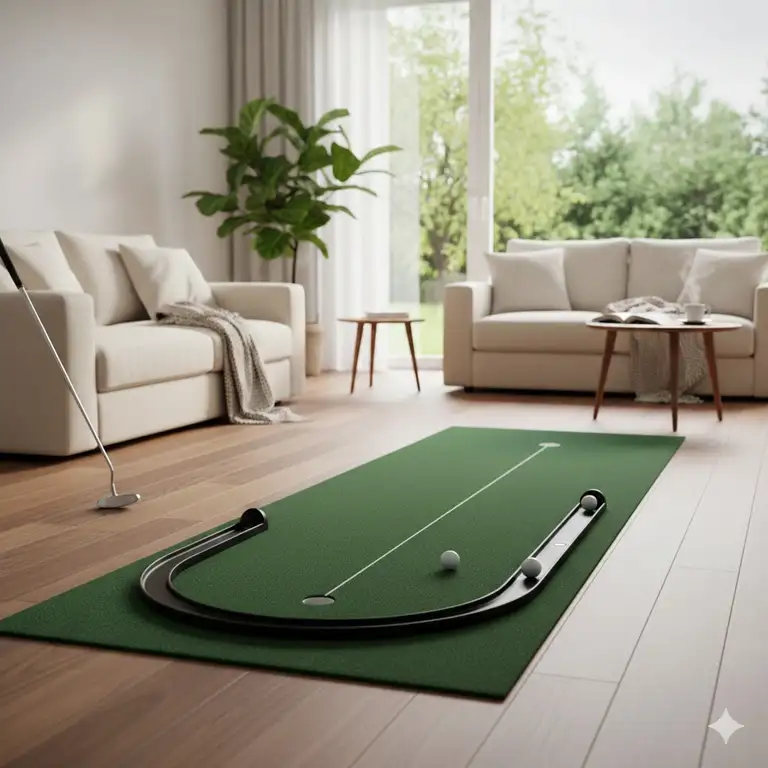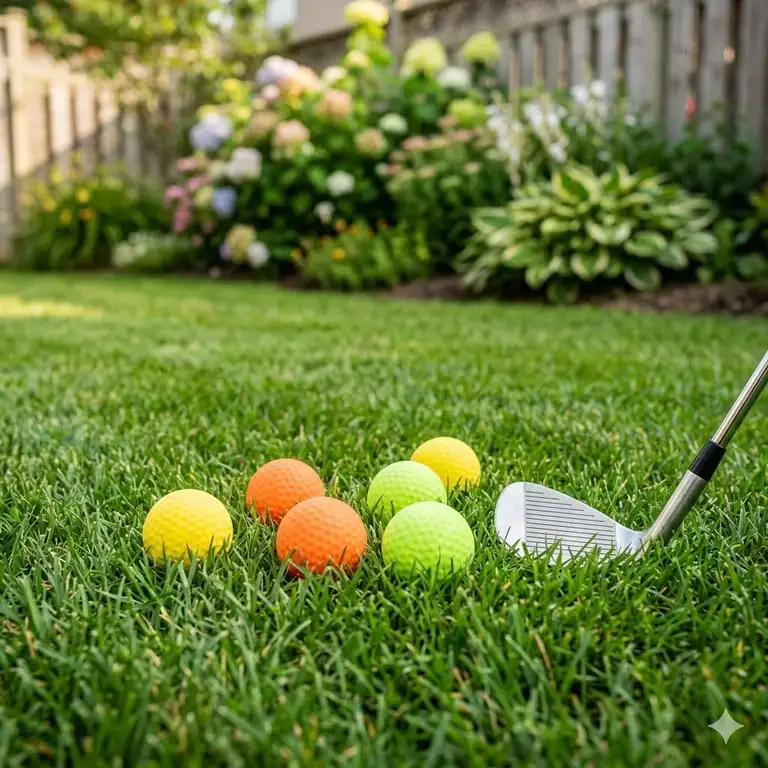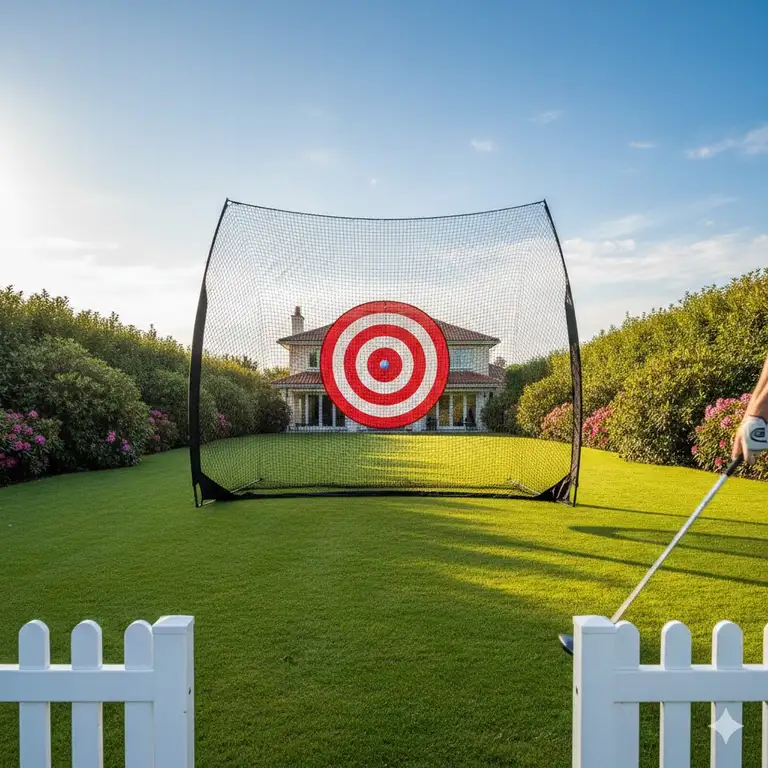
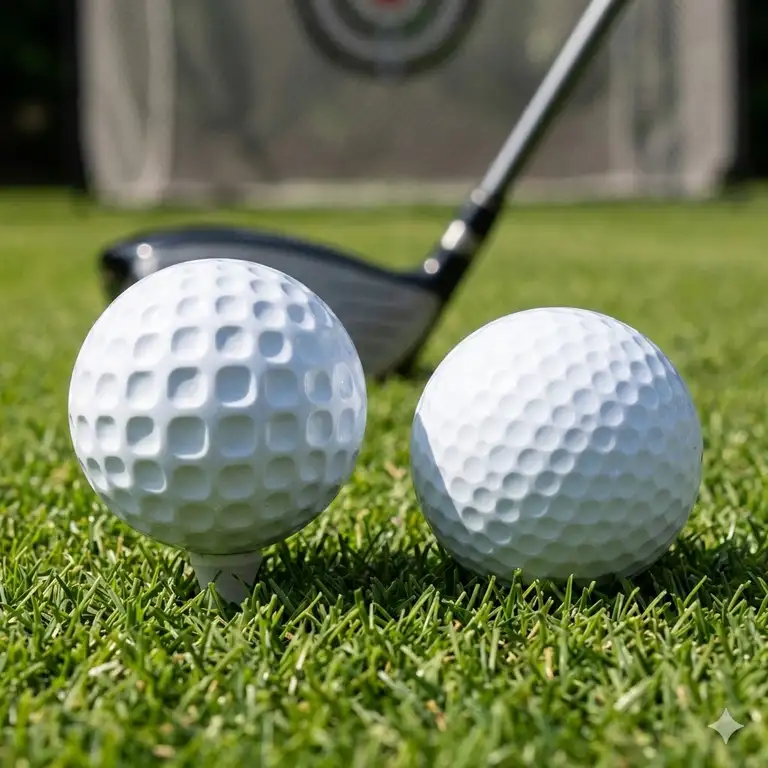
Let’s be honest for a second—we’ve all had that moment. You’re standing in your backyard, your favorite 7-iron in hand, looking at a beautiful patch of grass. You want to swing. You need to swing. But then you look at your neighbor’s expensive bay window or your own greenhouse, and the dream dies. Or does it? Welcome to the world of limited flight golf balls, the unsung heroes of the “I don’t have time to go to the driving range” club. In 2026, the technology behind these restricted flight golf balls has reached a point where you can actually get meaningful feedback without a single “shatter” sound effect following your follow-through.
✨Was this helpful? Spread the word! 🚀
I’ve spent years testing everything from high-compression tour balls to those flimsy plastic things that look like Swiss cheese. I can tell you that finding the right balance between safety and realism is an art form. Whether you are working with a tiny urban patio or a modest suburban lawn, choosing the right practice golf balls limited flight style is the difference between improving your handicap and just making noise.
Quick Comparison: Training Aids vs. Traditional Balls
Before we dive into the nitty-gritty, let’s look at how these specialty balls stack up against the real deal and common alternatives.
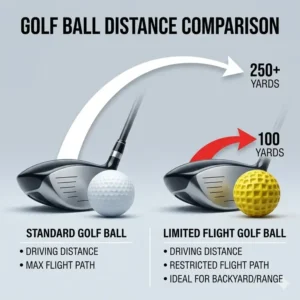
| Feature | Limited Flight Golf Balls | Traditional Golf Balls | Plastic Airflow Balls |
| Max Distance | 30–100 yards | 250+ yards | 15–30 yards |
| Feedback/Feel | High (Realistic) | Absolute | Low (Clicky) |
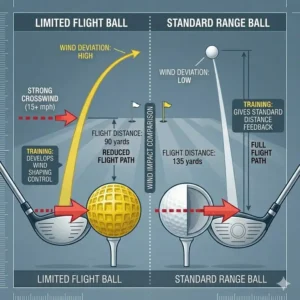
| Wind Resistance | Moderate | High | Very Low |
| Safety Level | High (Won’t break glass) | Dangerous for property | Extremely Safe |
| Price Point | Mid-range | High | Budget |
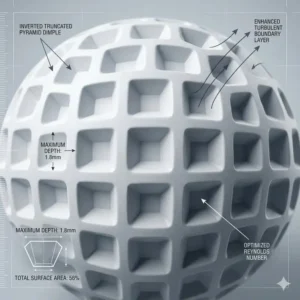
Top 7 Limited Flight Golf Balls: Expert Analysis
If you are looking to turn your yard into a private Masters-level practice facility, you need the right gear. I have researched the current 2026 Amazon marketplace to bring you the top seven options that offer the best performance, durability, and “neighbor-friendly” flight paths.
1. AlmostGolf Point3 Limited Flight Golf Balls
The gold standard for serious backyard practice. These are often cited by pros as the closest thing to a real ball without the danger. They feature a pressurized CO2 core and a high-velocity design.
-
Technical Specifications:
-
Material: Cross-linked closed-cell foam.
-
Weight: Approximately 13.5 grams (about 1/3 of a real ball).
-
Flight Distance: Max 100 yards.
-
Dimple Pattern: Traditional 322-dimple layout for realistic spin.
-
-
Customer Review Analysis: Users consistently praise the “true flight” characteristics. Many reviewers note that they can actually hit draws and fades, which is rare for short distance golf balls. Some mention they wear out after about 500-1000 hits, but the feedback is worth it.
-
Professional Applications: Ideal for teaching pros conducting lessons in confined spaces or indoor studios without high-end simulators.
-
Pros & Cons:
-
✅ Pros: Realistic spin, won’t break windows, excellent “pop” off the face.
-
❌ Cons: More expensive than basic foam, can be lost in high wind.
-
2. Callaway HX Practice Golf Balls
Callaway brings their hex-dimple technology to the practice range. These are made of high-durability foam and are designed to mimic the aerodynamics of their Chrome Soft line.
-
Technical Specifications:
-
Material: Soft, durable foam composite.
-
Design: Patented HEX aerodynamic dimples.
-
Quantity: Available in 9-pack or 18-pack.
-
Colors: High-visibility Orange, Pink, and Lime Green.
-
-
Customer Review Analysis: High marks for durability. Unlike cheaper foam balls that flake, the Callaway HX Practice Golf Balls tend to hold their shape for seasons. Users love the bright colors for finding them in tall grass.
-
Professional Applications: Great for warm-up drills before a round when a range isn’t available.
-
Pros & Cons:
-
✅ Pros: Extremely durable, easy to see, great brand reliability.
-
❌ Cons: Slightly softer feel than the AlmostGolf version.
-
3. SKLZ Impact Golf Balls
These are not your average plastic balls. The SKLZ Impact Golf Balls are made of a proprietary pop-back material that is nearly indestructible.
-
Technical Specifications:
-
Weight: Heavier than standard plastic (approx. 15g).
-
Structure: Regulation size but with a collapsible design.
-
Warranty: 1-year limited manufacturer warranty.
-
-
Customer Review Analysis: Reviewers are obsessed with the durability. You can step on these or hit them into a brick wall, and they just pop back into shape. They provide a satisfying “thwack” but only travel about 40 yards.
-
Professional Applications: Excellent for high-speed swing training where you are more concerned with contact than flight.
-
Pros & Cons:
-
✅ Pros: Indestructible, heavier weight helps in light breezes.
-
❌ Cons: Flight path is less realistic for shot shaping.
-
4. Intech Golf Hollow Practice Balls
For the budget-conscious golfer, the Intech Golf Hollow Practice Balls are the definitive choice. These are the classic “airflow” style but with a thicker wall construction for better longevity.
-
Technical Specifications:
-
Material: High-density polyethylene.
-
Design: Symmetrical holes for drag.
-
Flight: 15–25 yards.
-
-
Customer Review Analysis: Most users buy these for their kids or for very tight indoor spaces. They are basic, but they do the job. Some customers noted that they can crack if hit with a high-swing speed driver (110+ mph).
-
Professional Applications: Short-game chipping practice in living rooms or office environments.
-
Pros & Cons:
-
✅ Pros: Very affordable, safe for all indoor use.
-
❌ Cons: Minimal feedback, very short distance.
-
5. The Floppy Indoor Practice Golf Ball
This is a unique entry in the reduced flight golf balls category. The Floppy Indoor Practice Golf Ball has a soft, fabric-like exterior and a weighted core that feels surprisingly like a real ball on the clubface.
-
Technical Specifications:
-
Exterior: Durable woven fabric.
-
Core: Proprietary soft-bead filling.
-
Surface Compatibility: Safe for mirrors and TVs (though I wouldn’t test that theory on purpose!).
-
-
Customer Review Analysis: Golfers who live in apartments love “The Floppy.” It provides a “thud” rather than a “click,” which is great for late-night practice without waking the neighbors.
-
Professional Applications: Used by short-game coaches to teach soft hands and “feel” around the green.
-
Pros & Cons:
-
✅ Pros: Best indoor feel, quietest option on the market.
-
❌ Cons: Not intended for full driver swings; primarily for chipping/pitching.
-
6. Rukket Sports Foam Practice Golf Balls
Rukket is a powerhouse in the practice net industry, so it makes sense their flight limited golf balls are top-tier. These are denser than standard foam, giving them a bit more “heft.”
-
Technical Specifications:
-
Material: High-density EVA foam.
-
Quantity: Usually sold in packs of 12 or 24 with a mesh carry bag.
-
Weight: Optimized for mid-range flight (40-50 yards).
-
-
Customer Review Analysis: Users appreciate the included storage bag. The feedback on the clubface is described as “firm but safe.” They are a favorite for backyard “par 3” courses.
-
Professional Applications: Multi-sport training facilities use these for introductory golf clinics.
-
Pros & Cons:
-
✅ Pros: Great value per ball, includes storage, good wind stability for foam.
-
❌ Cons: The bright yellow can stain white clubface inserts over time.
-
7. GoSports Foam Flight Practice Golf Balls
Rounding out our list is the GoSports Foam Flight Practice Golf Balls. These offer a very soft landing, making them perfect for those who are worried about their lawn or flower beds.
-
Technical Specifications:
-
Design: Dimpled for aerodynamic stability.
-
Diameter: Standard 1.68 inches.
-
Safety: 100% soft foam.
-
-
Customer Review Analysis: Parents love these for teaching children. They are soft enough that getting hit with one (which happens!) doesn’t cause injury. They don’t travel as far as the AlmostGolf balls, staying within a 30-40 yard radius.
-
Professional Applications: Perfect for “Golf in Schools” programs or large group introductory classes.
-
Pros & Cons:
-
✅ Pros: High safety rating, very soft landing, vibrant colors.
-
❌ Cons: Limited feedback on miss-hits.
-
Detailed Product Specifications Matrix
| Product | Primary Material | Max Distance (Yards) | Indoor Safe? | Best Use Case |
| AlmostGolf Point3 | CO2 Foam | 100 | Yes | Serious Shot Shaping |
| Callaway HX | Soft Foam | 50 | Yes | General Backyard Practice |
| SKLZ Impact | Pop-back Plastic | 45 | Yes | Durability/Hard Hitting |
| Intech Hollow | Plastic | 25 | Yes | Budget/Kids |
| The Floppy | Fabric/Beads | 15 | Yes (High) | Short Game/Indoor |
| Rukket Sports | EVA Foam | 50 | Yes | Full Swing Repetition |
| GoSports Foam | Soft Foam | 40 | Yes | Family Fun/Safety |
✨ Don’t Miss These Exclusive Deals!
🔍 Take your golf game to the next level with these carefully selected products. Click on any highlighted item to check current pricing and availability. These tools will help you dial in your swing and build the muscle memory you need to crush it on the course! ✨
💬 Just one click – help others make better buying decisions too!😊
Why Use Limited Flight Golf Balls? (The Science of the Swing)
You might be wondering why you shouldn’t just hit real balls into a net. While nets are great, there is a psychological component to seeing a ball actually fly. This is where limited distance golf balls shine. According to research on motor learning, seeing the initial trajectory of a shot provides crucial feedback that hitting into a net just can’t replicate.
The Physics of Drag and Spin
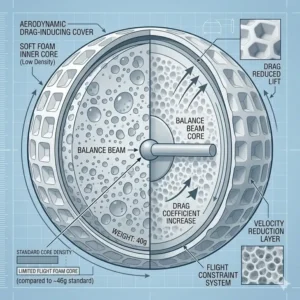
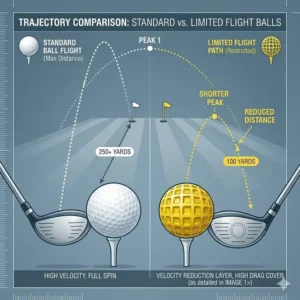
Most limited flight golf balls are designed with high-drag coefficients. In standard ball design, dimples are used to reduce drag and increase lift. However, with restricted flight golf balls, the dimples are often modified—or the ball’s overall weight is reduced significantly—so that air resistance takes over much sooner.
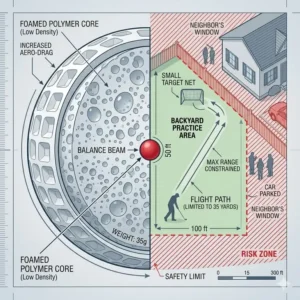
For example, a standard golf ball weighs about 45 grams. A foam practice ball might only weigh 10 to 14 grams. Because of the lower mass, the force of air resistance (drag) has a much larger effect on the ball’s deceleration. This is why you can swing a driver at 100 mph and the ball still stops before it hits your neighbor’s fence.
Safety and Property Protection
Let’s talk about the “Oops” factor. A real golf ball has enough kinetic energy to break bone, shatter automotive glass, and put holes in siding. The materials used in practice golf balls limited flight versions are designed to deform upon impact. This deformation absorbs the energy, making them virtually harmless.
Performance Metrics Comparison
| Metric | High-End Limited Flight | Low-End Plastic | Real Ball (Reference) |
| Initial Velocity | 70% of real | 40% of real | 100% |
| Spin Retention | Moderate | Very Low | High |
| Smash Factor | ~1.20 | ~0.80 | 1.45+ |
| Stopping Power | Instant | Rolls away | Depends on green |
Benefits of Using Reduced Flight Golf Balls vs. Traditional Alternatives
When we look at the benefits, it’s not just about safety. It’s about accessibility. Not everyone lives five minutes from a driving range. According to the National Golf Foundation, the biggest barrier to entry for new golfers is time and cost. Having a bag of golf balls limited flight style allows you to practice for 15 minutes during your lunch break.
1. Improved Contact Quality
Because you aren’t worried about where the ball is going (or what it’s breaking), you can focus entirely on the “smash factor.” You can feel if you hit it off the toe or the heel.
2. Shot Shaping in Small Spaces
High-quality balls like the AlmostGolf Point3 Limited Flight Golf Balls actually respond to side spin. If you slice it, the ball will curve. This is vital for learning how to control your clubface.
3. All-Weather Practice
In 2026, many of these foam and plastic composites are designed to withstand moisture. You can practice on a damp lawn without ruining the balls, unlike real balls which can lose performance if left in the elements.
Benefits Quantification Table
| Benefit Category | Impact Level | Description |
| Convenience | ⭐⭐⭐⭐⭐ | Practice anywhere, anytime without travel. |
| Safety | ⭐⭐⭐⭐⭐ | Reduces property damage risk to nearly zero. |
| Technical Skill | ⭐⭐⭐ | Improves contact and initial launch awareness. |
| Cost Savings | ⭐⭐⭐⭐ | Saves on range bucket fees and gas. |
| Family Engagement | ⭐⭐⭐⭐ | Safe for kids to join in the fun. |
Buying Guide: How to Choose Your Perfect Practice Ball
Choosing between the various restricted flight golf balls on the market depends on three main factors: your space, your skill level, and your goals.
Determine Your Available Space
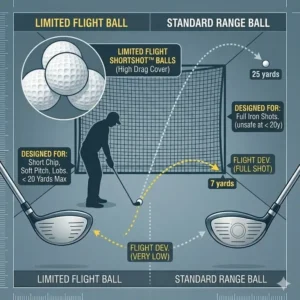
If you have a 100-yard field behind your house, go for the premium foam balls. They will give you the most “pro-like” experience. If you are hitting in a garage, the hollow plastic or fabric-weighted balls are better because they have zero bounce-back risk.
Skill Level and Feedback
-
Beginners: Look for durability and high visibility. You’ll likely be hitting the ground and “topping” the ball often. The SKLZ Impact is great here.
-
Advanced Players: You need spin. If the ball doesn’t curve when you hit a hook, you aren’t learning. The AlmostGolf series is your best bet.
Budget vs. Premium Comparison
| Category | Budget (Plastic) | Mid-Range (Foam) | Premium (Composite) |
| Price per Ball | $0.25 – $0.50 | $0.75 – $1.25 | $1.50 – $2.50 |
| Lifespan | Short (cracks) | Medium (fades) | Long (durable) |
| Flight Realism | Low | Moderate | High |
| Recommended Brand | Intech | Callaway / Rukket | AlmostGolf |
User Compatibility Matrix
| User Type | Recommended Ball Type | Why? |
| The Apartment Dweller | Fabric / Weighted (The Floppy) | Quiet, safe for indoor walls. |
| The Suburban Dad | High-Density Foam (Callaway HX) | Stays in the yard, survives the mower. |
| The Competitive Junior | Pressurized Foam (AlmostGolf) | Realistic flight for training. |
| The PE Teacher | Hollow Plastic (Intech) | Cheap for large groups, very safe. |
The Evolution of Golf Practice in 2026
The landscape of golf has changed. With more people working from home than ever, the demand for backyard solutions has skyrocketed. We’ve seen a surge in “home-grown” golf courses—people using limited flight golf balls to create 3-hole loops around their property.
Sustainability in Practice
In 2026, manufacturers are also focusing on eco-friendly materials. Some of the newer short distance golf balls are made from biodegradable polymers, ensuring that if you lose one in the woods, it won’t be there for the next thousand years. While none of our top 7 are fully biodegradable yet, the industry is moving that way rapidly.
Integration with Technology
Interestingly, some high-end restricted flight golf balls are now being designed with reflective coatings specifically to help low-cost launch monitors track them better. While they don’t have the internal sensors of a $500 smart ball, they are becoming more “tech-friendly.”
Material Performance Metrics
| Material Type | Air Resistance | Impact Force | Bounce Factor |
| EVA Foam | High | Low | Medium |
| Polyethylene | Very High | Very Low | Low |
| Closed-Cell Foam | Medium | Medium | High |
| Fabric Composite | Extreme | Negligible | Very Low |
✨ Don’t Miss These Exclusive Deals!
🔍 Take your practice sessions to the elite level with these carefully selected limited flight golf balls. Click on any of our top picks to check current pricing on Amazon and get fast shipping. Your neighbors (and your handicap) will thank you! ⛳
Conclusion: Take Your Yard Back
Mastering the game of golf doesn’t require a country club membership or a four-hour block of time every day. By integrating limited flight golf balls into your daily routine, you can chip away at those swing flaws while the coffee is brewing. Whether you choose the realistic flight of the AlmostGolf Point3 Limited Flight Golf Balls or the indestructible nature of the SKLZ Impact, the key is consistency.
I’ve seen my own game improve by leaps and bounds just by hitting 20 foam balls a day in my backyard. It keeps the “feel” in your hands and the rhythm in your legs. In 2026, there is no excuse for a rusty swing. So, grab a bucket, step out onto the grass, and start swinging. Just maybe… still aim away from the neighbor’s cat.
Frequently Asked Questions
✅ Most limited flight golf balls are made of foam or light plastic and are designed to be safe. While they shouldn't break a standard window, a direct hit at high speed could still cause minor damage to fragile items...
✅ They mimic the initial flight and spin, but the distance is significantly reduced. High-quality versions like AlmostGolf will slice or hook just like a real ball, providing essential feedback on your swing path and clubface angle...
✅ Depending on the brand and your swing speed, a foam ball lasts between 200-500 hits. Over time, the foam may compress or the outer skin may start to flake, which is when it's time to replace them...
✅ Yes, they are excellent for chipping and pitching. Since they are lighter, they help you focus on making clean contact. However, because they don't roll like real balls on grass, they are better for air-time practice...
✅ While some simulators can track them, most launch monitors (like SkyTrak or Trackman) are calibrated for the weight and speed of real balls. Using them might result in inaccurate data unless the software has a specific 'practice ball' setting... ❓ Can limited flight golf balls damage a car or window?
❓ Do these balls fly the same way as a regular golf ball?
❓ How long do foam practice golf balls typically last?
❓ Are restricted flight golf balls good for practicing chipping?
❓ Can I use these balls with my golf simulator?
Recommended for You:
- Soft Golf Balls for Backyard Practice: 7 Best Picks for 2026
- Foam Golf Balls Indoor Practice: 7 Best Picks for Your 2026 Game
- 7 Best Golf Chipping Target Mat Options to Crush Your Short Game in 2026
Disclaimer: This article contains affiliate links. If you purchase products through these links, we may earn a small commission at no additional cost to you.
✨ Found this helpful? Share it with your friends! 💬🤗