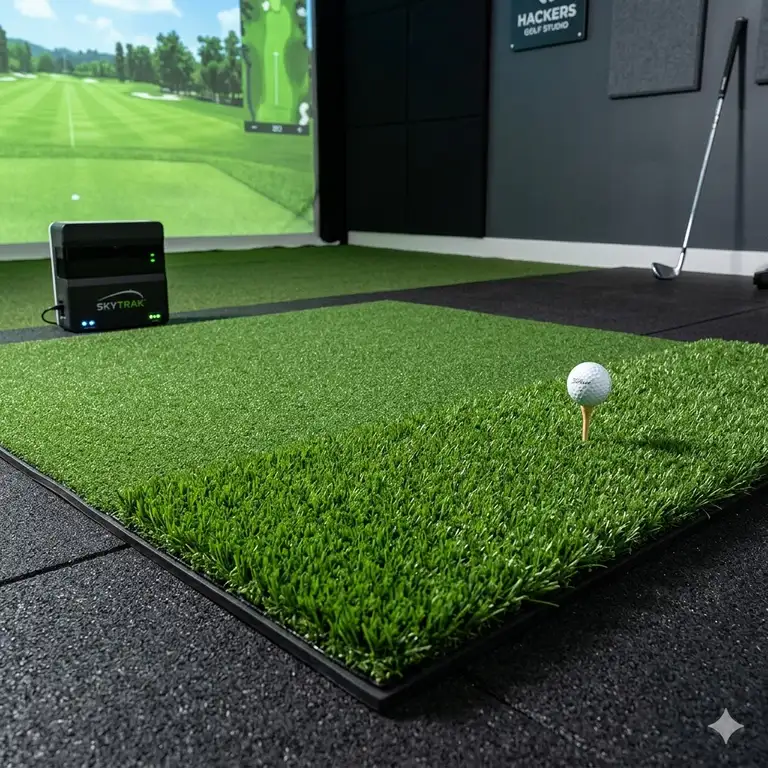
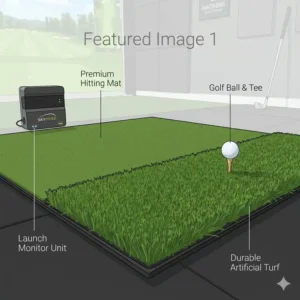
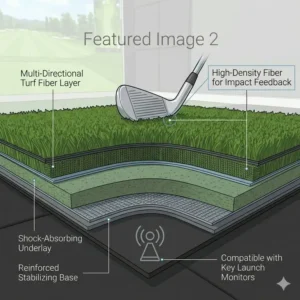
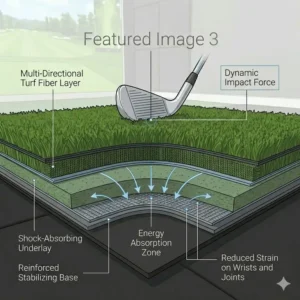
A golf simulator hitting mat is a specialized synthetic turf surface engineered to replicate the feel of natural grass while providing a stable foundation for indoor or outdoor practice. Unlike a standard driving range mat, which often feels like hitting off a concrete slab covered in green carpet, a high-quality golf simulator hitting mat is designed to absorb the kinetic energy of a full golf swing. This is critical for preventing common injuries like “golfer’s elbow” (medial epicondylitis), a condition often discussed in sports medicine research papers regarding repetitive strain.
In the context of a modern home setup, these mats serve two primary purposes: providing accurate launch monitor data by simulating realistic club-turf interaction and protecting your flooring from the impact of high-velocity clubheads. For enthusiasts in the USA, where home simulators have seen a massive surge in popularity through 2026, choosing the right mat is often the difference between a session that feels like Pebble Beach and one that feels like a basement chore.
Quick Comparison: Top 5 Simulator Mats at a Glance
| Product Name | Primary Surface Material | Core Technology | Best For | Price Range |
| Fiberbuilt Grass Series | Individual Fiber Bundles | Modular Rubber Base | Injury Prevention | $500 – $1,100 |
| SIGPRO Softy | 2.5″ Thick Synthetic Turf | High-Density Foam | Realistic Feel | $600 – $950 |
| TrueStrike Single | Gel-Filled Strike Zone | Silicone Base | Professional Realism | $800 – $1,200 |
| Country Club Elite | Dense Nylon Fibers | Long-Fiber System | Real Tee Usage | $300 – $700 |
| GungHo Golf Holy Grail | Soft-Strike Insert | Hidden Foam Recess | Joint Health | $450 – $650 |
Expert Analysis of the Data:
While the Fiberbuilt Grass Series offers the highest level of injury prevention due to its unique fiber structure, it commands a premium price point. Conversely, the Country Club Elite remains the best value for golfers who prioritize being able to push a real wooden tee into the surface, though it offers a “firmer” feel that might not suit those with existing wrist issues. The SIGPRO Softy sits in the “sweet spot” for most home users, balancing depth, softness, and a mid-range price.
💬 Just one click — help others make better buying decisions too! 😊
Top 5 golf simulator hitting mat Options: Expert Analysis
1. Fiberbuilt Grass Series Traditional Studio Mat
The Fiberbuilt Grass Series Traditional Studio Mat is widely considered the “gold standard” for golfers who practice daily and worry about their joints.
Key Specifications & Practical Meaning:
-
Modular Rubber Base: This heavy-duty base ensures the mat stays anchored to your floor, meaning you won’t have to reposition it every five swings.
-
4-Section Fiberbuilt Grass: Instead of a flat carpet, you get bundles of nylon that allow the clubhead to travel below the ball level, mimicking a real divot without the mess.
Expert Commentary:
In my experience, the Fiberbuilt system is the only one that truly eliminates “mat shock.” Most mats are just foam and carpet; Fiberbuilt uses actual fiber bundles that move independently. If you are a high-speed player or someone over 50 looking to protect your elbows, this is your best bet. It doesn’t look like a standard mat, but the performance is unmatched.
Customer Feedback Summary:
Users consistently praise the durability, with many reporting the hitting strip looks new even after 100,000 swings. Some mention the “seams” between modules as a minor aesthetic gripe…
Pros:
-
Exceptional joint protection
-
Modular design allows for easy part replacement
-
Extremely stable on hard surfaces
Cons:
-
Heavier than most mats
-
Doesn’t take real wooden tees
Price Range & Value Verdict:
Around $950-$1,100. It is a high-cost entry, but considering it prevents medical bills for elbow surgery, the ROI is excellent.
2. SIGPRO Softy Hitting Mat
The SIGPRO Softy Hitting Mat has quickly become a favorite in the US market because it feels more like a real fairway than almost anything else on the market.
Key Specifications & Practical Meaning:
-
2.5-Inch Thickness: This extra depth provides a “compression” feel that mimics real soil under turf, allowing for a realistic “thud” rather than a “clack” on impact.
-
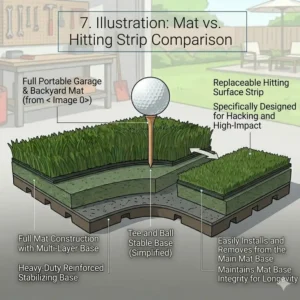
Replaceable Hitting Strip: You only have to replace the 1×2 foot section where you hit, saving you hundreds of dollars over the life of the mat.
Expert Commentary:
What most buyers overlook is the “launch monitor compatibility.” Because the SIGPRO Softy is so level and stable, it’s perfect for camera-based systems like the SkyTrak+ or Foresight GCQuad. It provides a consistent height that won’t mess with your sensor’s field of view. It’s “squishy” but firm enough to stand on comfortably.
Customer Feedback Summary:
Golfers love the “premium” look and the fact that it doesn’t leave green residue on their clubs. A few users noted it takes a day or two to fully “unroll” and lay flat…
Pros:
-
Outstanding fairway feel
-
Replaceable hitting area
-
Safe for all skill levels
Cons:
-
Can feel “too soft” for golfers who prefer firm turf
-
Large footprint requires significant space
Price Range & Value Verdict:
In the $750-$900 range. It is the perfect mid-range choice for a dedicated simulator room.
3. TrueStrike Single Hitting Mat
The TrueStrike Single Hitting Mat utilizes a revolutionary gel-based system that changes the physics of indoor practice.
Key Specifications & Practical Meaning:
-
Silicone Gel Insert: Located directly under the hitting area, this gel reacts like real mud, absorbing the blow and allowing the club to “dig” naturally.
-
Weighted Base: At nearly 60 lbs, this mat is a tank. It will not slide, even on polished concrete or hardwood.
Expert Commentary:
The spec sheet won’t tell you this, but the TrueStrike is actually used by many PGA professionals for indoor testing. The gel insert provides the most accurate “fat shot” feedback. If you hit it thick on a cheap mat, the club bounces into the ball and hides the mistake. On the TrueStrike, you’ll feel it instantly, making it a superior training tool for ball-striking.
Customer Feedback Summary:
Professionals rave about the realistic feedback, though some DIY home users find the assembly of the modular sections slightly tedious…
Pros:
-
Best feedback for “fat” or “thin” shots
-
Industrial-grade durability
-
Modular components
Cons:
-
Expensive to ship due to weight
-
Gel section can get cold in unheated garages
Price Range & Value Verdict:
Around $850-$1,000. This is for the serious golfer who treats their simulator like a laboratory.

4. Country Club Elite Real Feel Golf Mat
The Country Club Elite is the classic choice for traditionalists who want a simple, effective, and durable surface.
Key Specifications & Practical Meaning:
-
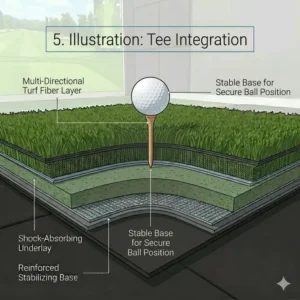
Long-Fiber System: The fibers are long enough and dense enough to hold a real wooden tee at any height you choose.
-
Non-Slip Backing: Works well on both indoor carpet and outdoor decks without needing extra adhesives.
Expert Commentary:
This mat is famous for its “Real Feel,” but I always warn my clients: it is firm. If you have a steep swing and tend to “dig,” the density of the Country Club Elite can be jarring over time. However, for the golfer who wants to practice their driver with the exact same tees they use at the course, there is no better option.
Customer Feedback Summary:
Commonly cited as the most “durable” mat for the price. Users warn that if you hit thousands of balls a week, you should rotate the mat to prevent a “wear spot”…
Pros:
-
Accepts real wooden tees
-
Very realistic turf appearance
-
Easy to roll up and store
Cons:
-
Less forgiving on joints than gel or fiber mats
-
Can leave green marks on white soles
Price Range & Value Verdict:
$400-$600 range. It is the best “standard” mat on the market for the money.
5. GungHo Golf Holy Grail Hitting Mat
The GungHo Golf Holy Grail Hitting Mat is a specialized solution designed to offer the “Holy Grail” of golf: a mat that is both soft and stable.
Key Specifications & Practical Meaning:
-
Recessed Hitting Strip: The hitting area is actually a cut-out with a specific foam backing that allows for maximum vertical give.
-
Lightweight Frame: Makes it easier to move than the heavy rubber-based models.
Expert Commentary:
What I love about the Holy Grail is that it solves the “wobble” problem. Many soft mats are hard to stand on because your feet sink in, ruining your balance. This mat uses a firm standing area with a ultra-soft hitting strip. You get the stability of a floor with the forgiveness of a cloud. It’s a brilliant piece of engineering for the home golfer.
Customer Feedback Summary:
Highly recommended by the “Simulator Forum” community for its price-to-performance ratio. Some mention they wish the standing area was a bit more plush…
Pros:
-
Excellent for joint health
-
Provides very accurate launch monitor data
-
Easy setup
Cons:
-
The hitting strip may need more frequent replacement than the base
-
Limited availability in some sizes
Price Range & Value Verdict:
Around $500-$650. A fantastic alternative for those who find Fiberbuilt too expensive.
✨ Don’t Miss These Exclusive Deals!
🔍 Take your indoor game to the next level with these carefully selected products. Click on any highlighted item to check current pricing and availability. These tools will help you create an authentic practice environment your family will love!
Buyer’s Decision Framework: Which Mat Suits You?
Choosing a golf simulator hitting mat isn’t just about price; it’s about matching the equipment to your physical needs and your space. Use this framework to self-identify:
-
The “Injury-Prone” Golfer: If you’ve ever felt a twinge in your wrist or elbow after a range session, stop looking at budget options. Your priority is “Vertical Give.” Choose the Fiberbuilt Grass or GungHo Holy Grail. These mats allow the clubhead to pass through the surface, drastically reducing peak impact force.
-
The “Realism Junkie”: If you want your simulator to feel exactly like the 7th fairway at Augusta, go with the TrueStrike Single. The gel-filled strike zone provides the most authentic club-turf interaction, rewarding pure strikes and punishing “fat” ones.
-
The “Space-Saver”: If you are setting up in a multi-purpose room and need to move the mat frequently, the Country Club Elite is the most portable high-quality option. It rolls up easily and doesn’t require a heavy modular base.
-
The “High-Volume” Practicer: If you’re hitting 200+ balls a day, you need a mat with a replaceable hitting strip like the SIGPRO Softy. Replacing a $100 strip is much better than replacing an $800 mat every year.
Maintenance & Longevity: How to Make Your Mat Last Until 2030
A high-quality golf simulator hitting mat is an investment, and like any piece of sports equipment, it requires care. Even the best synthetic turfs, which are often made of nylon or polyethylene, will degrade if neglected.
-
Rotate Your Mat: Even if you have a replaceable strip, rotate the entire mat every 3-6 months. This prevents “standing ruts” where your feet stay in the same position for thousands of swings.
-
Clean Your Clubs: Dirt and sand act like sandpaper on synthetic fibers. If you’ve been playing outdoors, scrub your wedges before bringing them to the simulator.
-
Vacuum Regularly: Dust and debris settle into the base of the turf, causing the fibers to lay flat over time. A quick vacuum once a week keeps the “grass” standing upright and performing as intended.
-
Avoid Direct Sunlight: If your simulator is in a sun-drenched garage, the UV rays can eventually make the fibers brittle. Use a cover or close the blinds when not in use.
How to Choose the Best golf simulator hitting mat
Selecting the right mat requires a balance of three critical factors: Forgiveness, Feedback, and Footing.
-
Analyze Forgiveness: Look for “Vertical Give.” A mat that is too firm will cause the club to bounce, which leads to inaccurate launch monitor readings and joint pain.
-
Evaluate Feedback: Does the mat tell you when you hit it fat? A good mat should feel “heavy” when you strike the turf before the ball.
-
Check the Footing: You should never feel like you are standing on a sponge. A firm standing area is vital for maintaining a consistent posture and balance throughout the swing.
-
Measure Your Space: Most professional-grade mats are 4×5 feet or larger. Ensure you have enough room to swing your longest club without the mat hitting the walls.
-
Consider the Tee System: Do you want to use real wooden tees, or are you comfortable with rubber “pop-up” tees? This will narrow your search significantly.
Common Mistakes When Buying a golf simulator hitting mat
The most common mistake I see is buyers spending $5,000 on a high-end launch monitor and then buying a $50 mat from a big-box retail store. This is the equivalent of putting budget tires on a Ferrari. A cheap mat will not only give you false data (because the club bounces into the ball, artificially increasing launch angle), but it will also lead to “Simulator Fatigue,” where your body starts to hurt after only 20 minutes of practice.
Another pitfall is ignoring the mat’s thickness. If your mat is 1 inch thick and your launch monitor is sitting on the floor next to it, the monitor is “seeing” the ball from an inch below the hitting surface. This leads to massive errors in spin and distance calculations. Always ensure your launch monitor is level with the top of the turf.
Preventing “Golfer’s Elbow” in the Simulator
Indoor golf is ironically more dangerous for your joints than outdoor golf. Why? Because on a real course, you might hit 40 full swings over 4 hours. In a simulator, you might hit 100 full swings in 45 minutes. That repetitive impact on a synthetic surface is a recipe for disaster.
To prevent injury, look for mats specifically labeled as “low-impact” or “injury-preventative.” These mats usually feature a layer of air or gel beneath the turf. According to the Consumer Product Safety Commission, equipment safety is paramount in home gym environments. In the world of golf, the mat is your safety equipment. If you feel even a slight “buzz” in your hands after a swing, the mat is too hard.
Setup for Small Spaces: Does Size Matter?
If you’re working with a tight space, you might be tempted to buy a small “hitting strip” instead of a full mat. While this saves money, it creates a “leveling” problem. You’ll need to build a platform so that your feet are at the exact same height as the ball.
For small apartments or narrow garages, I recommend a 4×7 mat. This allows you to stand on the mat and hit from the center, providing the most stability. If you must go smaller, look into “insert mats” that can be recessed into a larger area of gym flooring. This creates a seamless, professional look that doesn’t take up the whole room.
Noise Reduction Strategies for Indoor Simulators
One thing the glossy brochures don’t tell you: hitting a golf ball indoors is loud. The “thump” of the club hitting the mat can vibrate through the floor and annoy family members or neighbors.
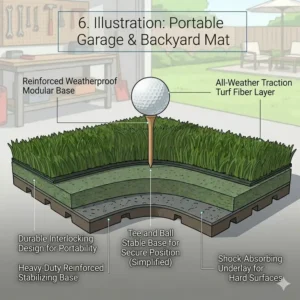
To mitigate this, don’t place your golf simulator hitting mat directly on a concrete floor. Use a layer of high-density EVA foam tiles (the kind used in gyms) underneath the mat. This acts as a muffler, absorbing the low-frequency vibrations before they travel through the structure of your home. Mats with a thick rubber base, like the TrueStrike, are naturally quieter than thinner, carpet-style mats.
Understanding Surface Friction and Launch Accuracy
The friction between your clubhead and the mat’s fibers significantly affects your “Launch Numbers.” Cheap mats are often “slick,” meaning the clubhead slides over them with very little resistance. This can lead to “ball speed inflation,” where your indoor numbers look much better than your outdoor ones.
High-quality mats use nylon fibers that create a realistic “drag.” This ensures that your practice sessions translate to the real course. When reading reviews, look for mentions of “clubhead speed consistency.” If a mat is too slippery, your launch monitor will struggle to provide accurate spin-axis data, which is crucial for diagnosing a slice or a hook.
DIY vs. Professional Mats: Is the Savings Worth It?
The DIY route usually involves buying a piece of industrial turf and gluing it to a foam pad. While this can save you about $200, the results are rarely comparable to a professional golf simulator hitting mat. Professional mats are engineered with specific “Shore Hardness” (a measure of material density) to ensure they don’t bottom out.
In my experience, DIY mats tend to “bubble” or delaminate after a few months of heavy use. When you consider the time spent building it and the inevitable cost of replacing it, the “savings” vanish quickly. For a piece of equipment you’ll use for 5-10 years, buying a proven brand is the smarter long-term financial move.
Realism vs. Forgiveness: The Great Debate
There is an inherent trade-off in mat design: the more “realistic” a mat is, the less “forgiving” it tends to be. A mat that lets you “dig” like real turf is going to put more stress on your body than a mat designed to be ultra-soft.
The goal for most home users should be a 70/30 split in favor of forgiveness. Unless you are a scratch golfer preparing for a tournament, the risk of injury from a “too realistic” mat far outweighs the benefit of the feedback. Modern mats like the SIGPRO Softy have nearly perfected this balance, offering enough feedback to let you know you hit it fat without sending a shockwave up your arm.
Long-Term Cost of Ownership
When price shopping, don’t just look at the initial tag. Look at the “Cost per 1,000 Swings.”
-
Budget Mat ($150): Lasts 5,000 swings. Cost: $30 per 1k.
-
Premium Mat ($800): Lasts 100,000 swings. Cost: $8 per 1k.
The premium mat is actually cheaper over time. Additionally, consider the resale value. High-end brands like Fiberbuilt hold their value remarkably well on the used market (Facebook Marketplace, etc.), whereas budget mats are essentially disposable.
✨ Don’t Miss These Exclusive Deals!
🔍 Take your indoor game to the next level with these carefully selected products. Click on any highlighted item to check current pricing and availability. These tools will help you create an authentic practice environment your family will love!
Conclusion
Finding the right golf simulator hitting mat is the most underrated aspect of building a home golf studio. While the projector and launch monitor get all the glory, the mat is what you physically interact with every single time you play. By prioritizing joint health, realistic feedback, and long-term durability, you ensure that your investment provides years of enjoyment rather than a trip to the physical therapist. Whether you choose the high-tech gel of the TrueStrike or the reliable fibers of the Fiberbuilt, your game (and your elbows) will thank you.
FAQs
❓ How long does a golf simulator hitting mat usually last?
✅ A professional-grade mat will typically last between 3 to 5 years with heavy daily use. Modular mats with replaceable hitting strips can last 10+ years, as you only need to swap out the small strike zone periodically…
❓ Can I use real wooden tees on all simulator mats?
✅ No. Only specific mats with dense, long-fiber technology like the Country Club Elite or SIGPRO Softy can hold a real tee. Most other mats require rubber tees or specialized “claw” tees that sit on top…
❓ Why are some mats much more expensive than others?
✅ Price differences usually reflect the research and materials used for joint protection. High-end mats use silicone gels, modular rubber bases, and specialized nylon fibers, whereas cheap mats are simply carpet glued to basic foam…
❓ Does the mat color affect my launch monitor?
✅ Generally, no. However, very bright green mats can sometimes cause glare for camera-based launch monitors. Most premium mats use a darker, “forest green” to ensure the cameras can easily track the white ball…
❓ Will a hitting mat damage my garage floor?
✅ No, in fact, it protects it. The mat absorbs the impact of the club. However, if you use a very thin mat, the vibration can eventually cause micro-cracks in brittle floor coatings like cheap epoxy…
Recommended for You
- 5 Best golf simulator accessories home to Build a Pro Setup in 2026
- Golf Impact Training Bag: 7 Best Smash Bags for a Pro Swing in 2026!
- Golf Strike Training Aid: 7 Best Tools to Master Your Ball Striking
Disclaimer: This article contains affiliate links. As an Amazon Associate, I earn from qualifying purchases. If you purchase products through these links, we may earn a small commission at no additional cost to you.
✨ Found this helpful? Share it with your friends! 💬🤗