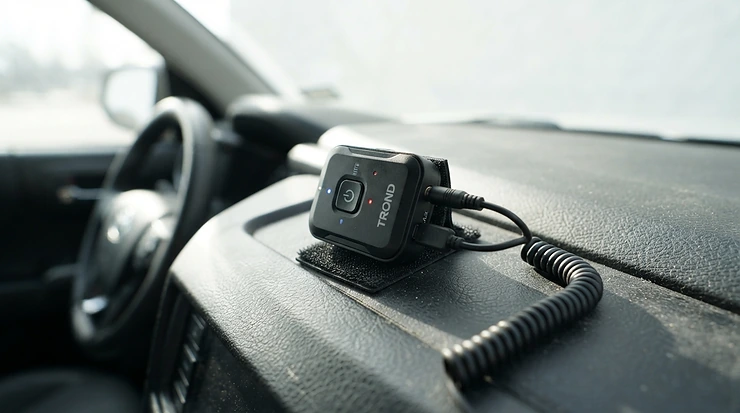
The costliest error with golf cart speakers happens before any music plays: a 12-volt soundbar wired into a 36V or 48V cart. ECOXGEAR’s SoundExtreme SE26 user guide says that bar has no internal battery, needs an external 12V DC supply and calls for a DC-DC converter on any other voltage, while a dealer’s owner guide warns that skipping the conversion can destroy stereo electronics within minutes. This 2027 guide puts the method first, from pack label to last fuse, and then names four real products that each solve one step of it.
No speaker was mounted or played for this guide. The findings rest on maker manuals and spec pages, dealer owner guides, a 2013 owner thread, two retailer review summaries and a municipal sound ordinance, and each report about behavior in use is credited to whoever made it.
The short version: a 36V or 48V cart needs a 12V source before any bar or speaker is connected, a 25-amp reducer leaves room for a soundbar plus lights, and a cart you don’t own calls for a magnetic portable that needs no wiring at all.
From pack label to fuse: the install order that avoids rework
Six checks, in this order, head off most of the rework owners describe.
1. Read the pack voltage and chemistry. Check the pack label or count the golf cart batteries. Carts at 36V and 48V, lead-acid or lithium, run far above the 12V that audio gear wants. A dealer’s owner guide from GolfCartStuff frames the choice as a voltage reducer, which steps the whole pack down to 12V, or a separate 12V auxiliary battery. Wiring a stereo to a single battery in the series string is the old shortcut, and Epoch’s reducer page rules it out for lithium in plain words: “Do not tap individual batteries or cells in a lithium bank.”
A gas cart is the easy case, because it already carries a 12V battery. An owner thread on Talk of The Villages about a 2023 Yamaha gas cart quotes roughly 12.5 volts at rest and about 14.5 while the engine runs.
2. Pick the format by ownership and volume. Golf Cart Tire Supply’s guide names three families: traditional component speakers with an amplifier, soundbars, and portable Bluetooth units. It calls the soundbar the most popular and relatively inexpensive, suggests at least 150 watts, and says bars typically mount to an inner front or rear roof support. Component sets take more work, since the amplifier and a wire run to every speaker are yours to install. Portable speakers need no installation, though the same guide warns that they are not fastened down and can be damaged.
3. Size the 12V supply with headroom. Add up the amp rating of everything on the 12V side, then leave margin. The SE26 manual lists a 10A input, so a 10-amp Reliance reducer sold by Golf Cart Tire Supply would have nothing left for a light kit. One poster in a 2013 Talk of The Villages thread described exactly that symptom: an undersized reducer made the radio cut out whenever the lights came on. GolfCartStuff adds a wiring rule, sizing the wire for the amperage plus a 25 to 50% margin over the full round-trip length, and says that once an amplifier or subwoofer joins the system, total draw above the reducer’s rating means moving to an auxiliary 12V battery.
4. Mount for tube size, wind and sun. GolfCartStuff favors roof-support mounts, which aim sound at the passengers and keep electronics away from road splash, and notes that dash mounts catch direct sun. It also says to look for IP66 or IP67 ratings and to angle the speakers slightly toward the seats. Measure the tube first. Kicker’s page says the round-tube brackets in the box fit 1.5, 1.75 and 2-inch tubes, and square-tube brackets are sold separately; two dealers point golf cart buyers to the square set.
5. Wire it so it can switch off. Every one of the golf cart accessories on the 12V side should turn off with the key. Epoch’s reducers include a Key ON+ trigger wire for that, and Golf Cart Tire Supply’s Reliance listing calls its reducer key-switch activated. ECOXGEAR’s manual says the SE26 keeps drawing a small amount of power even when switched off, and recommends unplugging it or adding a toggle switch if the cart sits for more than 48 hours. GolfCartStuff’s wiring advice is to run a main fuse to a fused 12V bus with branch fuses, install the fuses last, and secure wire with zip ties every 6 to 8 inches.
6. Check the noise rule where you ride. Sound limits are local. The code of Texas City, Texas (§ 118-278) bars operating or permitting a sound amplification system in a golf cart that is plainly audible 50 feet or more away on a street, alley, parking lot or driveway, public or private, and it lists no exceptions in that subsection. Read the ordinance itself for the wording, then look up your own city, county or community rules, because the distance and the places covered differ.
Where setups fail, and how to recover each one
Tapping one battery is the repeat offender. In a 2013 Talk of The Villages thread on voltage reducers, owners argued that accessories wired to one or two batteries wear those golf cart batteries down faster and unbalance the pack, and one poster put it as a pack being only as strong as its weakest battery. The thread is anecdotal, but Epoch’s page says the same about lithium banks, where tapping can cause BMS issues. The fix is a reducer across the full pack, installed before the speaker.
Buying on a peak-watt headline is the second. GadgetGuy, an Australian review site, objects to inflated peak figures on the ECOXGEAR bar. The arithmetic backs the complaint: a 10-amp input at 12 volts is about 120 watts (my arithmetic), well short of the 500 watts of peak output on dealer pages. Kicker’s page rates its bar at 300 watts at 14.4 volts without saying peak or RMS, and a dealer labels it 300W peak. Reading the manual’s input amps tells you more than the box does.
Indoor-grade gear is the third. GolfCartStuff says such speakers corrode and fail within a season, and reminds owners that head units and amplifiers need ingress ratings too, not only the speaker grilles.
The fourth is leaving a bar on permanent power. ECOXGEAR’s manual says the SE26 keeps drawing a little current when switched off and suggests a toggle switch for anything parked more than 48 hours, which makes a permanently connected bar a standing drain on a parked cart (my reasoning). Use the toggle, or switch the reducer’s trigger wire.
The last is a loose portable. A speaker riding in a cupholder slides, falls and cracks, as Golf Cart Tire Supply points out. A magnet or a strap is the recovery.
What a soundbar takes from golf cart batteries
Less than the motor does, but more than nothing. Take a hypothetical 48V, 100Ah pack, which holds about 4,800 watt-hours (my arithmetic). A 12V bar pulling its full 10A rating at 13.5 volts, the output Epoch lists for its reducer, uses about 135 watts. Over two hours that is 270 watt-hours before conversion losses, or roughly 5.6% of the pack. GolfCartStuff makes the same point from the other side: a 200-watt amplifier at moderate volume can noticeably shorten a round on a smaller pack. Vatrer, a lithium battery maker, adds that low-quality converters waste energy as heat.
The pack-balance problem is bigger than the energy problem. Spreading the load across the whole pack with a reducer is why one poster on that 2013 thread called a reducer essential, though another countered that a reducer is only needed if the lights run for more than about an hour at a time. Short trips with an audio-only load are where that counterpoint holds best.
Top of the Rock golf cart tour: when the cart isn’t yours
Rented and tour carts break every wiring step above. Big Cedar’s page describes the Top of the Rock golf cart tour in Ridgedale, Missouri, as a 2.5-mile route with nine waterfalls, ridden in electric carts that seat up to four and are handed out first come, first served. Nobody wires anything into a cart like that, and the page says nothing about rules for sound or speakers, so ask before bringing one.
A magnetic portable is the only realistic option on a loaner cart, and it is the reason the first pick below exists. Test the magnet on the cart’s actual roof strut, because a magnet only grips steel.
Best golf cart speakers 2027: four tools, each tied to a step
These are tools for the steps above rather than a ranking of the best golf cart speakers. Prices are ranges from dealer and maker pages, and the current price on Amazon.com may differ.
Model
Power source
Rating on the maker’s page
Water protection
Dealer price range
Bushnell Wingman 2 GPS Speaker
Rechargeable lithium-ion
14+ hours claimed by Bushnell
IPX6
Roughly $120 to $170
ECOXGEAR SoundExtreme SE26
External 12V DC
10A input per manual
IP66
Check the current price on Amazon.com
Kicker KPB2 PowerBar 47KPB2
12V harness, 15A inline fuse
300W at 14.4V
IP66
Roughly $800 to $900
Epoch 48V to 12V Voltage Reducer
Pack input of 40 to 90V DC
25A at 13.5V
Not published
Around $90
The price spread is the first thing the table shows: the reducer costs a fraction of the bar it feeds, and the bar costs several times the portable. The second is that only the portable and the reducer sidestep the 12V question, one by carrying its own battery and the other by solving it.
Borrowed carts, rented carts and tour carts such as the Top of the Rock golf cart tour’s share one rule: nothing gets wired, which is the situation the Bushnell Wingman 2 GPS Speaker was built around. It is a 2.9 by 2.8 by 7.4 inch, 24-ounce Bluetooth speaker with a rechargeable lithium-ion battery, an IPX6 water-resistance rating and a magnetic mount, according to PlayBetter and Chicago Golf Report. Bushnell’s page adds a magnetic remote that speaks front, center and back yardages, a built-in microphone for calls and a one-year limited warranty, and TGW lists a USB-A power-bank port plus pairing with another Wingman 2, View or Mini for surround sound.
Battery life is the figure to read carefully. Bushnell and dealers claim 14 hours or more, while GearCulture puts it near 10 hours with the speaker and GPS both running, so the answer depends on what you use.
Retailer feedback is split along that line. Golf Galaxy’s page shows 4.3 stars and 94% recommended across 19 reviews, with reviewers praising the sound and a magnet that holds firmly to carts, and TGW shows 4.8 from 9 reviews. The complaints sit in the same place: two Golf Galaxy reviewers say the battery died or would not charge after under two years, and one says Bushnell offered only a discount on a replacement. Two reviewers are not a pattern, but it is the failure to weigh against a price of roughly $120 to $170.
Bushnell Wingman 2 GPS SpeakerSee current price, sizes and reviews on Amazon.
Power rules come first with the ECOXGEAR SoundExtreme SE26. The manual lists a 12V DC, 10A input, a 15A, 32V blade fuse in the harness, an IP66 enclosure, Bluetooth range up to 100 feet and a 5V, 2.1A USB output for phones. Dealer pages call it a 500-watt-peak, four-speaker bar with an RGB light strip, and GadgetGuy found its sound listenable for an IP66 enclosure while noting that most people tire of the lights and switch them off.
An owner’s review mirrored on Desertcart shows the install done properly: a 2022 48V Icon cart, a 48-to-12 reducer feeding an SE26, and the reducer’s trigger lead run to a switch so the pack isn’t drained while parked. That is one owner’s account, though it matches ECOXGEAR’s own warning about standby draw. West Marine’s page shows 4.3 out of 5 for the bar without a visible review count.
A battery-powered sibling, the SEB26, exists as a separate listing. One retailer gives its play time as 20 hours at normal volume, 6.75 hours at 75% volume and 4 hours at maximum, which makes it a candidate for a cart you can’t wire. Warranty listings disagree for the SE26, one year at an Australian retailer and two years at a US dealer, so the paperwork in the box is the reference.
Pros:
✅ IP66 enclosure with a 100-foot Bluetooth range per the manual
✅ Built-in USB output for charging a phone
✅ A battery-powered variant exists for carts that can’t be wired
Cons:
❌ Needs an external 12V supply, so 36V and 48V carts need a reducer first
❌ The 10A input caps real power far below the 500W peak headline
❌ Draws a small current even when switched off
ECOXGEAR SoundExtreme SE26See current price, sizes and reviews on Amazon.
At roughly $800 to $900 on dealer pages, the Kicker KPB2 PowerBar 47KPB2 sits in the top price tier of this group. Kicker’s page lists IP66, stereo Bluetooth, a 65 Hz to 20 kHz response, a wireless remote that mounts on the steering wheel, round-tube brackets and a 12-foot wiring harness. Golf Cart Tire Supply gives the size as 34 inches long, 4-9/16 deep and 4-7/16 high, with an inline 15A fuse.
The power figures need reading, not trusting. Kicker rates 300 watts at 14.4 volts, which works out to about 21 amps if all 300 watts were output (my arithmetic), more than the 15A fuse on its harness, so treat the rating as a headline figure and plan the supply around the fuse. The 14.4V test voltage also points to a 12V vehicle system, though Kicker’s page does not list an operating voltage. That is why this bar belongs after a reducer or an auxiliary battery on a 36V or 48V cart, and why a 10-amp reducer is too small for it.
Dealer pages for the 47KPB2 show no owner reviews, so its durability record rests on the IP66 claim alone. Kicker’s page states a two-year warranty, though Golf Cart Tire Supply lists one year. Because dealers say most golf cart frames need square-tube clamps, add the separate bracket kit, which one dealer lists around $20.
Kicker KPB2 PowerBar 47KPB2See current price, sizes and reviews on Amazon.
A reducer is the unglamorous part that decides whether the bar works for years. The Epoch 48V to 12V Voltage Reducer is listed at 25 amps with a 40 to 90V DC input, a 13.5V output and a Key ON+ trigger lead. At 13.5 volts, 25 amps is roughly 337 watts (my arithmetic), which leaves 15 amps of headroom beyond the SE26’s 10-amp input for lights and a USB port. Epoch’s own page shows 4.8 stars from 6 reviews and a price near $90, matched by a dealer.
Two limits apply. Epoch’s listing does not publish an ingress rating, so mount it inside the dash rather than where road spray reaches it, and its pages pitch it mainly at lithium conversions, so confirm the pairing with the maker before using one on a lead-acid pack. A separate Epoch 36V to 12V Voltage Reducer, labeled for 30 to 45V input, covers 36V carts, and other makers sell 25-amp units too, including 10L0L, whose page lists 20A and 25A models.
Pros:
✅ 25A rating with a key-on trigger wire
✅ A 40 to 90V input window covers a 48V pack
✅ Replaces the single-battery tap that owners warn about
Cons:
❌ No ingress rating published
❌ 48V only, so a 36V cart needs the separate unit
❌ Only 6 reviews on Epoch’s own page
Epoch 48V to 12V Voltage ReducerSee current price, sizes and reviews on Amazon.
The small parts decide how clean the job looks and how easy it is to fix. GolfCartStuff lists a fused 12V distribution block, split-loom tubing, zip ties and dielectric grease for exposed connectors, and Epoch says to feed accessories from a fused distribution block rather than straight from the reducer. A toggle switch, which ECOXGEAR sells separately, answers the standby-drain problem on any bar. A square-tube bracket kit, about $20 at one dealer, is the part most often forgotten on a roof-mounted bar.
Golf cart speakers reviews: where testers and owners agree
Retailer pages and golf cart speakers reviews from testers point the same way: the reported problems cluster in the power supply and the portable’s battery, not in the speakers themselves. The 2013 owner thread recounts one shop quote of about $500 for rewiring and custom headlight work, and a second opinion found the wiring was fine and a reducer solved the problem, which is one owner’s story rather than a statistic. The same thread’s advice on buying a reducer was to match the amp rating, and one poster expected a cheap $90 48-to-12V unit to need replacing within a year. Bushnell’s reviewers, GadgetGuy and the Desertcart buyer each flag a different weak point, battery, peak watts and standby draw, and each is something a buyer can check before ordering.
Voltage, watts and street rules: straight answers on golf cart audio
❓ Can I wire a soundbar straight to my 48V golf cart batteries?
✅ No. ECOXGEAR's manual says its bar needs 12V and a DC-DC converter on any other voltage. Tapping a single battery in the pack can cause uneven wear, and Epoch warns against it on lithium banks. Use a reducer rated above the combined load.
❓ Do gas golf carts need a voltage reducer for a soundbar?
✅ Usually not, because a gas cart already carries a 12V battery. A Talk of The Villages owner thread quotes about 12.5 volts at rest. A fuse and a switch still matter, since ECOXGEAR's manual says its bar draws small power while off.
❓ How many watts does a golf cart soundbar need?
✅ Golf Cart Tire Supply suggests at least 150 watts, yet GadgetGuy objects to inflated peak ratings. A 10-amp input at 12 volts tops out near 120 watts (my arithmetic), so compare input amps and RMS figures where a maker lists them.
❓ Is a portable Bluetooth speaker enough for a golf cart?
✅ It can be, for casual rides. Golf Cart Tire Supply says portables lack soundbar power and are not fastened down, so they can be damaged. A magnetic model on a steel strut solves mounting, and Bushnell claims over 14 hours of battery on its golf speaker.
❓ Are speakers allowed on golf carts on public streets?
✅ It depends on the city. Texas City's code bars sound amplification from a golf cart that is plainly audible at 50 feet or more on streets, lots and driveways, public or private. Check your own city or HOA rules before mounting a bar.
Match the 12V supply first, then choose the speaker
The decision rule is short. On a 36V or 48V cart, buy the reducer before the bar, size it above the bar’s input amps and wire it to the key. On a gas cart, fuse and switch the 12V feed. On a cart you don’t own, use a magnetic portable and nothing else. For golf cart speakers in 2027, the right pick is the one whose power supply your cart can actually feed, and a bar chosen for its peak-watt headline and wired without that check is the one that gets rewired later. If one of the four fits your cart, its Amazon.com page is the next stop, and the voltage line is the first thing to read there.
Disclaimer: This post contains affiliate links. As an Amazon Associate, I earn from qualifying purchases made through these links, at no additional cost to you.
Compare the exact model number and input voltage on the listing against your pack label before you order any of these.