
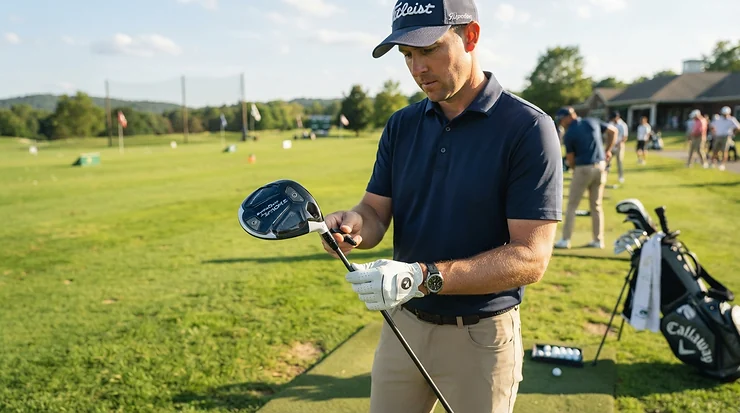
Buy the wrong driver and you pay twice: once at checkout, then again on every tee box where the ball drifts into the trees. Most golf drivers on shelves for the 2027 season are well made, so the expensive mistake is rarely a bad club. It is a good club that doesn’t match how you miss.
Six current models follow, all rated by independent testers for forgiveness or slice control, plus the shaft and swing questions that decide whether any of them works for you. Everything here comes from published reviews, manufacturer pages, forum threads and the USGA rulebook, not from my own swings, and I name who measured each number. Every model was on sale when I gathered sources in November 2026.
Best golf driver for high handicapper 2027: start with these three traits
Golf Monthly’s guide to high-handicap drivers puts forgiveness first, meaning stability when you miss the sweet spot. It adds two supporting traits: a draw bias for the many players who slice, and a face that looks confident at address. Those three, in that order, are the filter used for this list.
Golf Digest’s 2026 Hot List shows why the category isn’t one-size-fits-all. Its high-handicap panel had handicaps from 10 to 16 and driver speeds from about 92 to 119 mph, and its favorites included a few low-spin heads next to the stereotypical high-MOI ones. A 16-handicap tester swinging about 119 mph liked a low-spin model because it suited the swing he made.
Size won’t separate these six. Five of them are listed at 460 cc by the reviewers or makers I read, which is the ceiling in the USGA equipment rules (460 cc plus a 10 cc tolerance), alongside a 48-inch limit on club length.
One uncomfortable counterpoint comes from GolfLink, which argues that many high handicappers would score better with a fairway wood off the tee because a driver is harder to square. If your driver finds the fairway less often than a 3-wood would, try the models below and still price a 3-wood into the conversation.
Anyone typing 2027 best golf driver for higher handicap and slice into a search bar wants one name. The sources don’t agree on one, and I won’t invent a winner: the Ping G440 K leads on forgiveness, while the Callaway Quantum Max-D and Ping G440 SFT lead on slice correction.
Best golf drivers compared by miss, shaft and price band
| Driver | Built for | Draw help | Lofts | List-price band |
|---|---|---|---|---|
| Ping G440 K | Maximum forgiveness | Adjustable weight (fade, neutral, draw) | 9°, 10.5°, 12° | About $650 to $705 |
| Callaway Quantum Max-D | Slice correction with speed | Built-in heel weighting | 9°, 10.5°, 12° | About $650 |
| TaylorMade Qi4D Max | Stability, tight dispersion | None reported; movable weights | 9°, 10.5°, 12° | About $650 |
| Ping G440 SFT | Strong slice fix | Two-position weight, closed face | 9°, 10.5° | About $450 to $600 |
| Cobra OPTM Max-K | Forgiveness plus fine hosel tuning | Neutral; hosel settings | 9°, 10.5°, 12° | About $400 to $600 |
| Tour Edge Exotics Max | Forgiveness on a budget | Adjustable weight, heel to toe | 9.5°, 10.5°, 12° | About $500 |
📌 Keep this page handy to compare at your own pace, and share it if it can help someone.
The bands come from Golf Monthly, Golf Digest and the makers’ own pages; where two sources disagree, I kept the wider range. Only the two Ping heads and the Callaway Quantum Max-D carry a real slice-correction pitch, while the other three solve forgiveness first. These are list prices reported by reviewers, so what you pay on Amazon can differ.
Six picks, from maximum forgiveness to best value
The order follows how directly each head answers a high handicapper’s usual problems. It is my reading of the sources, not a laboratory ranking.
1. Ping G440 K — most forgiving head in Ping’s lineup
Golf Digest’s 2026 panel gave the G440 K an Extreme moment-of-inertia rating, the top tier the magazine assigned that year. One panelist, a 13-handicap swinging about 101 mph, singled out its launch and accuracy. Golf Monthly named it the top pick for high handicappers, reporting carry, spin and speed similar to the older G430 Max 10K, with a 32-gram back weight that lets you shift the flight.
Plugged In Golf adds the detail that matters for a slicer. The head has an 8-position hosel and a three-position weight (fade, neutral, draw), yet the reviewer warns that those settings won’t cure a true slice or hook. The stock neutral setting produced very straight flights for him, and the stock counterbalanced Alta CB Blue 50 shaft deserves a fair number of swings before you judge it.
A reader on a GolfWRX launch report says he expected to hate Ping’s counterbalanced shaft and ended up liking it. That is one report, not a trend. List prices run roughly $650 to $705 depending on whether you read Golf Monthly or Golf Digest.
Pros:
- ✅ Top-tier stability rating in Golf Digest’s 2026 measurements
- ✅ Weight and 8-position hosel give wide tuning
- ✅ Launches high, per Golf Monthly and Plugged In Golf
Cons:
- ❌ Almost no feedback on where you struck the face (Plugged In Golf)
- ❌ Golf Monthly’s reviewer dislikes the blue colorway
2. Callaway Quantum Max-D — draw bias without the big speed loss
Draw bias normally costs ball speed, and this head loses less than most. In Golf Monthly’s launch-monitor session, it ran about 2 mph behind the Callaway Quantum Triple Diamond, carried more than 500 rpm extra spin and gave up roughly 11 yards in total, yet the reviewer still found it closer to the Quantum family’s speed than most anti-slice heads. He also saw a substantial amount of left curvature. National Club Golfer called it the longest draw-biased driver the site had hit, with spin kept in check.
The extra spin isn’t all bad news. Golf Monthly notes it can help moderate-speed players launch the ball and find carry. The face combines titanium, poly mesh and carbon, and Golf Monthly points out that the address profile is essentially a repackaged Ai Smoke Max-D, so if you liked that shape, you’ll recognize this one.
Callaway also sells a women’s build of the Max-D with a 44.5-inch shaft, according to TGW. For context, Golf Digest’s panel ranked the standard Callaway Quantum Max at the top of its list; the D version is the one to look at when your miss goes right. List price is about $650 per National Club Golfer and Golf Monthly.
3. TaylorMade Qi4D Max — high stability, fewer adjustments
Adjustability is where the Max gives ground. GolfMagic’s review says it carries two movable weights against four on the core TaylorMade Qi4D, and the reviewer would pick the core head in a straight contest. Even so, he called the Max “fantastically forgiving,” and his data backs the claim: 224 yards of carry at 137.1 mph ball speed and 2,616 rpm of backspin, level with the Cobra OPTM Max-K on carry and total distance.
The shafts need attention. TaylorMade’s stock Mitsubishi REAX line comes in three profiles matched to your rotation and release, and GolfMagic’s reviewer thinks an off-the-rack buyer may struggle to pick the right one, so he recommends a fitting. GolfWRX’s launch report lists 13-gram and 4-gram movable weights to trade speed against forgiveness. None of the reviews I read credits it with a built-in draw bias, so a pure slicer should look at the two heads on either side of it in this list.
National Club Golfer notes that the head looks unmistakably forgiveness-focused at address without being as bulky as you might expect. List price is about $650.
4. Ping G440 SFT — the strongest slice-fighter here
Ping says moving the 23-gram weight from Draw to Draw+ changes the shot by about 7 yards, from a 13-yard draw to a 20-yard one. The head also sits more closed in its neutral setting and carries a lighter swing weight (D0 against D3 for the Ping G440 Max), according to Plugged In Golf, where the reviewer found Draw+ so strong he had to fight a hook. Golf Monthly’s reviewer couldn’t stop it going left, which is the point.
The evidence isn’t one-sided. A robot test published by Australian Golf Digest found that even the SFT, the most draw-biased Ping, shaded toward the middle with a less pronounced left bias than expected. In Today’s Golfer’s table, it posted solid ball speed and carry but the widest left-right dispersion of the group, 42.5 yards, and a louder sound. That is one tester’s session, but it is a reminder to hit one before you buy.
Golfer Geeks says a golfer who already hits straight shots or a draw probably doesn’t need it. Lofts are 9° and 10.5°, and list prices reported by the sources range from roughly $450 to $600.
Pros:
- ✅ Two-position weight adds up to a 20-yard draw, per Ping
- ✅ Looks like the Max rather than an anti-slice head (Plugged In Golf)
- ✅ 9° option for players who need less launch and spin
Cons:
- ❌ Widest dispersion in Today’s Golfer’s data table
- ❌ Louder at impact than most rivals, per the same review
5. Cobra OPTM Max-K — fine-tuning through 33 hosel settings
The hosel is the story. Cobra’s FutureFit33 system offers 33 loft-and-lie combinations, a finer grid than any other head in this group, and Plugged In Golf calls the result a plug-and-play driver once you dial in your setting. It has a fixed 11-gram rear weight and a 460 cc oversize head, and Cobra describes it as its highest-MOI head ever.
Forgiveness comes with a price in carry. Plugged In Golf’s reviewer produced a huge proportion of usable drives, but he gave up some carry to get them and generated a lot of spin. Golfalot’s cons list agrees that ball speeds aren’t the highest, and finds the looks unremarkable. GolfMagic’s numbers sit close to the TaylorMade Qi4D Max: 224 yards of carry, 136.8 mph and 2,453 rpm of backspin.
A five-month long-term write-up on Amateur Golf says a proper fitting changed one writer’s results with this head, a single report but a useful one. Cobra’s own store lists $599, while Golf Monthly’s guide shows $399, so treat roughly $400 to $600 as the working band. If your miss is a slice rather than a scatter, the draw-biased Cobra OPTM Max-D is the sibling to look at.
6. Tour Edge Exotics Max — forgiveness at a lower price
At about $500 list, this head undercuts most of the others by around $150. MyGolfSpy ranked it first for accuracy and forgiveness among mid-swing-speed drivers in its 2026 test and second overall, with a 9.3 score. Its distance score was the weakest part of the report card, and MyGolfSpy names distance as the one thing it doesn’t deliver.
Golf Monthly frames it as a forgiveness-on-a-budget pick and says it excels at fixing poorly struck drives thanks to a large profile and deep center of gravity, with an 18-gram sliding weight for tuning. National Club Golfer agrees that speed and distance trail rivals while calling the value remarkable. Tour Edge claims the highest total MOI of any driver, a company figure that MyGolfSpy relays rather than confirms. Stock shafts are from Fujikura’s Ventus family, per GolfMagic.
Pros:
- ✅ Top accuracy and forgiveness for mid swing speeds in MyGolfSpy’s 2026 test
- ✅ Lowest list price of the six, by a wide margin
- ✅ 18-gram sliding weight for ball-flight tuning
Cons:
- ❌ Speed and distance trail pricier heads (National Club Golfer, MyGolfSpy)
- ❌ Golf Monthly’s reviewer dislikes the new logo, though that is purely cosmetic
⚡ The right choice often comes down to one detail.
📋 Go back to the table, find the row that matches your miss and your budget, and click the product to check up-to-date information before you decide.
Tensei golf driver shafts: what each colour does to launch and spin
Mitsubishi color-codes Tensei the same way across the range: red for high launch and mid spin, blue for mid launch and mid spin, white for low launch and low spin, per Nine by Nine Golf’s overview. Orange is the counterbalanced low-launch, low-spin option, according to Mitsubishi’s own 1K Pro page. For a golfer who slices or swings slowly, red and blue are the profiles worth a conversation with a fitter.
Golf Monthly’s review of the whole Tensei 1K family is the best independent read I found. Its reviewer calls the Tensei 1K Pro Red the highest-launching profile in the Pro series, with data close to the Tensei 1K Pro Blue, and says it was slightly easier to square at impact, giving him a touch of draw. The Tensei 1K Pro White held spin just under 2,000 rpm but needs full effort and doesn’t suit smooth-tempo swings. The cheaper non-Pro Tensei 1K Blue produced the highest ball speeds in that test, and the Tensei 1K Black is described as a stability machine for powerful swings.
Owner reports back the fitting warning. A forum poster on the Golf Monthly forums found his Tensei AV White in 75-gram stiff produced a low ball flight, and replies pointed him to a mid-launch Blue at a lighter weight. One thread isn’t a verdict, but GolfWRX writers and Global Golf make the same point generally: a shaft that is too stiff for your speed tends to fly lower and to the right.
A Tour Spin Golf guide offers a rough starting point: below about 90 mph look at the AV Blue or 1K Red, at 90 to 105 mph the AV Raw Blue or 1K Blue, and above 105 mph the 1K Black or CK Pro Orange. Treat that as a retailer’s guideline, not a fitting. A shaft changes launch and feel, not the face and path that cause a slice.
As for the six heads: TaylorMade’s stock REAX shafts are built by Mitsubishi, and Dallas Golf says the Qi4D family can be ordered with a Tensei through custom fitting. Callaway’s stock options include Mitsubishi’s Vanquish, a different line. Golf Galaxy and Dick’s Sporting Goods both list the 1K Pro line as custom options, so Tensei golf driver shafts reach most buyers as an upgrade whose price depends on the retailer.
Golf driver how to swing: four checkpoints to try before you blame the club
Equipment helps, but it works on top of a swing. These four checkpoints come from teachers and testers who wrote about slices, and they cost nothing to try.
- Tee height and ball position. A UK tour professional’s guide on Swyng suggests that roughly half the ball should sit above the crown. Today’s Golfer says a low tee steepens your attack and makes you cut across the ball, while a higher tee flattens the path and helps launch. Golf Monthly adds that a driver wants an upward angle of attack, with your sternum behind the ball. Sources disagree on exact ball position: MyGolfSpy suggests just inside the lead heel, a GOLFTEC video lines it up with the left big toe.
- Aim. GOLFTEC points out that aiming left to compensate for a slice encourages an outside-in path. Set an alignment stick on the target line, align your feet and shoulders parallel to it, and hit shots focusing on starting the ball down that line. In one GolfWRX lesson example, squaring the body lines improved a student’s path by about eight degrees.
- Face versus path. The ball starts near the face direction and curves away from the path, so a slicer’s face sits right of the path. GolfWRX’s instructor puts the fix in one sentence: shift the path right and the face left. His article on path and face angle also shows why a draw-bias head helps: it can keep the face left of the path while the path improves.
- The first move down. In an older Golf Digest piece, Butch Harmon says slicers usually start the downswing by pushing the right shoulder out toward the ball, creating a steep path across it. MyGolfSpy’s 30-minute range routine pairs a high tee and soft grip pressure with the goal of hitting a pull instead of a weak slice, a different miss that is easier to fix.
If a few sessions don’t help, a lesson with launch-monitor data diagnoses the pattern faster than video tips, as Swyng’s guide also notes.
Golf drivers reviews agree on three things and split on two
Across Golf Monthly, Golf Digest, National Club Golfer, GolfMagic, Today’s Golfer and MyGolfSpy, three themes repeat in the best golf drivers lists. First, high-MOI heads suit high handicappers, and nearly every pick here sits in that class. Second, draw bias buys slice help at some cost in speed or spin, as Golf Monthly’s Max-D numbers show. Third, fitting beats guessing, as GolfMagic’s REAX advice and the Cobra long-term write-up both suggest.
The disagreements are more interesting when you read golf drivers reviews side by side. MyGolfSpy cautions that an MOI figure is often treated as a synonym for forgiveness, so a bigger number from a maker is a claim, not a promise. And the draw-bias evidence is split: Plugged In Golf and Golf Monthly found the SFT eager to go left, while an Australian Golf Digest robot test saw less left bias than expected, and Today’s Golfer’s table shows wide dispersion for it.
Prices conflict too. The Ping G440 K appears at $647 in Golf Monthly and $705 in Golf Digest, and the Cobra OPTM Max-K at $399 in Golf Monthly and $599 on Cobra’s store. That is why the table shows bands, not single numbers, and why Amazon’s listing deserves a look on the day you buy.
Five questions to settle before you pay for a new driver
❓ What is the 2027 best golf driver for higher handicap and slice?
❓ Do Tensei shafts help fix a slice?
❓ Are these drivers legal for tournament play?
❓ Is a 3-wood a smarter tee club than a driver for a high handicapper?
❓ Which loft should a slicer pick: 9°, 10.5° or 12°?
Three mistakes that undo a good driver purchase
Choosing among golf drivers is only half the job; three habits waste the benefit after checkout. The first is accepting the stock shaft without checking flex and weight, since a shaft that’s too stiff pushes shots low and right. The second is leaving an adjustable weight where it shipped. Ping’s own numbers put the gap between Draw and Draw+ on the SFT at about 7 yards, and a hosel with 33 settings is wasted if it stays untouched. The third is judging the club after one range session with a low tee and an aim line drifting left. Fix the tee height and alignment first, then compare heads on the same day, under the same conditions, with the same ball.
Recommended for you
- 8 key golf: The 6 Tools Worth Buying Right Now
- Steel fiber golf shafts: The 6 Worth Buying Right Now
- Best driver for high handicapper: 6 Models and What Sets Them Apart
Disclosure: This article contains affiliate links. As an Amazon Associate I earn from qualifying purchases, at no extra cost to you.
📣 Have a question or a tip? Leave it in the comments: it will help the next readers! 💬