As an Amazon Associate I earn from qualifying purchases. Links in this article may be affiliate links. How we choose gear
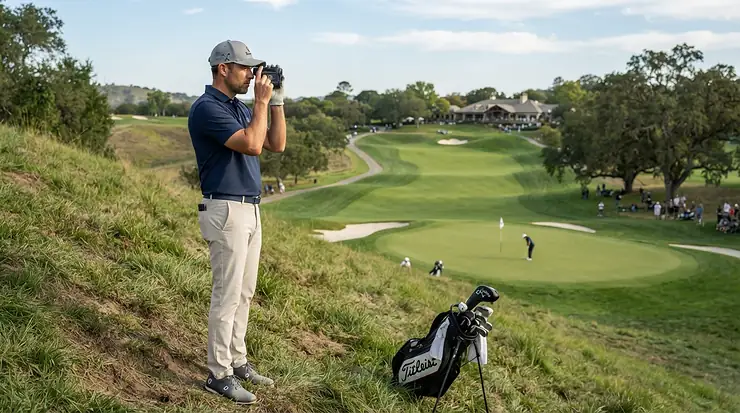
Golf rangefinders have a reputation for exact numbers, yet the figure on the display is only as trustworthy as the object the laser actually hit. When the beam finds the flag, the tests cited below land within about a yard of a measured distance. When it finds the tree behind the flag, you get a confident, wrong answer. That gap runs through the forum threads and tester notes behind this 2027 guide, so it is built as a method first and a shopping list second.
The short version: a laser suits you when most approaches are visible and your hands stay steady, GPS suits you when blind shots and quick glances matter more, and MyGolfSpy notes that many golfers use both. Four lasers follow, from around $150 to around $450, each matched to the problem it solves. No unit was fired for this guide; every spec traces to a maker, tester or retailer page, and every opinion about speed, glass or feel belongs to a named reviewer or forum member. Golf Monthly’s rangefinder roundup is a useful cross-check, and prices shift often, so confirm the current price on Amazon.com.
A laser clock, a tilt sensor and a buzz: how a golf rangefinder works
People who type “golf rangefinder how does it work” are usually asking two things at once: where the number comes from, and why it sometimes lands on the wrong object. The first answer is short. A laser pulse leaves the front lens, bounces off the target and returns, and the device turns the round-trip time into a distance, as Golf College’s explainer describes it. Some models add an inclinometer, a tilt sensor that reads how far the target sits above or below level, and that is what makes a slope-adjusted number possible.
Slope can be worth a club. Golf Digest columnist Alex Myers described a par 3 where a friend’s laser read 183 yards playing like 173; he dropped from a 6-iron to a 7-iron, hit it within a couple of feet and made birdie.
The second answer is lock-on. The flag is rarely the only reflective thing in the line of sight, so most lasers in Golf Monthly’s roundup add a flag-lock mode that buzzes when the pin has been picked out. Golfers Authority notes that a vibration plus a visual confirmation helps you avoid measuring trees behind the green. Hybrid units pair the laser with GPS course maps, which Golf College treats as a third category.
Golf rangefinder vs GPS: what each one can and cannot see
Start here, because the choice between rangefinders for golf and GPS devices decides everything after it. Golf Monthly’s comparison credits the laser with an exact distance to the pin and calls the GPS watch’s front, middle and back numbers adequate for most players. It also flags the laser’s weak spots: it needs a line of sight, so blind approaches, doglegs and trees cause trouble, and it can struggle in fog or low light.
| Question | Laser rangefinder | GPS watch or handheld |
|---|---|---|
| Distance you get | Exact to the flag or any object you aim at | Front, middle and back, plus hazards on the map |
| Blind shots | Needs a visible target | Works wherever you stand |
| Slope | Common as a switchable mode | Mostly absent, though some watches show plays-like distances |
| Power | Small lithium battery that lasts dozens of rounds | Charge after every round |
| Speed | Take it out, aim, press | Glance at your wrist |
| Cost | The lasers here run from about $150 to $450 | Handhelds are described as much cheaper than most lasers |
The table maps onto two kinds of golfer. MyGolfSpy’s GPS-versus-laser piece points laser players toward golfers who know their home course and GPS toward those who travel or play new layouts, and it adds that many golfers use both, a handheld for layout and a laser for the approach. PlayBetter’s comparison reaches the same conclusion: carry a rangefinder and a GPS device.
Owner reports add texture. In a short 2019 Sand Trap thread, one member said GPS units can differ from a rangefinder by up to about 10 yards, which he counted as a full club; the poster who started the thread said pressing the laser’s button often knocked his aim off the flag. Golf Monthly’s advice for anyone undecided is to borrow a demo unit from a pro shop first.
Lock-on, slope, glass and power: a method for picking a laser
Four checks, run in this order, separate a laser that earns its place in the bag from one that ends up in a drawer.
Test the lock before the zoom
A laser that cannot isolate the flag gives you the tree. Tom’s Guide found that the Garmin Approach Z30 sometimes needed several tries to catch a flagstick or hazard, with vibration confirmation inconsistent at first but improving with use, and it adds that newer laser-friendly flagsticks help. A Sand Trap member suggested holding the button down and sweeping toward the flag, because the device keeps refreshing the number about once a second.
Shaky hands raise the stakes. Myers wrote that his old rangefinder rarely left the bag until he bought a Callaway 300 Pro, whose flag lock gives a pulse before the yardage appears and made the device usable despite his tremor. Golf Monthly’s comparison says golfers with shaky hands often struggle even with a steady-mode feature, so a vibration-confirmed lock is worth more here than extra range.
Treat slope as a switch before it is a feature
USGA’s guidance on Rule 4.3a lets players use distance-measuring devices as long as they do not access prohibited information, a list that covers slope-based and plays-like distances, club recommendations and measured wind speed or altitude. A first breach costs the hole in match play or two penalty strokes in stroke play, a second breach in the same round means disqualification, and a committee can ban the devices outright through a Local Rule.
The R&A said in January 2026 that the next edition of the Rules of Golf will be published on 1 January 2028, and its page says nothing about rangefinders, so the current rule is the one to plan around for 2027. Golfers Authority’s advice is to look for a physical switch or a fast toggle, since the habit that matters is turning slope off before the first tee.
Pick the glass and the screen for your own eyes and hands
Most rangefinders for golf magnify 6x, and the 7x models in Golfers Authority’s lineup sit among the pricier ones. Golfers Authority says magnification is not what decides whether you hit the green and warns against paying $200 more for it alone, though it adds that 7x helps a shaky-handed player pick up a distant flag and that a heavier body can feel steadier once you adjust. Screens matter more than the number: the same source says OLED displays are easier to read early and late in the day.
Count the battery, the weather rating and the subscription
A replaceable lithium cell lasts dozens of rounds, according to Golf Monthly’s comparison, which still suggests carrying a spare for quick swaps. USB-C models trade that convenience for charging. Weather ratings range from IP67 to a plain “water resistant” with no number, which is not the same thing.
Subscriptions are the quiet cost. Golf Monthly says the Arccos Smart Laser needs an annual subscription and its hardware stops working if the subscription lapses. Golfers Authority puts the typical spend for most golfers between $200 and $400, and advises adding up any membership before buying.
Golf rangefinders reviews: where testers split and what to do about it
Two testers can describe the same unit very differently. MyGolfSpy’s review of the Voice Caddie TL1 scores it 8.8 overall and praises the display and auto slope, yet lists inconsistent distances among its cons, attributing that to “some users”; its page does not describe a test method. PlayBetter’s reviewer compared the same laser with sprinkler heads, yardage stakes, other rangefinders and a GPS watch, called it spot-on, and noted that repeat shots from one spot occasionally differed by a yard or two. Both can be true: a laser reads whatever it hit.
The recurring complaints in golf rangefinders reviews and owner threads point to five fixable mistakes:
- Paying for zoom or app extras first. Fix it by ranking lock-on, a slope switch and a battery you can live with above magnification.
- Leaving slope on in a counting round. Fix it with a physical switch or an indicator light, and a pre-round check.
- Shooting a tree. Fix it with flag lock and a steady two-handed stance; hold the button and sweep if the first reading looks off.
- Using a laser for a blind approach. MyGolfSpy says blind shots mean moving to higher ground, and then the number is approximate; a GPS device is the better tool there, which is the golf rangefinder vs GPS question in miniature.
- Missing the fee. Golf Monthly’s review of the Blue Tees Captain Pro notes a free year of its analytics package before a charge starts, and Plugged In Golf’s review of the Garmin Approach Z30 says the Garmin app puts many features behind a paid membership.
Durability stories exist too. Readers commenting under the Plugged In Golf review of the Garmin Approach Z30 describe a unit that broke after minor shocks and another that failed after about a year; those are individual comments, not a failure rate.
Best golf rangefinders for each check: four lasers worth a look
A list of best golf rangefinders can sort by price or by brand; this one sorts by the check each laser passes, so every pick below is tied to one. Prices are ranges drawn from the pages opened, and they disagree with each other more than the specs do.
| Model | Magnification | Slope control | Power | Water rating | Price tier |
|---|---|---|---|---|---|
| Shot Scope Pro X | 6x | Switch on top of the unit | Replaceable battery | Water resistant, not waterproof | Around $150 to $200 |
| Blue Tees Captain Pro | 7x | Three-second button hold; button glows red when slope is on | USB-C rechargeable | IP67 | $250 to $300 |
| Voice Caddie TL1 | 6x | Physical switch | One CR2, about 5,000 measurements | No rating published | $280 to $450 |
| Garmin Approach Z30 | 6x | Blue light shows slope is off | CR2, up to about a year per Garmin | IPX7 | $390 to $450 |
Only the Blue Tees Captain Pro and the Garmin Approach Z30 carry a published waterproof rating, and only the Garmin Approach Z30 pairs with a watch. The Shot Scope Pro X and the Voice Caddie TL1 keep to the basics, which is also why their prices sit lower. Compare each unit’s magnification, power source and slope control against this table before deciding.
1. Shot Scope Pro X — the plain kit at the lowest price
A budget tier that still gets flag-lock vibration, a slope switch and a cart magnet is why the Shot Scope Pro X is the entry point here. Golf Monthly’s reviewer, writing in May 2025, found it quick to lock on, noted an 800-yard range with 6x magnification, and named the dull display and a plastic feel as the main criticisms. GolfLink’s controlled test with pre-measured distances found accuracy under half a yard, and its scorecard gave optics the lowest mark of its categories, 7 out of 10.
Controls are minimal: a shoot button and a slope toggle, according to GolfLink. The battery is replaceable rather than rechargeable, and the side plate can be swapped for Shot Scope designs or a custom logo, though a custom plate carries a six-unit minimum. Golfers Authority ranks it its best under-$200 pick and lists it as water resistant but not waterproof, with about 5,800 measurements per battery.
Pages disagree on price: GolfLink’s text says about $199 while its scorecard shows $149, so treat the range above as a guide. The same Golfers Authority card says the unit has no GPS, while Golf Monthly and GolfLink both note that the free Shot Scope app supplies GPS maps.
2. Blue Tees Captain Pro — 7x glass and a sealed body
Read the subscription terms first on the Blue Tees Captain Pro. Golf Monthly’s Conor Keenan, in a May 2026 review, found the 7x OLED display very clear and the flag-lock vibration reassuring when foliage sits behind the green. The body carries an IP67 rating, and a button lights red when slope is in use, which helps before competition.
The same review lists a few Bluetooth drop-outs mid-round, an app that lags in places and a manual the reviewer needed to learn the features. Golfers Authority adds that there is no dedicated slope switch, only a three-second hold on the action button, and lists battery consistency and target acquisition speed among its cons.
Pros:
- ✅ 7x magnification with a display Golf Monthly’s reviewer rated very clear
- ✅ IP67 dust and water rating
- ✅ A red light confirms when slope is active
Cons:
- ❌ App analytics move to a paid tier after the first year
- ❌ Golf Monthly saw Bluetooth drop out randomly a few times
- ❌ Slope is toggled by a button hold, not a dedicated switch
The two sources disagree on the renewal fee: Golf Monthly gives $49 a year or $99 for three years, while Golfers Authority lists $79.99 a year, so read the terms inside the app.
3. Voice Caddie TL1 — a fast laser with no extras
Speed is the whole pitch for the Voice Caddie TL1. PlayBetter’s Marc found readouts nearly instant (Voice Caddie claims 0.1 seconds, which he did not verify), with a vibration strong enough to feel and hear. He rated the hand feel on par with the Bushnell Pro X3+ and the stability as good as the Nikon Coolshot Pro II Stabilized, though that Nikon has clearer optics and reads to a tenth of a yard where the TL1 reads whole yards.
The specs on PlayBetter’s page list a 1,000-yard range, 6x magnification, a two-color OLED with auto brightness, an auto slope switch and a magnet. Complaints are small: the pouch is large and clunky and the optics are very good rather than best-in-class. Golfers Authority adds a silicone sleeve, one CR2 good for about 5,000 measurements and no published waterproof rating.
Price is the muddiest part. Golfers Authority puts it between about $280 and $350 depending on whether its reader code is used, while PlayBetter’s page shows about $450, so check Amazon.com’s current number. Golfers Authority’s card also lists no GPS and no wind, which means the Voice Caddie TL1 gives distance and slope and nothing else.
4. Garmin Approach Z30 — a laser that talks to your watch
Watch owners are the audience for the Garmin Approach Z30. Its Range Relay sends the lasered distance to a paired Garmin watch, and Plugged In Golf’s reviewer, using a Garmin Approach S70, saw the watch swap its center-of-green number for the actual pin distance of 134 yards, which matched the laser. Tom’s Guide lists compatibility with the Approach, Enduro, Epix (Gen 2), fenix and MARQ lines, a 400-yard range to the flag, 6x magnification, a weight of 7.4 ounces and an IPX7 rating.
Pros:
- ✅ Range Relay pushes the pin distance to a paired watch in about a second, per Plugged In Golf
- ✅ Built-in magnet and a Find My feature that shows the last known location
- ✅ A blue light signals that slope is off for competition
Cons:
- ❌ Tom’s Guide found flag acquisition sometimes took several tries
- ❌ Golfers Authority says it is poor value without a compatible Garmin watch
- ❌ Plugged In Golf says many app features sit behind a $9.99-a-month or $99-a-year membership
Plugged In Golf checked actual and slope-adjusted readings against a Nikon Coolshot Pro II Stabilized and found them usually within a yard. Tom’s Guide points to the Callaway 300 Pro at about half the price for anyone who wants only a laser.
Golf rangefinders on sale: reading markdowns without panic
Golf Monthly’s deals page, updated 11 November 2026, said many retailers had gone early with golf sales ahead of Black Friday on 27 November. It listed Amazon markdowns on the Blue Tees Captain Pro, the Garmin Approach Z30, the Voice Caddie Laser Fit, the Bushnell Tour V6 Shift, the Nikon Coolshot Pro II Stabilized and the Blue Tees Captain Air. Golf rangefinders on sale today are a snapshot, because discounts rotate by model and by retailer.
The same page’s advice is plain: research the model before the event, set a budget and avoid panic buying, compare several retailers, look at Amazon price history with a tracker such as CamelCamelCamel and watch for suspicious reviews on retailer sites. A markdown helps only if the discounted unit already passes your four checks, and the Golf Digest column shows the upside: Myers bought his Callaway 300 Pro during Prime Day at about 50 percent off, and his one regret in his rangefinder column was not choosing a model that also measures wind.
Quick answers on accuracy, tournament rules and spending
❓ How does a golf rangefinder work?
❓ Is a golf rangefinder more accurate than a GPS watch?
❓ Can I use a rangefinder with slope in a tournament?
❓ How much should I spend on a golf rangefinder?
❓ When do golf rangefinders go on sale?
Settling on golf rangefinders: a decision rule
Start with the shots you face. If most approaches are visible and your hands stay reasonably steady, golf rangefinders give an exact flag number that a basic GPS watch cannot; if blind approaches are common, lean on GPS or carry both. Among the four above, the Shot Scope Pro X covers the essentials for the least money, the Voice Caddie TL1 adds speed and a steady feel, the Blue Tees Captain Pro adds 7x glass and a sealed body with an app fee to read closely, and the Garmin Approach Z30 earns its price mainly for owners of a compatible Garmin watch. Whatever you choose, rehearse flipping slope off before the first tee. Before ordering, read the listing’s slope switch, battery type and any app fee against the notes above.
Recommended for You
- 4×4 golf cart: Fixes, Mistakes, and the Gear You Need
- Golf rangefinders with slope: 6 Models, Real Differences
- Colored golf balls: Mistakes, Fixes, and the Balls to Buy
Disclaimer: This post contains affiliate links. As an Amazon Associate, I earn from qualifying purchases made through these links, at no additional cost to you.
Confirm the exact model name on the Amazon.com listing before a laser goes into your cart. ⛳