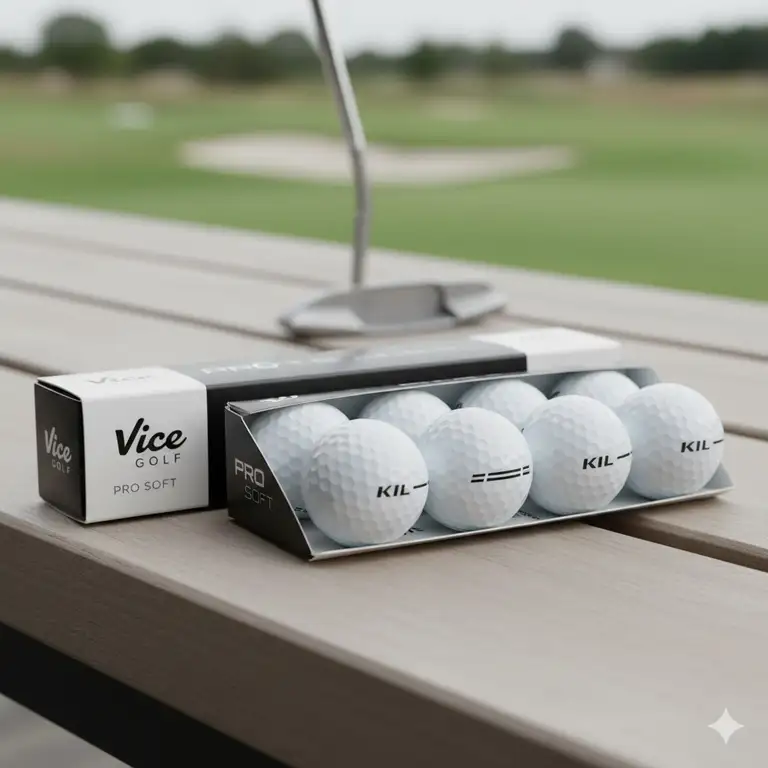
The belief that a tour-level ball is wasted on anyone who swings slower than a pro runs into MyGolfSpy’s 2026 robot test, which pushed 48 balls through three swing speeds. On a wet full wedge shot, ionomer balls lost nearly a third of their spin, while urethane balls lost about a tenth. That margin is what premium golf balls are priced to protect, and it is why this 2027 guide sticks to urethane covers.
Six picks follow, from the most balanced to the most spin-hungry, with colored golf balls, funny golf balls and a golf ball cleaner routine after them. The 2027 Titleist Pro V1 and Titleist Pro V1x are on tour but not on sale, so they get their own section near the end. The evidence behind the picks is robot data, Hot List scores, outlet reviews and a few forum threads; where a claim rests on one reviewer, the sentence says so, and every price is a range.
What a premium ball buys: a urethane cover, extra layers and wet-weather spin
Cover material is the first dividing line. Golf Digest’s 2026 Hot List for golf balls gave its Gold rating only to urethane-cover balls, and its listings for that tier run from around $40 for the Maxfli Tour family to between $55 and $58 for Bridgestone, Callaway, Srixon, TaylorMade and Titleist. Spin tells the same story. MyGolfSpy found the ionomer Titleist Tour Soft among the top ten 7-iron spinners at every speed, yet it ranked 42nd of 48 in the greenside test.
Construction varies more than the labels suggest. Golf Monthly describes the TaylorMade TP5 as a five-layer ball, Golf Digest lists the Callaway Chrome Tour X as a four-piece with two mantle layers, and Today’s Golfer’s robot table counts the Bridgestone Tour B XS and Srixon Z-Star Diamond as three-piece designs. More layers do not automatically mean more spin, because the tuning of core and cover decides how each ball behaves with a driver versus a wedge.
Swing speed is the second dividing line, and it is the one a shopper can check before looking at brands. Golf Digest aims its firmer models, such as the Bridgestone Tour B XS, at swings above 105 mph and its softer ones at slower swingers. MyGolfSpy’s robot test sorted its picks at roughly 86, 102 and 116 mph of driver speed, so start with the row that matches your swing.
Best premium golf balls by swing speed: MyGolfSpy’s 2026 picks
Driver speed
Low-spin pick
Mid-spin pick
High-spin pick
About 86 mph
Maxfli Tour
Wilson Staff Model, Titleist Pro V1x Left Dash, Titleist Pro V1
TaylorMade TP5, Callaway Chrome Tour X, Bridgestone Tour B XS
About 102 mph
Callaway Chrome Soft, Bridgestone Tour B RXS, Callaway Chrome Tour
TaylorMade TP5x, Wilson Staff Model, Titleist AVX
Mizuno Pro X, Titleist Pro V1x, Vice Pro Plus
About 116 mph
TaylorMade Tour Response, Titleist Pro V1, Mizuno Pro S
Maxfli Tour X, Titleist Pro V1x Left Dash, Bridgestone Tour B X
Titleist Pro V1x, Callaway Chrome Tour X, Srixon Z-Star Diamond
No single ball wins every row. The Titleist Pro V1x is the high-spin choice at two speeds, the Callaway Chrome Tour X shows up at the slowest and fastest, and the Titleist Pro V1 moves from mid-spin to low-spin as the swing speeds up, which is how a ball earns the label “balanced.” A Maxfli Tour at under $45 a dozen also takes the low-speed low-spin slot, so a premium result does not always carry a premium price.
Six tour-level balls, from most balanced to most spin-hungry
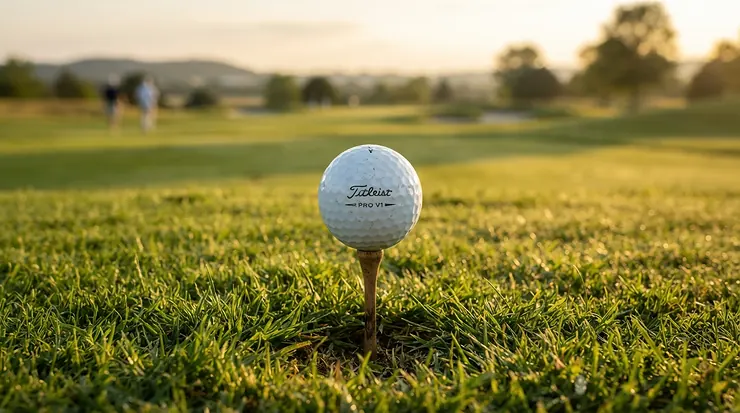
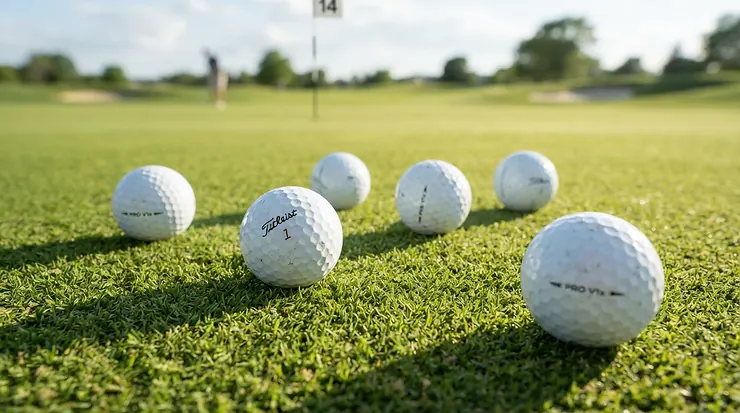
Golf Digest’s editors describe the Titleist Pro V1 as the most balanced ball in the family, mixing off-the-tee speed, greenside spin and a soft feel, and they list it in the $55-to-$58 band that Titleist, Callaway and TaylorMade share. MyGolfSpy’s 2026 data makes it the low-spin pick at high swing speeds and a mid-spin pick at lower ones, which is the profile of a ball with no obvious hole. The same outlet’s 2025 analysis adds a caveat: greenside control is reliable, but the TaylorMade TP5, Bridgestone Tour B XS and Callaway Chrome Tour X reach higher peak spin in the 35-yard test.
Real-use reports are mixed in a useful way. Today’s Golfer’s reviewer rated durability 4 out of 5 on the current generation and said the ball scuffs, mostly in bunkers, as any urethane ball would. Golf Monthly’s Joel Tadman, who normally plays the Titleist Pro V1x, felt the lower driver flight of the Titleist Pro V1 cost him total distance in wet conditions. That is one reviewer’s experience, but it flags the trade-off for anyone who needs help getting the ball airborne.
The current generation launched in January 2025, according to MyGolfSpy, and its successor has already begun tour seeding.
Where the Titleist Pro V1 plays down the middle, the Titleist Pro V1x pushes more spin up the bag. MyGolfSpy’s 2026 test had it among the longest balls at high swing speed while spinning about 100 rpm above the field median of roughly 2,400 rpm off the driver. Around the green it was among the highest-spinning balls tested, and MyGolfSpy named it the high-spin pick at both high and mid speeds.
Sources disagree on flight. Golf Digest describes a higher flight and firmer feel than its sibling, while MyGolfSpy’s data places it among the lowest-launching balls in the 48-ball field. The baselines differ, so read “higher” as relative to the Titleist Pro V1 and “lower” as relative to everything else. The updated Titleist Pro V1x Left Dash is a separate model: Golf Digest lists it as the firmest, lowest-spinning member of the family, and MyGolfSpy named it a mid-spin pick at low and high speeds. Expect around $55 to $58 a dozen for either version.
Pros:
✅ MyGolfSpy’s high-spin pick at two of three swing speeds
✅ Gold on Golf Digest’s 2026 Hot List, with a firm, higher-flying profile
Cons:
❌ Firmer feel that slower swings may not compress as easily
❌ One of the lowest-launching balls in MyGolfSpy’s 48-ball field
Five layers are unusual, and the TaylorMade TP5 is the only five-piece ball here. Golf Monthly says the 2026 version carries TaylorMade’s largest-ever tour core, built to shorten contact time with the face and hold more energy. National Club Golfer’s tester saw about 200 rpm more spin on 50-yard shots than with the previous generation, with wedge spin well into the 7,000s, and noted that Rory McIlroy and Collin Morikawa already play it. Today’s Golfer points to very soft feel and strong short-game spin. MyGolfSpy picked it as a high-spin option at the slowest speed, and its firmer sibling, the TaylorMade TP5x, as a mid-spin pick at 102 mph.
Durability is where owners push back. In a MyGolfSpy forum review, three of five testers planned to make the TaylorMade TP5 line their gamer, while two would keep it in rotation because of price and cover wear. One tester, hitting the TaylorMade TP5x, reported scuffing on nearly every well-struck full wedge and burned through five to eight balls per round instead of his usual two to five. Another tester said 20-to-30-yard pitches with a 56-degree wedge chewed up the cover. The page does not state which model year it covers, so weigh it as owner color rather than a verdict on the 2026 ball.
A dozen lands around $55 to $58 on Golf Digest’s listing. For golfers who lose several balls a round, that wear pattern matters as much as the spin numbers.
Today’s Golfer’s robot table is blunt about this ball. At 93 mph of driver speed the Callaway Chrome Tour X produced 3,048 rpm of driver spin, 5,242 rpm with a 7-iron and 6,343 rpm on a 40-yard pitch. Among the ten balls in that table, only the Bridgestone Tour B XS spun more off the driver, and none beat it with the iron or the pitch. MyGolfSpy agrees: top-three iron spin at high speed and more than 5,900 rpm in the greenside test. Golf Digest says the four-piece build, with two mantle layers, is meant to trim spin and add ball speed.
Its sibling, the plain Callaway Chrome Tour, posted the fastest ball speed in Today’s Golfer’s table at 165.1 mph, against 163.6 for the X. That is the trade in numbers: the X buys stopping power with some distance, and Today’s Golfer cautions that its high spin may not suit every golfer. Golf Digest lists the family around the high-$50s per dozen.
Compare those spin figures with your own wedge distances before ordering a dozen.
Pros:
✅ Highest 7-iron and pitch spin in Today’s Golfer’s ten-ball robot table
✅ MyGolfSpy’s high-spin pick at both the slowest and fastest speeds
Cons:
❌ Driver spin of 3,048 rpm at 93 mph is on the high side for distance
❌ Today’s Golfer notes the high spin may not suit every golfer
Bridgestone prices the Tour B line a few dollars under its rivals, with Golf Digest listing the Bridgestone Tour B XS at the $55 mark against $58 for the Titleist, Callaway and TaylorMade group. Golf Digest rates it Gold and targets swingers above 105 mph who want short-game spin. Today’s Golfer’s table shows why: 3,059 rpm of driver spin, the highest of the ten balls, with 5,170 rpm on the 7-iron and 6,036 rpm on the pitch.
National Club Golfer’s tester measured about 8,400 rpm on wedge shots and called the ball one of the spinniest he had ever tested, with a consistently low launch that suited aggressive shot-making. Today’s Golfer’s reviewer praised the responsive feel but said it is not the most versatile option. For wet weather, MyGolfSpy’s 2025 look at Bridgestone found all of the Tour B models held up well in wet wedge spin testing.
Golf Monthly’s 2026 review tested the updated XS against the Titleist Pro V1 and noted Bridgestone’s claim that it had closed the gap with the firmer Bridgestone Tour B X. A Mindset-graphics version offers a visual aid for aim and pre-shot routine.
Price is the entry point: Today’s Golfer lists the Srixon Z-Star Diamond between $50 and $55, and Golf Digest puts it at $55. It is a three-piece ball with a compression of 102, per MyGolfSpy’s 2025 review, and a thin urethane cover now made partly from a corn-derived biomass polyol, according to Today’s Golfer. Golf Digest says it is firmer than the standard Z-Star, with more driver, iron and wedge spin for shaping shots.
MyGolfSpy’s 2026 data backs that up. At high speed it tied for the highest driver spin, just over 2,500 rpm, and ranked among the highest spinners with irons and around the green, with a lower, more penetrating iron flight. It is the high-spin pick at the fastest speed. National Club Golfer’s reviewer said it needs a moderate-to-fast swing to perform, and praised a softer feel than the previous generation.
Today’s Golfer’s reviewer called durability a strong trait of Srixon balls in general, though that is one reviewer’s view and not a measured result.
Pros:
✅ Strong iron and wedge spin, per MyGolfSpy’s 2026 robot data
✅ Priced below the $55-to-$58 Titleist, Callaway and TaylorMade group
Cons:
❌ High spin slightly reduces distance, per Today’s Golfer
❌ Best with a moderate-to-fast swing, per National Club Golfer
Premium golf balls reviews: where three outlets agree and where they split
Three methods, three sets of winners. MyGolfSpy used a robot with a driver, a 7-iron and a 35-yard wedge on 48 balls. Today’s Golfer ran a robot table and on-course testing, and in its larger roundup of 62 balls it named the Wilson Staff Model X best overall. Golf Digest scored balls through a panel and handed Gold only to urethane covers.
The overlap is more useful than any single ranking. The Titleist Pro V1, Titleist Pro V1x, TaylorMade TP5, Callaway Chrome Tour X, Bridgestone Tour B XS and Srixon Z-Star Diamond each carry Gold on Golf Digest’s list and each appears in MyGolfSpy’s picks or Today’s Golfer’s data, so the premium tier is consistent across methods. The splits are about priority: Today’s Golfer’s reviewer leans toward feel and short-game numbers, while MyGolfSpy’s picks are organized by swing speed and spin band.
Price is where the reviews loosen. Golf Digest’s Gold list includes Maxfli Tour models listed under $45 a dozen alongside the $55-to-$58 group, and MyGolfSpy picked Maxfli Tour and Maxfli Tour S as its low-speed value choices. If spin and feel are what you are buying, the gap between a premium dozen and a value-urethane dozen is real but narrow.
Colored golf balls: yellow, matte and patterned covers on premium cores
BallCaddie says every flagship tour ball now comes in yellow. Skratch reports that Titleist offers its premium models in yellow, and National Club Golfer lists the TaylorMade TP5 in white, yellow, stripe and Pix versions. Srixon sells the Z-Star line in yellow and a two-tone Divide, and Bridgestone offers the Tour B line with Mindset graphics for aim. A practical way to think about colored golf balls is as a cover color and print layered on the same ball, not a different ball.
Performance mostly stays put. BallCaddie’s roundup says makers sell yellow and white as the same ball, with one exception: a warehouse-brand ball whose two colors come from different factories. A 2023 MyGolfSpy wet-versus-dry wedge test, as summarized by BallCaddie, found a yellow Titleist Pro V1 spun slightly less than white when dry, not significantly so, and about 700 rpm less when wet. That is one ball from one model year, so treat it as a flag, not a rule.
The real trade is finish. Matte covers cut glare in bright sun, but BallCaddie reports MyGolfSpy’s 2024 verdict that matte balls lose a lot of wet-weather spin, published without the underlying numbers. Premium tour balls mostly stay glossy for that reason. As for the rules, any color is legal if the ball is on the USGA and R&A conforming list, with the only wrinkle being the optional one-ball rule some elite events use, which requires the same brand, model and color for a round.
Funny golf balls: novelty prints, gag sets and what you actually play
Funny golf balls come in two types: printed balls and novelty sets. Zazzle’s listings let you customize text on a ball, and the base ball is a menu choice that runs from a value ball and the Wilson Ultra Distance to the Callaway Warbird Distance+, Callaway Supersoft, Bridgestone e6, Srixon Soft Feel 13, TaylorMade TP5 and the Titleist 2023 Pro V1. Packs come as three, with a 12-pack at added cost. That last option is a previous-generation ball, since the current Titleist Pro V1 arrived in January 2025.
Gag sets are cheaper and plainer. Golf Galaxy’s emoji set holds six balls with six emoji designs for around $10 to $15, and reviewers there rate it 4.7 out of 5 across 22 reviews, with most reviewers buying it as a stocking stuffer, a gift or a charity-event giveaway. Some say they play it on the course just for laughs.
If the joke has to be premium, a printed TaylorMade TP5 keeps the urethane cover. If the joke is for the tournament prize table, a gag set is fine, but conformance for competition is decided by the model, not the print or color.
Golf ball cleaner: soap, a brush or a clip-on washer
A golf ball cleaner does not have to be a product. Golf.com’s guide to cleaning golf balls names warm soapy water as its best method: soak the balls in a bucket for about an hour, then finish with a towel or hand brush. Hydrogen peroxide or distilled white vinegar can stand in for soap, and the guide also lists a dishwasher cycle, a denture-whitening soak, a mesh bag in the washing machine and a dab of nail polish remover on marker or mud, which it warns smells strong.
Soak times differ between guides. A GolfBalls.com retailer blog suggests 15 to 20 minutes with mild dish soap, so the hour is on the generous side. Golf.com’s piece does not separate urethane covers from other types, which makes soapy water, the gentlest method on its list, the sensible default for a premium dozen.
For a mid-round fix, the guide names the Clean Flight portable ball washer, which includes cleaning solution, a strap and a carabiner for clipping to the bag. It sells for roughly $35 to $40. Cheaper still is a damp towel with a drop of soap, or a toothbrush in the bag.
Best premium golf balls 2027: buy a dozen now or wait for Titleist’s update?
The 2027 Titleist Pro V1 and Titleist Pro V1x entered tour seeding at the Baycurrent Classic in Japan in early October 2026, according to GOLF.com’s tour report. They reached the USGA conforming list about three weeks earlier, and Titleist has not disclosed what changed. The same report carries no price. Tour players are talking: Jordan Spieth said he was switching to the 2027 Titleist Pro V1, Sahith Theegala described a ball that comes out a touch lower with a touch more spin on 20-to-40-yard pitches, and Doug Ghim, who plays the 2027 Titleist Pro V1x, noticed more consistent spin and less crosswind curve.
Release timing is unconfirmed. MyGolfSpy notes that the current pair launched in January 2025, and a GOLF.com writer’s reading of Titleist’s usual two-year cadence points to January 2027, but that is speculation. Until Titleist posts a date, the current generation is the only version with test data behind it.
The rollback adds a second reason to think about timing. Under the governing bodies’ plan, balls that conform in 2027 stay legal for recreational players through 2029, new testing conditions start in January 2028 for pros, and every golfer moves to the new standard in January 2030. GOLF.com cites research putting the typical recreational loss at 5 to 7 yards of driver distance, and the USGA expects more than 30 percent of models to stay conforming afterward. Today’s Golfer’s reviewer argues that value in premium balls could get harder to find once the rollback takes hold, so buying sooner may pay off.
Spin, yellow covers, rollback dates and wash water: quick answers
❓ Do slower swings gain anything from a urethane ball?
✅ Possibly. MyGolfSpy's low-speed picks, measured at about 86 mph of driver speed, include urethane balls such as the Pro V1, TP5 and Maxfli Tour. Its wedge test found urethane kept roughly nine-tenths of its spin when wet, while ionomer lost nearly a third.
❓ Does a yellow premium ball spin less than a white one?
✅ Makers sell the same ball in both colors. A 2023 MyGolfSpy test, as summarized by BallCaddie, found a yellow Pro V1 spun about 700 rpm less when wet, though not significantly different dry. It covered one ball from one model year.
❓ What is the gentlest way to wash a premium golf ball?
✅ Golf.com ranks warm soapy water first. Soak the balls, then finish with a towel or hand brush. Peroxide or white vinegar can replace the soap. Dishwashers, denture tablets and solvents also appear in its list, but soapy water is the mildest.
❓ Will the golf ball rollback make my dozen illegal?
✅ Not before 2030 for recreational golf. Balls conforming in 2027 stay legal through 2029, and the new testing conditions begin January 2028 for professionals. The USGA expects more than 30 percent of models to remain conforming after the change.
❓ Are printed novelty balls allowed in a tournament?
✅ Color and print do not decide it. The USGA and R&A conforming list judges size, weight, speed and symmetry, so the base ball model matters. Printed balls built on a listed model qualify; an unnamed gag set gives you nothing to verify.
Which premium golf ball goes in the bag first
Start with swing speed, then decide how much spin you want. The Titleist Pro V1 is the safest first dozen: balanced, widely tested and well suited to mid-range swings. Golfers who want the highest spin at fast speeds should audition the Titleist Pro V1x, Callaway Chrome Tour X or Bridgestone Tour B XS. Anyone chasing a soft feel can try the TaylorMade TP5, accepting its reported wear. The Srixon Z-Star Diamond is the pick when price matters but urethane spin still does. Wait for the 2027 Titleist update only if you specifically want that ball, because its price, date and changes are still unannounced.
Whichever you buy among premium golf balls, match the swing-speed row in the table before the brand name, and compare the exact model number before buying.
Disclaimer: This post contains affiliate links. As an Amazon Associate, I earn from qualifying purchases made through these links, at no additional cost to you.
Match the cover and compression to your swing speed first, and let the dozen’s price come second. ⛳
At GolfEquipHub, we bring expert insights, reviews, and guides on the best golf equipment to enhance your game. Our team is dedicated to helping golfers of all skill levels find the perfect clubs, accessories, and gear for peak performance on the course.