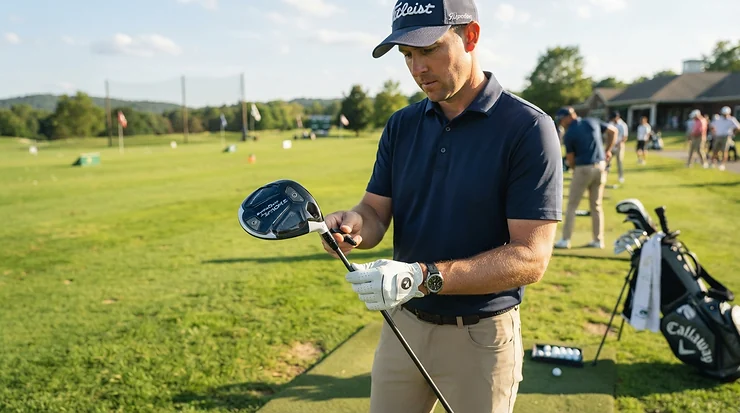
A golfer who opens a new driver box and finds a torque wrench inside is holding the main promise of adjustable golf drivers: a setting for almost every miss. The promise is real but narrow. In 2027, the head you pick and the order you turn the wrench matter more than how many positions are printed on the sleeve.
This guide gives the method first (baseline, loft, weight, torque, lock) and then four tools that fit it: three adjustable heads and a wrist training aid for practice days. The findings rest on a Golf Digest robot test, launch-monitor work from Golf Monthly and Today’s Golfer, R&A and USGA rule text, and owner threads on forums, so nothing here describes a swing made at this site.
The short version: these clubs reward a golfer who fits the head first, changes one setting at a time, and then leaves the club alone. They do very little for someone clicking through positions to dodge a swing problem.
Are adjustable golf drivers good, or just a wrench in the box?
Mostly good, with a ceiling. The sleeve and weights are real controls. Golf Digest’s robot test, run at 95 mph with a Callaway Paradym Ai Smoke, moved launch from 10.9° to 13.1° and spin from 2,807 to 3,420 rpm across its loft positions while the swing stayed the same. Few other things in a golf bag change ball flight that much with one turn of a screw.
The ceiling is low for anyone hoping to fix a swing. Golf Monthly’s feature on whether you should adjust your driver argues for letting a fitter choose the setup and then leaving it alone, because loft, lie and weight interact and changing one shifts the others. A fixed-setting driver also has a case. In a 2019 Today’s Golfer test, adjustable rivals averaged about 2 mph more ball speed and six more yards of carry than the non-adjustable Cleveland Launcher HB Turbo, yet the reviewer noted that mid-to-high handicappers often miss across the face, which narrows the gap between models.
Owners lean positive without much heat. A poll in a 2015 Sand Trap thread split 21 to 10 in favor of adjustable drivers among 31 voters, and the thread is old enough that current models may differ. A fair reading: adjustable golf drivers are good as a one-time fitting tool and poor as a weekly tinkering habit.
The setup method: baseline, loft, weight, torque, lock
Do these in order. Skipping ahead is where most of the confusion starts.
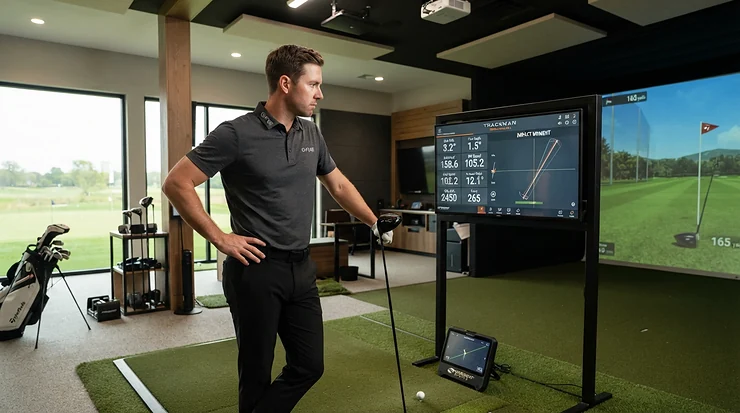
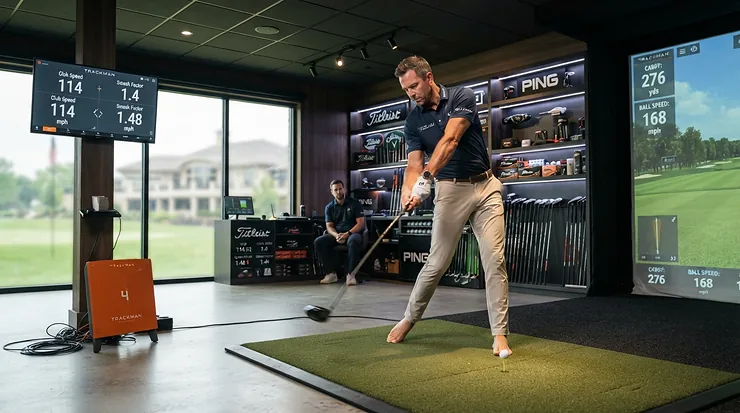
- Record a baseline at the factory setting. Start from the neutral position and note carry, launch, spin, start line and your usual miss, on a launch monitor if you can borrow one. MyGolfSpy’s driver loft adjustment chart says a random left-and-right miss means the settings should stay alone, since that pattern points to swing consistency, and that high spin at normal loft usually traces to attack angle rather than hardware.
- Settle the head and shaft before touching the sleeve. Golf Monthly describes the usual fitting order as head type, then loft, then shaft, with the adjustable loft and weights saved for fine-tuning at the end. That order matters because a high-spin head will not turn into a low-spin one with a single click. The same feature says specialist fitters offer more than 200 shaft options and most manufacturers stock at least three.
- Move loft one click at a time and watch the face. Golf Digest’s robot test of loft sleeve settings swung a Callaway Paradym Ai Smoke at 95 mph through five settings with the same swing and attack angle.
| Setting | Launch | Spin (rpm) | Carry (yards) |
|---|---|---|---|
| N Minus 1 (less loft) | 10.9° | 2,807 | 223.4 |
| Neutral | 11.6° | 2,966 | 222.1 |
| N Plus 1 | 12.3° | 3,116 | 221.6 |
| N Plus 2 | 13.1° | 3,420 | 217.3 |
| Draw | 11.8° | 3,108 | 220.7 |
The lowest-loft setting carried farthest but scattered most: 37.5 feet of dispersion against 10.3 feet at neutral, nearly four times as wide, while the draw setting was tightest at 6.7 feet. Golf Digest called N Plus 1 the sleeper, and the table shows why: 0.7° more launch and 150 rpm more spin than neutral for only half a yard less carry (my arithmetic from its figures). It is one robot, one driver and one swing speed, so treat the pattern as a prompt to test, not a rule.
Face angle moves with loft. MyGolfSpy says adding loft closes the face slightly and removing it opens the face, across Titleist SureFit, Callaway OptiFit and TaylorMade FCT sleeves alike, and Golf Monthly adds that loft and lie are usually linked, so a loft change can shift lie by up to 2° because the hosel is bored off-centre. One Sand Trap member points out that whether the head is soled or hovered at address decides whether you see a loft change or a face-angle change, which is worth knowing before you compare numbers from two sessions.
- Shift weight to shape the miss. MyGolfSpy’s chart pairs heel weight with a slice, toe weight with a hook, forward weight with a ball that balloons in wind, and rear weight with a ball that will not get airborne. Golf Monthly agrees on direction: rear weight adds spin and launch, forward weight lowers both, and heel-side weight promotes a draw. Because weight changes the center of gravity relative to the face, it interacts with the loft you chose in step 3, so change only one of them per range session.
- Torque it to the click, then check it. Torque specs differ: MyGolfSpy puts Titleist’s GT-series wrench at 30 in-lbs and most Callaway and TaylorMade sleeves at 40 in-lbs, so use the wrench that shipped with your club and tighten until it clicks. The R&A’s rules of equipment require adjustable parts to be firmly fixed, with no reasonable likelihood of working loose during a round, which makes a second check at the range worth the minute.
- Keep the swing steady while you test. A setting tuned on a swing that changes every week is tuned to noise. This is where a wrist training aid, the fourth tool below, can earn its place, strictly as a practice device.
- Freeze the setting before the first tee. The R&A’s equipment text bars purposely changing a club’s performance characteristics during a round, and Golf Monthly’s rules explainer says making a stroke with a club changed that way means disqualification. Tightening a screw that has come loose is a different matter: Golf.com’s rules column treats it as a repair when the club goes back to its original setting, and adds that a screw already loose when play began cannot be fixed that way.
What adjustable golf drivers reviews and owner threads keep reporting
Test labs and owners tell overlapping but different stories.
Settings that never get touched
Jeff Brunski, Cleveland’s head of R&D, told Today’s Golfer that almost half of adjustable-driver buyers never change lie or face angle and one in three never changes loft. A maker selling a fixed-setting driver has a reason to say that, so weigh it accordingly. The forum record points the same way: in the Sand Trap thread, most members who commented keep the factory setting or pick one position and leave it, and a few switch between draw and neutral as their swing varies.
A sleeve that goes wrong
A Golf Monthly forum thread describes the owner of a roughly 10-month-old Callaway XR who heard a cracking sound in the backswing and at impact after setting minus one loft and tightening to the click. Two posters pointed to loose epoxy, two suggested debris or over-tightening, and no diagnosis was confirmed. The most consistent advice was to clean the head-to-adaptor interface, check the glue under the grip, and contact the maker. One thread is not a failure rate, but it explains why step 5 ends with a check.
Extra weight for a modest yardage gain
The Sand Trap thread’s original poster liked his adjustable driver but disliked the added hosel weight, and Today’s Golfer’s Cleveland piece puts the adjustable hardware at 25 grams. In that same 2019 test the reviewer reckoned the test pro could have picked up five or six yards of carry by dialing in the adjustable models. That is a modest gain for a fitted player, which fits Golf Monthly’s advice to set the club once.
Reviews that disagree
Golf Monthly’s 2026 guide names the TaylorMade Qi4D Driver its top pick, citing a tester clubhead speed about 1.5 mph above every other driver he used that season. It picks the Ping G440 K Driver for wide appeal and the Vice Golf VGD01+ Driver for value. Another guide will crown a different winner, which is why the tools below are matched to steps and not stacked as a league table.
Best adjustable golf drivers and the tool for each step
These four are not a ranking. Each one maps to a step above, and the order follows the order you would use them.
1. Ping G440 Max Driver — weight bias with a forgiving head
Step 4 is where this head does its best work. Golf Monthly calls the G440 Max the most forgiving model in Ping’s G440 range: a 460cc head in 9°, 10.5° and 12° lofts, an adjustable hosel good for plus or minus 1.5°, and a 29-gram back weight with draw, fade and neutral positions. Its tester said the weight does a good job of dialing in flight, saw launch about a degree higher than on the Ping G430 Max Driver, and noticed much less ball-speed loss on low strikes. Golf Monthly’s 2026 guide shows it at around $450, and the review’s retailer snapshot ran between roughly $420 and $620.
Pros:
- ✅ One weight turn changes shot bias without touching the loft setting
- ✅ Ball speed holds up better on low-face strikes than on the previous model, per Golf Monthly
Cons:
- ❌ Golf Monthly says the sole design will divide opinion
- ❌ Its successor family is already on the USGA conforming list (see the timing section below)
Spotted one that matches your miss? Take a closer look at the current listing.
2. Cobra Optm X Driver — two weights, with numbers to read
At around $400, this is the cheapest of the three heads here, and it is the one with test numbers for both weight positions. Golf Monthly lists a FutureFit33 hosel, two weights of 11 grams and 3 grams, and lofts of 9° and 10.5°, with the heavier weight at the back for a neutral flight and moving it toward the toe to encourage a fade.
Today’s Golfer tested it at 10.5° with head speed around 110 to 111 mph. With the weight forward it recorded 160.0 mph ball speed, 2,015 rpm of spin, 10.9° launch, 274.9 yards of carry and 23.7 yards of left-right dispersion. With the weight back, the readings were 158.1 mph, 2,214 rpm, 12.0°, 275.2 yards and 20.7 yards. By my arithmetic, forward weight bought about 1.9 mph of ball speed and 199 rpm less spin, at the cost of three more yards of spread (23.7 against 20.7), with carry level within 0.3 yards. A slower swing will see smaller numbers, so the pattern is a guide, not a promise.
The tester said the head feels fast and mishits seem to fly straighter, though the look and finish did not excite. Today’s Golfer’s page does not confirm the FutureFit33 hosel for this exact model, so read the settings chart that ships in the box before trusting the loft range.
3. Callaway Quantum Max-D Driver — draw bias for a stubborn slice
Draw bias is built into this head, so it does part of the work of steps 3 and 4 before the wrench comes out. Golf Monthly lists lofts of 9°, 10.5° and 12° on an adjustable hosel at around $450, and its tester found effective slice reduction with good ball-speed retention for a draw driver, plus a powerful, thuddy feel.
The trade shows up against the Callaway Quantum Triple Diamond Driver: ball speed about 2 mph slower and spin more than 500 rpm higher, which cost the tester roughly 11 yards at his faster swing speed. My reasoning is that a head that already closes the face leaves little room for MyGolfSpy’s slice recipe of more loft and heel weight on top of it, since that stack could overcorrect into a hook. Start from the neutral sleeve position and move one thing at a time.
4. NorthDeer Golf Adjustable Wrist Fixing Strap Training Aid — keeps the wrist quiet during practice
Practice days are where step 6 lives, and a wrist aid is one way to run it. NorthDeer’s golf wrist training aid for swing stability and control uses an adjustable wrap-around design that suits men and women golfers, and aids of this type strap over the lead wrist to limit how far it can hinge or cup, the idea being to make the same clubface delivery easier to repeat while you test a driver setting.
The Amazon listing for NorthDeer’s longer breathable version with an arm band shows polyester, about 97 grams and a 180-day warranty, first available in June 2026 and ranked #881 in Golf Swing Trainers when the search snapshot was taken. The specs belong to that version, so confirm which one the listing you open carries. On NorthDeer wrist strap reviews, Amazon blocks automated reading of its pages, so star ratings and review counts could not be checked, and no independent test of this strap turned up; treat it as an unrated budget aid. A Golf Monthly review of a pricier wrist aid, the ProSENDR, cautions that good shots with an aid on flatter the player, much like bumpers at a bowling alley.
Rules decide where it can be used. The USGA’s equipment FAQ says training aids are likely not allowed during a round under Rule 4.3, and that wrist braces are generally not permitted, though items designed for a specific medical condition are judged individually by the Committee. So this one stays in the bag during play. Curious about the strap? Take a closer look at the listing, compare versions, and check the current price on Amazon.com.
Timing the purchase: Ping’s G450, TaylorMade’s pause, and yearly launches
Three launch facts shape when to buy. Golf.com reported in early November 2026 that Ping’s G450 family (MAX, LST, SFT and a new MiniMax mini driver) had appeared on the USGA conforming list, with no release date or price in that report, which would make the Ping G440 Max Driver the outgoing generation once those ship. TaylorMade announced it will not launch a new driver in 2027, so the TaylorMade Qi4D Driver that topped Golf Monthly’s guide stays current through the year. Callaway and Cobra keep launching yearly, according to Golf.com, so the Cobra Optm X Driver and Callaway Quantum Max-D Driver sit on a one-year clock. Whether that matters depends on whether you want the newest label or a fitted setting you can leave alone.
Wrench clicks, round rules, and wrist aids: short answers
❓ Is an adjustable driver worth it for a mid-handicapper?
❓ How much does one loft click change ball flight?
❓ Can you change driver settings during a round?
❓ Do I need a fitting if my driver is already adjustable?
❓ Can I wear a golf wrist training aid on the course?
A setting you can leave alone
Treat adjustable golf drivers as a one-time fitting tool: baseline at the factory setting, one loft click, one weight move, torque to the click, then freeze it before the first tee. If your miss changes from swing to swing, steady the swing before the wrench gets another turn. If the same miss shows up every time, the Callaway Quantum Max-D Driver and heel weight on the Ping G440 Max Driver attack a slice from different directions, and the Cobra Optm X Driver gives the clearest numbers for what weight does. The NorthDeer Golf Adjustable Wrist Fixing Strap Training Aid belongs to practice days only.
Found a head that fits your miss? Take a closer look at it on Amazon.com.
Recommended for You
- Golf drivers: the 6 models to buy right now
- Best golf clubs: 7 Expert-Picked Sets, Drivers & Irons for 2027
- Best Golf Driver for Beginners: Top 8 Clubs to Improve Your Game in 2025
Disclaimer: This post contains affiliate links. As an Amazon Associate, I earn from qualifying purchases made through these links, at no additional cost to you.
Write down your ball flight at the factory setting first, then let the wrench earn each turn after that.