Fifteen to 20 rounds is how long a set of golf shoe spikes lasts, according to the Softspikes and Champ product manager Golf Digest interviewed, which works out to about two changes a season for the average golfer. That number is worth checking against your own round count before the 2027 season starts, because worn cleats give up grip on the first damp slope. Golf Digest also calls a swap an affordable alternative to new shoes, as long as the upper is still in good shape.
This guide follows the order your hands will work: read the insert, judge the wear, clean, remove, install, check, and store. Four tools are tied to those steps, and the shoe-side questions come after them, including what to know about the seven removable spikes on the Air Jordan 12 Low. Golf Digest’s interview, Golf Monthly’s spike tests, CaddieHQ’s walkthroughs, Golf Galaxy buyer pages and a pair of forum threads supply the findings; nobody wore these cleats for a round here, so every remark about wear or fit is credited to the page it came from.
The swap, step by step: from worn cleat to snug spike
Match first, buy second. Golf Digest’s source says Fast Twist cleats fit most recent Nike, Callaway, Puma, ASICS, Johnston & Murphy, True Linkswear and Under Armour shoes, plus most FootJoys. The exceptions are FootJoy Classic and Dry Premiere models, Ecco shoes with 12 to 14 cleats, and adidas shoes built on Thintech, which take adidas clamshell cleats instead.
Flip the shoe and read the insert. Replaceable cleats usually show a brand name and wrench holes, per Golf Digest, and TGW’s replacement guide says to compare the insert pattern with its Tri-Lok, Fast Twist and Slim-Lok examples. The systems cross over in one direction only. A compatibility chart citing Softspikes and Champ packaging says Fast Twist 3.0 cleats fit Slim-Lok, Fast Twist and Tri-Lok receptacles, while original Fast Twist cleats fit neither Fast Twist 3.0 nor Slim-Lok ones.
Judge the wear, then decide how many to change. Golf Digest’s source says hardpan courses and cart-path walking use spikes up faster, and cart riders get more life from a set. Right-handed golfers tend to wear the back right heel first, so replacing only the worst few is a legitimate shortcut. Golf Monthly’s testers suggest every couple of years or sooner, which lines up with the 15-to-20-round range for someone who plays about ten rounds a year (my arithmetic).
Clean the insert and the old spike. CaddieHQ’s Nike walkthrough says to scrub away mud, grass and sand first, because forcing a wrench into a packed cleat strips the plastic holes. TGW gives the same instruction for clearing debris before removal. A stiff brush and a towel do the job.
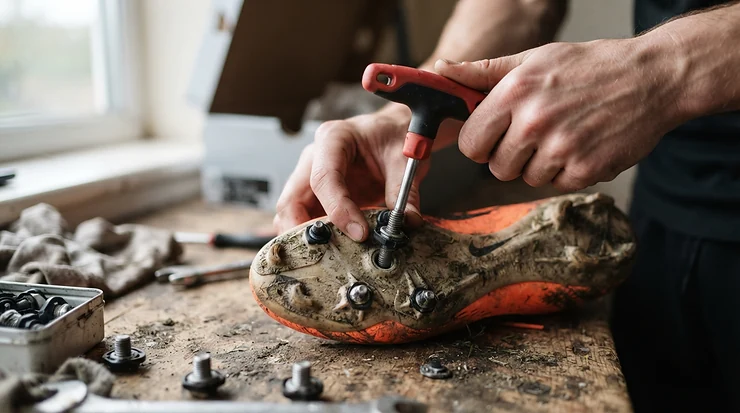
Back the old spike out. Seat both wrench prongs firmly and turn counterclockwise until it breaks loose. If the wrench slips, clean the holes again. For a spike that still holds, CaddieHQ’s removal article suggests penetrating oil at the seam for 10 to 15 minutes, and a hairdryer on the sole for 30 to 60 seconds, taking care not to melt it. Needle-nose pliers are the fallback for a stripped head.
Thread the new spike by hand. Turn clockwise until it catches; if it resists, back it out and retry, because it may be cross-threaded. Then finish with the wrench. For Fast Twist 3.0, CaddieHQ’s guide says to stop after the second click so the insert is not stripped, while PINS-style cleats go to snug rather than maximum force.
Check every spike on both shoes. CaddieHQ’s guide ends the install the same way, and its separate removal article adds a quick snugness check with the wrench before a big round. Not everyone agrees on routine loosening: in a 2012 Golf Monthly forum thread of 13 posts, one member loosened studs after every round to ease later swaps, while another warned that the plastic-on-plastic lock can eventually stop holding. Check for snug; do not make a habit of backing them out.
Wipe the soles and store the shoes dry. Dirt left in the insert is what makes the next swap hard, and forum posters in the same thread recommend cleaning after every round. A vented golf shoe bag keeps the trunk clean while the shoes air out; the FootJoy Nylon Golf Shoe Bag below is one of the simple ones.
Where a spike swap goes sideways, and how to recover
Buying by brand name instead of by attachment. One Golf Galaxy reviewer of the Softspikes Pulsar Fast Twist 3.0 bought a different Softspikes type whose center post was too long, and a store associate supplied the one that fit their New Balance shoes. Reviewers on the Champ Zarma Tour Fast Twist 3.0 page report a similar miss: one bought the wrong cleat for FootJoys despite staff advice, and another notes that different FootJoy models each take a different set. Across two listings that adds up to a handful of reports, but the pattern is consistent: the insert, not the logo, decides the fit.
Stripped wrench holes. A forum member with Adidas Tech Response shoes found that the wrench would not turn the factory spikes and the holes tore instead. Nine replies from seven members offered fixes: vise grips or pliers, a flathead screwdriver worked into the gap, or a golf shop doing the job. One reply read torn holes as a sign the cleat itself had worn out, and another said fast-twist styles are far easier to swap. It is one thread, so weigh it as a pattern of workarounds rather than a verdict.
Spikes that will not stay seated. Some Golf Galaxy reviewers of the Champ Zarma Tour Fast Twist 3.0 say cleats came loose within a month, and one reports them falling off after four wears. Those are a minority of 40 reviews, and a missed system match or a dirty insert is the likelier cause, so recheck the attachment type and clean the receptacle before blaming the spike.
Overtightening. The second-click rule in step five exists because the insert strips; the same walkthrough describes cross-threading as a reason to back out and restart rather than push on.
Air Jordan 12 golf shoes spikes: check the receptacle first
Nike describes the Air Jordan 12 Low Golf Shoes as a springy full-length Zoom Air unit under a hybrid outsole with integrated traction and seven removable spikes. MyGolfSpy’s first look at the “Playoffs” colorway adds that the herringbone traction and carbon-fiber shank plate of the original shoe show beneath the seven spikes, which is how Nike kept the old sole’s look.
Buyer evidence is warm with one caution. WearTesters scored the shoe 9 out of 10, found traction strong even on soggy turf, and called the fit true to size, but warned that leather and little ventilation make it a poor choice above about 90°F. A Nike buyer calls it bulkier than most golf shoes. Nike’s own page shows a 4.9-star rating, mostly praising comfort and Zoom Air cushioning.
Replacing them is the open question. A CaddieHQ guide to Nike spikes ties the PINS-style Pivix cleat to Jordan shoes and calls Fast Twist 3.0 the most prevalent system on newer Nike golf shoes, yet none of the pages opened for the AJ12 Low names its receptacle. Cleat names do not settle it either: Golf Monthly lists the Softspikes Ultimate Cleat Kit as a PINS pack for Nike, FootJoy and Callaway shoes, and it lists Softspikes Pivix as a Fast Twist 3.0 cleat. Pull one spike, look at the insert, and match it to the attachment printed on the pack.
Seven per shoe means 14 per pair, so a standard 18-count pack leaves four spares (my arithmetic).
Best golf shoe spikes and tools for each step of the swap
These are four tools for four jobs, not a ranking. The first two are replacement cleats with different strengths, the third is the tool that rescues stubborn spikes, and the fourth handles storage.
Tool
Step it serves
Fits or holds
What the listing gives
Price range
Softspikes Pulsar Fast Twist 3.0
1 and 5
Fast Twist, Tour Lock, Slim-Lok and Tri-Lok inserts, per Golf Galaxy
Pack counts from 18 to 22 depending on the listing
Cleat packs run roughly $15 to $20, per Golf Monthly
Champ Zarma Tour Fast Twist 3.0
2 and 3
Fast Twist 3.0 insert
18 cleats in the title, 19 in the feature list
Roughly $15 to $20, per Golf Monthly
Softspikes Multi-Wrench Kit
4
Ripper wrench plus a two-prong insertion wrench
Two tools
Around $10
FootJoy Nylon Golf Shoe Bag
7
13 x 9.5 x 5 inches, side vents
One bag with a carry handle
Around $25
The two cleats share an attachment but not a purpose: one is the broad-fit default, the other trades flex for a visible wear marker. The kit is the only item that does not wear out between swaps. Check current availability on Amazon.com.
Most replacement orders for shoes with a Fast Twist-style insert end up here. Golf Galaxy says these cleats are compatible with Fast Twist, Tour Lock, Slim-Lok and Tri-Lok systems, and Golf Monthly describes a 16-component design whose flexor knuckles add strength. Its testers found them easy to insert and remove, though they flag that the cleats may be too long for some golfers.
The buyer page at Golf Galaxy shows 4.7 stars from 141 reviews, with 95% recommending. Treat that with a little care: many of the visible reviews are tagged as received with an incentive, and three of the roughly 20 on view say the spikes wear quickly or wish they lasted longer. Pack counts differ between listings, so count the receptacles on your soles first and compare the total with the pack. A wrench is a separate purchase on several retailer listings, which is where the kit in entry three comes in.
Softspikes Pulsar Fast Twist 3.0See current price, sizes and reviews on Amazon.
Wear markers are rare in replacement spikes, and that is the reason to look at this one. Golf Galaxy says the Champ “C” logo wears away when the spikes need replacing, and Golf Monthly’s testers praise the visible indicators and the reinforced wrench holes, which matter in step four. The listing calls it a hard-plastic, six-point spike, and Golf Monthly notes the pack holds six spares beyond the twelve needed for one pair.
Pros:
✅ Wear indicator removes the guesswork from step two
✅ Reinforced wrench holes make removal less likely to strip
Cons:
❌ Golf Galaxy buyers report spikes loosening within a month, or falling off after four wears
❌ The wrench is sold separately, and the pack count differs between the title and feature list
Golf Galaxy shows 4.3 stars from 40 reviews, 88% recommending, with quality at 4.4 out of 5 and value at 4.2.
Champ Zarma Tour Fast Twist 3.0See current price, sizes and reviews on Amazon.
A tool is not a given in a cleat pack. The Zarma Tour listing says its wrench is sold separately, and Golf Monthly singles out the Softspikes Ultimate Cleat Kit for including a removal tool. This kit, per Golf Galaxy, contains a Ripper Wrench for worn or stuck cleats and a two-prong insertion wrench for snapping new Pulsar cleats in.
Golf Galaxy buyers rate it 4.5 stars across 55 reviews, with 89% recommending. The praise centers on the ripper: one reviewer removed 14 of 16 spikes with it after nothing else worked. The complaints centre on the other half. One reviewer’s thin metal peg snapped after two spikes, and two more say the insertion wrench is harder to use than the ripper, though it works. Golf Digest’s source lists the kit at around $8, a bit under the Golf Galaxy price of around $10, so shop around.
Softspikes Multi-Wrench KitSee current price, sizes and reviews on Amazon.
A golf shoe bag earns its place once the spikes are fresh, because new cleats still drag mud and grass into a trunk. Golf Galaxy lists this one at 13 by 9.5 by 5 inches with a large main compartment, double pull zipper, carry handle and side vents. Reviewers there give it 4.7 stars from 15 reviews with everyone recommending; they say shoes lay flat with room for socks, the nylon wipes clean, and the trunk stays clean. One reviewer wants more vent holes.
Pros:
✅ Side vents and a wipe-clean shell, per Golf Galaxy reviewers
✅ Around $25 at PGA TOUR Superstore
Cons:
❌ Only one buyer comment on vents, but it asks for more
❌ No divider or pockets in the listing
Confirm the exact model on the Amazon page, since FootJoy sells several shoe bags that look alike.
FootJoy Nylon Golf Shoe BagSee current price, sizes and reviews on Amazon.
Golf shoe spikes reviews: what testers praise and buyers flag
Golf Monthly’s testing weighs durability, weatherproofing and how easily cleats go on and off, and it points out that durability matters because a pack costs roughly $15 to $20. The magazine says its team uses the cleats over multiple rounds in different conditions. Its roundup of the best golf shoe spikes praised the Softspikes Pulsar Fast Twist 3.0 for easy insertion and removal and praised the Champ cleats for their wear indicators.
Buyer pages tell a more mixed story, and the pattern is worth reading closely. Easy installation is the common compliment across the Softspikes Pulsar Fast Twist 3.0, the Champ Zarma Tour Fast Twist 3.0 and the Softspikes Multi-Wrench Kit. The recurring complaints are different: wear speed on the Pulsar, loosening on the Zarma, and the insertion wrench on the kit. Because several Golf Galaxy reviews are incentive-tagged, a lone five-star score deserves less weight than a complaint that appears in more than one review.
Choosing spiked shoes for 2027 when the tests date from 2026
Searches for “best golf shoes 2027 spikes” mostly land on 2026 testing, and no 2027 models were verified for this guide. The most recent ranking checked is MyGolfSpy’s best spiked golf shoes of 2026, which scored these six:
Shoe
MyGolfSpy score
Award label
Skechers Blade Tour
9.9
Best spiked golf shoe
PAYNTR Chef RX Tour Knit
9.8
Runner-up
adidas Adipower 26
9.8
Best value
Under Armour Drive Pro Clone
9.7
Editor’s choice
Nike Victory Pro 4
9.7
Most stable
TravisMathew NuAge Mega
9.5
Most comfortable
Prices on that page run between roughly $140 and $200 across the six. A high score measures comfort, traction and stability, not how easy the spikes are to replace, and Golf Digest’s source notes that adidas Thintech models use adidas clamshell cleats rather than the usual Fast Twist type. Before paying for any new pair, find the cleat system in the product listing so the steps above still apply a season from now.
Cleat systems, wrenches and Jordans: short answers
❓ How often should you change golf shoe spikes?
✅ Golf Digest's source says every 15 to 20 rounds, about twice a season for the average golfer. Hardpan courses and cart-path walking shorten that, while riding a cart stretches it. Golf Monthly suggests every couple of years, so your round count decides.
❓ Are golf shoe spikes universal?
✅ No. Fast Twist 3.0 cleats fit Slim-Lok, Fast Twist and Tri-Lok receptacles, but original Fast Twist cleats fit neither Fast Twist 3.0 nor Slim-Lok inserts. Some shoes, such as adidas Thintech models, take their own clamshell cleats, so read the insert first.
❓ What do you need to replace shoe spikes?
✅ You need the correct replacement spikes, a two-prong spike wrench, a stiff brush and a towel, per CaddieHQ. Packs often skip the wrench, so check the listing. A ripper-style tool helps with cleats a standard wrench cannot turn.
❓ Can you replace the spikes on Air Jordan 12 golf shoes?
✅ Nike lists seven removable spikes on the Air Jordan 12 Low. The pages checked do not name the receptacle, and sources point to both PINS and Fast Twist 3.0 for Nike shoes, so remove one spike and match the insert to the pack.
❓ How do you remove a stuck golf spike?
✅ Clean the holes, spray penetrating oil at the seam, wait 10 to 15 minutes, then retry with the wrench. A hairdryer for 30 to 60 seconds can help. Pliers or a ripper wrench are the fallback, though pliers usually destroy the spike.
Pick the system first, then the tools
For golf shoe spikes, the insert on your sole decides everything else, so read it before you spend a dollar. If your shoes take Fast Twist 3.0 or a cross-compatible system, the Softspikes Pulsar Fast Twist 3.0 is the broad-fit default and the Champ Zarma Tour Fast Twist 3.0 adds a wear marker for golfers who forget to check. Whichever you choose, pair it with the Softspikes Multi-Wrench Kit, because the Ripper Wrench is the item reviewers credit with freeing cleats nothing else would move. The FootJoy Nylon Golf Shoe Bag is a cheap, vented finish to the job. For Air Jordan 12 owners, confirm the receptacle on your own pair before ordering anything. Take a closer look at the current listings on Amazon.com once the system is settled.
Disclaimer: This post contains affiliate links. As an Amazon Associate, I earn from qualifying purchases made through these links, at no additional cost to you.
Count the receptacles on your sole tonight, and you will know exactly what to order.