
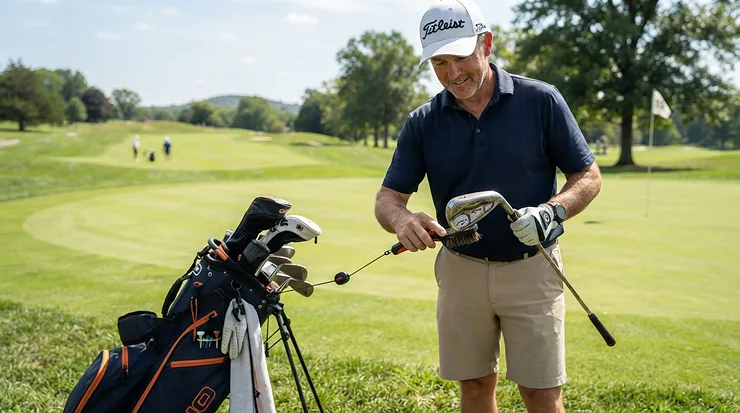
For most golfers, the smartest buy among golf club brushes is a nylon-faced model that hangs off the bag, because a brush you can grab in two seconds gets used and a fancier one that lives in the trunk does not.
The stakes are bigger than they look. In a launch-monitor test by Australian Golf Digest, a 60-degree wedge averaged just over 10,500 rpm from a clean face and about 5,759 rpm after a divot with no brushing. Five shots per condition is a small sample, yet the gap is hard to wave away.
This 2027 shortlist matches five brushes to five kinds of golfers instead of crowning one winner. The findings lean on editor roundups from GOLF and Golf Monthly, a Team Titleist forum thread, club-maker care notes and retailer review pages, so you get what others measured and reported, not a promise about how a given bristle will feel in your hand. Prices are ranges taken from those pages; check Amazon.com for today’s number.
Bristles, water, attachment, size: what really separates golf brushes
Four design choices decide whether a brush earns its spot on your bag. They also explain why the picks further down look so different from one another.
Nylon, brass, or both
Bristle material is where opinions split hardest. GOLF’s roundup says brass brushes aren’t bad for clubs, yet it prefers a head that mixes brass and nylon over all-brass, and it steers softer forged irons toward nylon. Golf Monthly’s five picks include three that pair nylon with metal, and it faults two nylon-only models, a Callaway and an Izzo, for missing firmer bristles.
Owners are less relaxed than editors. In a Team Titleist forum thread of 14 posts, roughly seven members avoid metal on their clubs, three use it, and the rest rely on cloths, soapy water or nylon. The worries are scratched faces on forged irons and rust; one member put it as “Nothing metal on metal for me.” Another reports using small wire brushes on iron grooves for more than 20 years without trouble. That is a handful of opinions, not a study, but the lean toward nylon is clear.
Club makers sit on the cautious side too. In the same forum, Titleist consumer support recommends a damp cloth and a soft brush, a toothbrush or plastic-bristle type, for modern multi-material irons, and advises against soaking them. A Vokey product specialist adds a medium-soft brush with light soap and warm water for wedges.
Water in the handle
A reservoir lets you dampen the bristles without a towel. The Grooveit Brush has a hollow handle that holds enough for two to three rounds according to GOLF, and about 36 holes according to Golfers Authority, which puts a refill at roughly 30 seconds. The same reviewer flags the cost: it is bulkier than a plain brush and needs topping up. A damp brush is a lighter touch than the bucket soak Titleist cautions against, though that is reasoning from the advice, not something the maker tested.
Cord, magnet or carabiner
How the brush attaches decides whether you reach for it. Golf Monthly likes the snap-back cord on the PGA Tour Deluxe but says its bristles bend easily, and it calls the groove cleaner on the Masters 3-In-One tiny and easy to lose. GOLF reports that some users found the carabiner and groove cleaner on a budget retractable less durable than they wanted. Magnetic attachment, used by both the Grooveit Brush and the Grooveit Mini G Brush below, avoids cords altogether.
Size and the groove spike
Bigger heads clean more per stroke and are harder to carry. A retractable spike is safer than an exposed one, according to Golf Monthly’s reviewer, and one Golf Galaxy shopper misses having any prong at all. Which camp you fall into depends on whether you play wedges with deep, packed grooves or just want grass off a face.
What golf club brushes reviews agree on, and where the evidence thins out
Editors rarely agree on the best golf brushes. GOLF names the Grooveit Brush its staff favorite; Golf Monthly’s five picks do not include it at all, while the Champkey Pro Retractable Golf Club Brush appears on both lists. That overlap is worth noticing, because it is the only pick here that two outlets independently placed near the top.
Ratings deserve the same caution. Even among top rated golf club brushes, scores come from small pools: the Callaway Dual-Sided Club Brush shows 4.0 from 25 reviews on Golf Galaxy, with some marked as incentivized. GOLF frames its picks around features such as bristle composition, retractable cords and groove cleaners rather than a lab protocol, while Golf Monthly says its writers test accessories outdoors on courses.
The one scored head-to-head in the sources is MyGolfSpy’s 2017 club cleaner test, which weighted cleaning ability at 40 points, ease of use at 30, durability at 20 and size at 10. The Frogger Brush Pro won at 90.25, ahead of the Groove Caddy at 88, and the Groove Caddy ranked first for durability. Testers also favored cleaners that offered more than one way to clean. None of those models is in the lineup below, and the test is nine years old, so use it for its method, not its verdict.
So the best golf club brushes are the ones that match how your bag is carried and how dirty your grooves get. That is how the five below are sorted.
Five golfers, five brushes
Every brush here appears in at least one roundup of the best golf club cleaning brushes. The profiles are hypothetical, a way to think about your own habits, and the quick map comes first.
| Brush | Bristles (as reported) | Water | How it attaches | Rough price |
|---|---|---|---|---|
| Grooveit Brush | Heavy-duty nylon (one review also mentions brass) | Yes, in the handle | Magnet and clip | Around $24 to $25 |
| Champkey Pro Retractable Golf Club Brush | Nylon and wire, two heads | None mentioned | Retractable cord and clip | Under $10 |
| Callaway Dual-Sided Club Brush | Hard and soft nylon | None mentioned | Retractable carabiner | Check the current price on Amazon.com |
| Grooveit Mini G Brush | Non-wire | No | Strong magnet | Around $20 |
| Dimple and Divot Classic Hickory Golf Brush | Extra-firm nylon | None mentioned | Paracord tether and snap | Around $45 |
In this lineup, only the Champkey Pro Retractable Golf Club Brush combines two brush heads with a retractable groove cleaner, and only the Grooveit Brush carries its own water. The price spread is wide, yet every option does the same core job, which is why attachment and size matter more than headline features.
1. Grooveit Brush — water in the handle, magnet on the bag
A golfer who plays dewy mornings or soft fairways and wants the mud off before the next shot is the hypothetical buyer here. The Grooveit Brush carries its water in a hollow handle, and a pump pushes it to the bristles, so the face gets damp without a towel dunk. A rare-earth magnet in rubber grabs any metal part of the bag; the maker claims it holds 5 pounds, and the Golfers Authority reviewer found it stayed put in 25 mph winds. The handle runs 7.5 inches, which gives leverage on dried mud.
Bristle details conflict. GOLF lists heavy-duty nylon backed by a 3-year replacement warranty, and Golfers Authority says a worn head is replaced free if you send it back. That same review’s introduction describes a brass-and-nylon mix, while the rest of it mentions only nylon, so the product label should settle it before you assume either.
Pros:
- ✅ Water reservoir lasts two to three rounds
- ✅ Magnet attaches to any metal on the bag
- ✅ Replacement-head warranty on the bristles
Cons:
- ❌ Bulky, and a poor fit on some bags
- ❌ Needs refilling
- ❌ Pricey next to plain brushes
The price lands around $24 to $25 across GOLF and Golfers Authority. GOLF’s staff made it their favorite and the same piece still calls it expensive next to the budget options below.
Check the current listing for the Grooveit Brush on Amazon.com.
2. Champkey Pro Retractable Golf Club Brush — oversized heads for under ten dollars
Under $10 is where the Champkey Pro Retractable Golf Club Brush lives, and both GOLF and Golf Monthly still put it on their lists. It carries nylon and wire bristles on two oversized heads, a retractable groove cleaner, a rubber grip and a bag clip, and it comes in four colors. GOLF’s testers found the grip comfortable and the double head useful on shoes. Golf Monthly credits the retractable groove cleaner as safer than many rivals’ designs.
Pros:
- ✅ Two oversized heads
- ✅ Retractable groove cleaner
- ✅ Comfortable rubber grip
Cons:
- ❌ Bulkier than most competing brushes
- ❌ Metal bristles can snag towels
- ❌ Awkward on the side of some bags
Two outlets flagging the same size complaint makes it a consensus, not a one-off. The wire half is the part to use sparingly on soft forged faces, since GOLF itself points those clubs toward nylon. At under $10, it also sits inside the $5 to $10 range Australian Golf Digest suggests a bag-clipped groove brush should cost.
See the Champkey Pro Retractable Golf Club Brush on Amazon.com.
3. Callaway Dual-Sided Club Brush — two nylon sides, no metal
Weak bristles are the most repeated complaint on the Golf Galaxy page for the Callaway Dual-Sided Club Brush, which shows 4.0 from 25 reviews and 88 percent recommending it. Several reviewers call the bristles too soft for real cleaning, one misses a metal prong for grooves, and a few see it as a shoe brush more than a club brush. Fans like the retractable carabiner and the easy handling, and one reviewer bought it as a gift.
The listing describes hard and soft nylon sides with no metal. Golf Monthly’s write-up of a Callaway cleaning brush agrees that it lacks firmer metal bristles but praises how easily it attaches and works, and The Manual describes a Callaway club brush with a phosphorus-bronze-and-nylon head. Callaway sells several brushes that are not interchangeable, so match the exact model number on the Amazon listing to the one described here.
For owners of soft forged irons who want metal kept off their faces, an all-nylon head fits the cautious advice from Titleist; the trade-off is that packed grooves may take more patience. The Golf Galaxy page shows no price, so check the current price on Amazon.com.
4. Grooveit Mini G Brush — pocket-size with a strong magnet
At pocket scale, the Grooveit Mini G Brush trades capacity for convenience, a fair match for a walker with a slim carry bag. GOLF named it best pocket-size: strong magnets hold it to a carabiner or belt, the non-wire bristles are described as durable, and there is no water reservoir. A GOLF writer who calls it a favorite accessory says it hangs from the bag without getting in the way, snaps back into place after use, and clears grass and dirt from the face mid-round without fiddling with a wire or chain.
GOLF’s roundup rates it a notch below the full-size Grooveit Brush and puts it around $20. That rundown doesn’t describe a groove spike or a retractable cord. Around $20, it costs only a few dollars less than the full-size Grooveit Brush.
See the Grooveit Mini G Brush on Amazon.com.
5. Dimple and Divot Classic Hickory Golf Brush — hickory handle, extra-firm nylon
A hickory handle and a paracord tether make the Dimple and Divot Classic Hickory Golf Brush the odd one in this lineup, and GOLF filed it under best boutique. The body is hickory with a light varnish, the bristles are extra-firm nylon, the finish resists UV, and a gunmetal snap clips it to the bag. A retailer listing gives the handle as 7 inches with a 6-inch tether and describes it as handmade in the USA.
GOLF’s drawbacks are plain: it is pricey, not retractable, and has no groove cleaner. Its stated audience is the walker with a one-strap bag. Golf Digest describes it as an upscale swap for the plastic wire brush many golfers carry, and at around $45 it suits a gift or a bag that deserves matching gear. One retailer lists the retractable-tether Pro versions higher, between $60 and $70.
Where a brush does damage: finishes, bag pockets and soaked heads
Most brush mishaps come from pairing the wrong bristle with the wrong club, not from the brush itself.
Finish is the first trap. A Vokey product specialist on Team Titleist notes that SM6 Raw and Jet Black wedges are un-chromed and designed to rust, and advises against removing that rust with abrasives, chemicals or buffing wheels. A wire brush is exactly that kind of abrasive for a finish that is meant to wear in a particular way. Soaking is the second: Titleist’s support specialist advises against running water over or bucket-soaking modern multi-material irons.
Bag fabric is the third. One Team Titleist member reports that a metal-bristled brush shredded a bag pocket. Wear is the last one: the Vokey blog notes that heavily worn grooves can’t be restored by cleaning, so a brush keeps wedges performing but doesn’t rebuild them.
Golf Monthly’s roundup also points out that clubs with mud-clogged grooves produce less spin and weaker contact, which is the case for brushing between shots in the first place.
Brass, water, shoes and spin: brush questions answered
❓ Is it safe to use a brass or wire brush on golf clubs?
❓ Do I need a brush with a water reservoir?
❓ How much does a dirty clubface really cut spin?
❓ How often should you brush your grooves?
❓ Can the same brush clean golf shoes too?
Pick by how you carry your bag
Start with the carry. A cart bag with room can host the Grooveit Brush if wet fairways are your norm, or the Champkey Pro Retractable Golf Club Brush if you want two big heads for under $10. A walker with a slim stand bag will likely prefer the Grooveit Mini G Brush, or the Dimple and Divot Classic Hickory Golf Brush when the brush doubles as a gift. The Callaway Dual-Sided Club Brush fits golfers who want soft nylon on soft irons and can live with gentler cleaning.
The decision rule is short: nylon on the face, a strong way to stay attached, and a size you will actually carry. Whichever of these golf club brushes you pick, the best golf brushes are the ones clipped on and used after every wedge shot. Take a look at the current listings on Amazon.com.
Recommended for You
- Ben Hogan Golf Shirts: 7 Best Performance Picks for Every Golfer
- Golf Quiet: 7 Revolutionary Silent Solutions Every Golfer Needs in 2025
- Arnold Palmer Golf Hat: 7 Best Options for Every Golfer in 2025
Disclaimer: This post contains affiliate links. As an Amazon Associate, I earn from qualifying purchases made through these links, at no additional cost to you.
Clean grooves are a two-second habit, so clip a brush to your bag before the next round.