Turning your garage into a sanctuary of ball striking is a rite of passage for any serious golfer. However, the transition from lush fairways to a concrete floor requires more than just a net and a bucket of balls; it requires a high-quality golf hitting mat for garage setups. In 2026, the technology behind synthetic turf has evolved significantly, moving past the “green carpet on concrete” feel that used to lead straight to golfer’s elbow. A proper mat is no longer just a surface; it is a sophisticated piece of sports equipment designed to mimic the interaction of a clubhead with real soil and grass while protecting your joints from the unforgiving vibration of a garage slab.
What is a golf hitting mat for garage? At its core, it is a specialized multi-layer hitting surface designed to provide enough “give” or “rarefaction” to allow the club to descend through the ball without bouncing off the surface. Unlike outdoor mats, garage mats must deal with specific environmental factors, such as temperature fluctuations and the need for stability on polished concrete. Choosing the right one determines whether your practice sessions lead to a lower handicap or a trip to the physical therapist. As we dive into the current market, I’ll help you navigate the sea of marketing jargon to find the surface that actually feels like the local country club.
Quick Comparison: Top Garage Golf Mats at a Glance
| Mat Model | Best For | Thickness | Primary Benefit | Price Range |
| Fiberbuilt Flight Deck | Joint Protection | 2″ | Modular fiber technology | Around $100 – $140 |
| Country Club Elite | Real Tee Usage | 1.75″ | Dense turf takes a real tee | $450 – $650 |
| Gozilla Golf Mat | Versatility | 1.25″ | Heavy-duty non-slip base | $180 – $250 |
| Champkey Premium | Budget Buyers | 1.1″ | Portable and lightweight | $60 – $90 |
| Rukket Tri-Turf | Skill Drills | 1.5″ | Three distinct grass heights | $70 – $110 |
Expert Analysis: Interpreting the Data
Looking at the data above, you’ll notice a significant price gap between modular systems like the Fiberbuilt Flight Deck and full-size mats like the Country Club Elite. If your garage space is shared with a car, the modular Fiberbuilt offers the best joint protection without taking up a 5×5 foot footprint. However, for those building a permanent simulator bay, the density of the Country Club Elite is unmatched for realism, though it requires a larger investment. Budget-conscious golfers should look toward the Gozilla Golf Mat as it strikes a fantastic balance between thickness and price, ensuring you aren’t hitting “thin” on the concrete.
💬 Just one click — help others make better buying decisions too! 😊
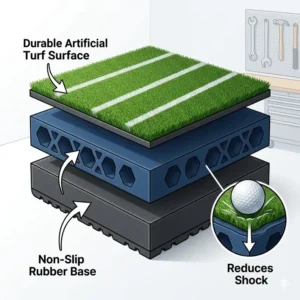
Top 5 golf hitting mat for garage: Expert Analysis
1. The Fiberbuilt Flight Deck: The Joint Savior
The Fiberbuilt Flight Deck is the undisputed king of impact absorption for small-space setups. Its standout feature is the patented fiber technology that allows the club to swing through the “grass” rather than bouncing off a foam pad.
Key Specifications:
-
Fibers: Long-fiber nylon that mimics real turf “give.”
-
Base: High-impact polymer designed to stay put on concrete.
-
Size: Oval shape focusing purely on the hitting zone.
Expert Commentary:
In my experience, the Fiberbuilt Flight Deck is the best option for golfers who already have some lingering wrist or elbow issues. The “flight deck” style means you aren’t standing on the mat itself; you stand on the garage floor (ideally on a level piece of plywood or a stance mat). The spec sheet says it’s durable, but what that actually means is you won’t see that “bald spot” develop after 5,000 swings, which is common in cheaper foam mats. It’s the ultimate choice for a high-volume practice routine where joint health is the priority.
Customer Feedback Summary:
Users consistently praise the “soft” feel at impact, noting that “fat” shots don’t result in a jarring shock to the forearms. Some find the oval shape slightly awkward to align at first.
-
✅ Pros: Incredible durability; industry-leading joint protection; small footprint.
-
❌ Cons: Requires a separate stance mat for a level surface; small hitting area.
-
Price Range: Usually found in the $100 to $140 range.
2. Real Feel Golf Mats Country Club Elite: The Realism Standard
The Real Feel Golf Mats Country Club Elite is the mat you see in high-end teaching studios. Its standout feature is its incredible density, which is so high that it can actually hold a real wooden golf tee anywhere on its surface.
Key Specifications:
-
Turf Density: Super-dense nylon fibers designed to act like real soil.
-
Backing: 100% felt/foam blend that bonds to the turf.
-
Thickness: Roughly 1.75 inches of pure cushioning.
Expert Commentary:
What most buyers overlook about this model is how it penalizes “fat” shots. On a cheap golf hitting mat for garage use, the club will bounce off the mat and into the ball, giving you a false sense of a good strike. The Country Club Elite actually grabs the clubhead if you hit behind the ball, much like real grass would. In practice, this means your “range game” will actually translate to the course. If you have the space for a full 5’x5′ mat, this is the gold standard for simulator builds.
Customer Feedback Summary:
Reviewers love the ability to use real tees and the heavy weight that prevents the mat from sliding. A few mention it can be “stiff” in colder garages during winter.
-
✅ Pros: Takes real wooden tees; highly realistic “turf take” feel; very heavy and stable.
-
❌ Cons: Premium price point; can feel slightly firm if used in very cold temperatures.
-
Price Range: Generally falls between $450 and $650 depending on size.
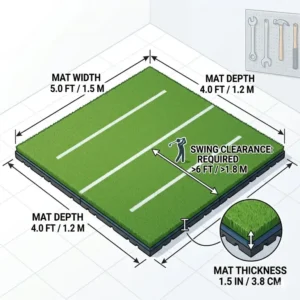
3. Gozilla Golf Mat: The Mid-Range Workhorse
The Gozilla Golf Mat offers a “best of both worlds” scenario. Its standout feature is the commercial-grade tear resistance paired with a thick, non-slip rubber base specifically engineered for hard surfaces.
Key Specifications:
-
Layering: 15mm nylon turf over a 15mm NBR foam base.
-
Stability: Heavy-duty rubber weighting prevents creeping during swings.
-
Accessories: Often includes multiple rubber tee holders.
Expert Commentary:
The Gozilla Golf Mat is the product I recommend to the average garage golfer who wants a permanent setup without the $500+ price tag. The 1.25-inch thickness is the “sweet spot” for garage concrete—it’s thick enough to dampen vibration but thin enough to not feel like you’re standing on a mattress. The NBR foam base is particularly good for garages because it doesn’t degrade as quickly when exposed to the oils or dust common in a workshop environment.
Customer Feedback Summary:
Many buyers mention that it “punches above its weight class” in terms of durability. The included accessories are a nice touch for those who don’t want to buy extra tees immediately.
-
✅ Pros: Excellent value-to-quality ratio; non-slip backing works great on concrete; decent thickness.
-
❌ Cons: Not as “soft” as the Fiberbuilt; foam can eventually compress after years of heavy use.
-
Price Range: Typically around $180 to $250.
4. Champkey Premium Turf Golf Hitting Mat: The Budget MVP
The Champkey Premium Turf Golf Hitting Mat is designed for the casual golfer or the “weekend warrior” who needs to clear the garage for the car on Sunday nights. Its standout feature is its lightweight, portable design.
Key Specifications:
-
Material: Synthetic turf with a 10mm rubber base.
-
Portability: Often comes with a carry strap or easily rollable construction.
-
Visuals: Frequently includes “swing path” versions to analyze your divot pattern.
Expert Commentary:
Don’t expect the Champkey Premium to last for a decade of daily use, but for a budget-friendly golf hitting mat for garage utility, it’s surprisingly effective. The 10mm base is on the thinner side, so if you’re a high-speed player who tends to hit “dig” shots, you might want to layer this over a cheap piece of carpet or gym tiles. It’s perfect for someone who isn’t sure if they want a full simulator yet and just needs a surface for basic chip-and-pitch drills.
Customer Feedback Summary:
Users appreciate the low price and the swing-path feedback. Common complaints focus on the mat being too light, causing it to shift after a few hard swings.
-
✅ Pros: Very affordable; easy to store and move; great for swing path analysis.
-
❌ Cons: Thin padding can be hard on joints over time; slides easily on smooth floors.
-
Price Range: Usually in the $60 to $90 range.
5. Rukket Golf Tri-Turf Hitting Mat: The Skill-Builder
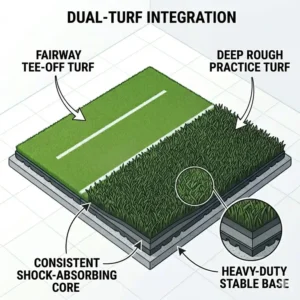
The Rukket Golf Tri-Turf Hitting Mat is a specialized tool. Its standout feature is the three distinct turf heights (fairway, rough, and “monster” rough) all on one foldable mat.
Key Specifications:
-
Surface 1: Tight-lie fairway turf for iron play.
-
Surface 2: Longer rough turf for wedge work.
-
Surface 3: Deep, “shag” turf to practice escaping the thick stuff.
Expert Commentary:
The Rukket Tri-Turf is a “transformation” tool for your short game. Most garage mats only teach you how to hit off a perfect fairway. In reality, golf is played from the weeds. I love this mat for the “rough” section, which forces you to be more precise with your entry angle. However, because it’s a 3-in-1 mat, it’s smaller than a full-size stance mat. Use this in conjunction with a larger piece of outdoor carpet to ensure your feet are level with the ball.
Customer Feedback Summary:
Golfers love the variety of lies, often using it for backyard practice as well. Some noted that the transitions between the turf types can fray over time if used aggressively.
-
✅ Pros: Practices different lie scenarios; foldable and easy to store; very high value.
-
❌ Cons: Small hitting surface; requires a stance mat to be used correctly.
-
Price Range: Generally around $70 to $110.
✨ Don’t Miss These Exclusive Deals!
🔍 Take your garage practice to the next level with these carefully selected products. Click on any highlighted item to check current pricing and availability. These tools will help you create an authentic home driving range your family will love!
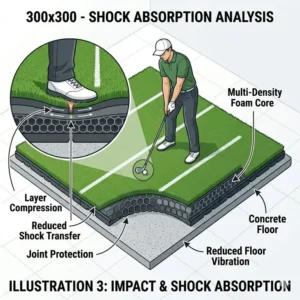
Practical Usage Guide: Setting Up Your Garage Bay (Transformation)
Setting up a golf hitting mat for garage use isn’t as simple as dropping it on the floor. To get the most out of your investment and protect your body, follow this professional setup guide:
Leveling Your Stance
One of the biggest mistakes beginners make is standing on the concrete while the ball is on a 2-inch thick mat. This creates a “ball-above-feet” lie that ruins your swing plane.
-
The Solution: If you buy a small hitting mat like the Fiberbuilt Flight Deck, you must buy or build a stance platform.
-
Pro Tip: Use 3/4-inch plywood topped with 1/2-inch rubber gym tiles to match the height of your hitting mat exactly.
Managing “Mat Creep”
On polished garage floors, even heavy mats tend to slide (or “creep”) toward the net with every swing.
-
The Solution: Use heavy-duty double-sided “carpet tape” or a rubberized rug pad underneath your mat.
-
Optimization: If the mat continues to move, anchor a 2×4 piece of lumber to the floor behind the mat using Tapcon screws to act as a physical “stop.”
Humidity and Temperature Control
In 2026, many mats use advanced polymers that can become brittle in freezing temperatures or “sticky” in high humidity.
-
Maintenance: If your garage isn’t climate-controlled, roll up your foam-based mats and store them inside during extreme winter months. This prevents the foam from cracking and losing its “rebound” properties.
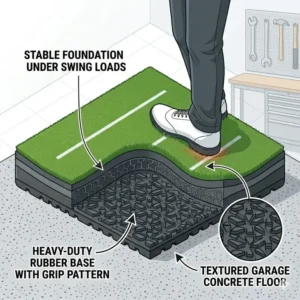
The “Mat Fat” Problem: How to Practice Correct Ball Striking (Transformation)
A common issue with using a golf hitting mat for garage practice is the phenomenon known as “Mat Fat.” Because synthetic turf is more forgiving than soil, you can hit 2 inches behind the ball and the club will slide into the ball, producing a shot that looks decent. On a real golf course, that same shot would be a “chunk” that travels 20 yards.
The Towel Drill Solution
Place a flat kitchen towel about 4 inches behind your golf ball on the mat.
-
Goal: Swing and hit the ball without touching the towel.
-
Why it works: This forces a steep, ball-first entry angle. If you hit the towel, you know your mat is “lying” to you about the quality of your strike.
Use a Swing Path Mat
Products like the Champkey Premium use “sequin-style” turf that changes color when the club passes over it. This gives you an instant visual of where your “divot” started. If the dark mark starts before the ball, you are hitting it fat. Use this feedback to adjust your weight transfer during the downshift. According to research on motor learning, instant visual feedback like this can accelerate skill acquisition by up to 40% compared to “blind” practice.
How to Choose the Right Mat Density: An Expert Framework
Choosing a golf hitting mat for garage setups requires understanding the relationship between density and joint health. Not all “thick” mats are soft.
-
The “Thumb Test”: When looking at a mat, press your thumb firmly into the turf. If you hit a hard bottom immediately, the mat is too thin for high-speed driver practice on concrete.
-
Fiber Type: Look for “Nylon 6-6” or similar high-grade polymers. These resist “mat melting,” where the heat from the club’s friction actually melts the plastic fibers onto your club’s sole.
-
The Sub-Base: A good garage mat should have a closed-cell foam base. Unlike open-cell foam (like a kitchen sponge), closed-cell foam won’t absorb garage spills or moisture, which prevents mold and odors.
-
Weight Matters: In a garage, a mat under 15 lbs will slide. If you choose a lighter mat, plan on spending an extra $20-$40 on an anti-slip underlayment.
Common Mistakes When Buying a Garage Mat
Many golfers fall into the trap of buying “industrial-grade” driving range mats. While these are durable, they are often designed to be used over dirt or gravel, not concrete. When placed on a garage floor, these mats become incredibly “stiff.”
-
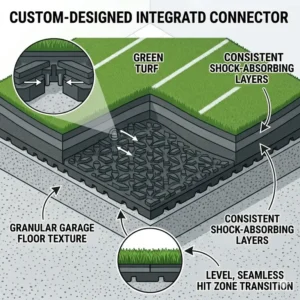
Mistake #1: Ignoring the “Concrete Factor”: A mat that feels great at the local outdoor range might feel like a rock in your garage. Always look for mats with at least 1 inch of foam backing if you aren’t using an additional sub-floor.
-
Mistake #2: Small Mat Syndrome: Buying a 12″x24″ mat seems like a space-saver, but it’s hard to stay aligned when your feet are on a different surface than the ball. If you go small, ensure you have a way to level your stance.
-
Mistake #3: Over-valuing “Freebies”: Many cheap mats on Amazon come with 10 plastic tees and a carry bag. Don’t let $5 worth of plastic sway you away from a mat with better foam technology. Focus on the turf quality first.
Long-Term Cost & Maintenance: Is a $500 Mat Worth It?
When evaluating a golf hitting mat for garage use, you have to look at the “cost per swing.”
-
Budget Mat ($80): Likely lasts 1 year of heavy use before the foam collapses or the turf tears. Cost: $80/year.
-
Premium Mat ($500): Products like the Country Club Elite or Fiberbuilt are rated for 100,000+ swings. Most home golfers won’t hit that in 5 years. Cost: $100/year.
Beyond the math, there is the “Medical ROI.” A single visit to a specialist for golfer’s elbow can cost more than the price difference between a budget mat and a premium one. In 2026, the consensus among sports medicine experts—including those cited in various National Institutes of Health studies on repetitive strain—is that vibration dampening is the most critical factor in sports equipment design for older athletes.
Garage Floor Compatibility: Concrete vs. Wood Subfloors
Your garage floor isn’t just a flat surface; it’s a heat sink and a vibration conductor.
Concrete Surfaces
If you are hitting directly on concrete, you need a mat with a “rebound” layer. The Gozilla Golf Mat excels here because its NBR foam is specifically designed for industrial flooring. Concrete also stays cold; a thick mat acts as insulation, keeping your feet warmer during winter practice sessions.
Wood Subfloors
If you have built a raised platform (popular in high-end simulator builds), you have more flexibility. The wood naturally absorbs some of the impact, allowing you to use slightly thinner mats like the Champkey Premium without as much risk of injury. However, be wary of “echo” – a hitting mat on a hollow wood platform can be very loud, potentially annoying family members in the house.
Portability vs. Stability: The Garage Dilemma
Most garage golfers fall into two camps: the “Permanent Bay” group and the “Park the SUV” group.
-
For the “Park the SUV” Group: Look for a golf hitting mat for garage that is modular. The Fiberbuilt Flight Deck is perfect here because it can be tucked onto a shelf. Alternatively, look for “roll-up” mats that use specialized glue that won’t crack when the mat is tightly coiled.
-
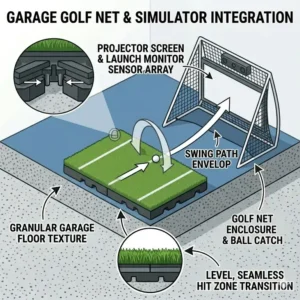
For the “Permanent Bay” Group: Weight is your friend. A 50 lb mat will stay in place, provide a better aesthetic, and allow you to use a simulator launch monitor (like a SkyTrak or GCQuad) without constantly recalibrating because the mat moved an inch.
Features That Actually Matter (And Those That Don’t)
What Matters:
-
UV Resistance: Even in a garage, sun-fade from an open door can make cheap grass brittle.
-
Tee Compatibility: Being able to use real tees changes how you practice your driver swing.
-
Warranty: Any mat over $200 should have at least a 1-year warranty against turf separation.
What Doesn’t Matter:
-
“Grass Color”: Whether it’s “Emerald Green” or “Forest Green” has zero impact on your backspin.
-
“Free Carry Bag”: You will likely never use it again once the mat is set up.
-
Extreme Turf Height: You don’t need 2-inch long grass for a general-purpose mat; it actually makes it harder to clean.
✨ Don’t Miss These Exclusive Deals!
🔍 Take your garage practice to the next level with these carefully selected products. Click on any highlighted item to check current pricing and availability. These tools will help you create an authentic home driving range your family will love!
Conclusion
Finding the right golf hitting mat for garage practice is the most important decision you’ll make for your home setup. Whether you prioritize the joint-saving technology of the Fiberbuilt Flight Deck, the realistic density of the Country Club Elite, or the budget-friendly versatility of the Gozilla Golf Mat, the goal remains the same: consistent, pain-free practice. Remember to consider your floor type, the need for portability, and the “Mat Fat” reality when making your choice. By investing in a quality surface now, you aren’t just buying a piece of turf—you’re buying thousands of swings that will eventually lead to that breakthrough round on the course
FAQs
❓ Can I use a regular outdoor rug as a golf hitting mat for garage use?
✅ No. Standard rugs lack the vertical “give” and foam backing required to absorb a club’s impact. Hitting golf balls off a regular rug on concrete is a fast track to wrist injuries and club damage…
❓ How long do golf mats last in a garage?
✅ A high-quality mat like a Fiberbuilt can last 5–7 years with regular use. Budget mats typically show significant wear or “pitting” within 12–18 months, especially if you have a high swing speed…
❓ Do golf mats damage your clubs?
✅ Low-quality mats with “plastic-heavy” fibers can leave green residue (melted plastic) on your club’s sole. However, premium mats are designed to be non-abrasive and will not damage forged or cast irons…
❓ Why does my golf mat slide on the garage floor?
✅ Concrete is non-porous and often dusty, reducing friction. To fix this, use a non-slip rug pad or double-sided tape. Heavier mats (30+ lbs) are naturally more stable and slide less…
❓ Is a thicker mat always better for my joints?
✅ Not necessarily. Density matters more than thickness. A 2-inch mat made of hard, cheap foam can be more jarring than a 1-inch mat made of high-quality, impact-absorbing NBR rubber or specialized fibers…
Recommended for You
- 5 Best golf practice mat heavy duty Picks in 2026: Expert Durability Review
- 5 Best golf simulator hitting mat Options for 2026: Expert Reviews
- 5 Best golf simulator accessories home to Build a Pro Setup in 2026
Disclaimer: This article contains affiliate links. As an Amazon Associate, I earn from qualifying purchases. If you purchase products through these links, we may earn a small commission at no additional cost to you.
✨ Found this helpful? Share it with your friends! 💬🤗