Have you ever stood on the first tee, watching a player calmly stripe a drive 290 yards right down the middle, followed by a crisp iron shot that sticks to the green like glue? You whisper to your buddy, “Man, that guy must be a stick.” In the world of golf, there is a specific gold standard that every amateur player dreams of reaching, yet only a tiny fraction ever achieve. We are talking about the elusive zero handicap. But what is a scratch golfer, exactly? Is it just about shooting par every time, or is there a deeper mathematical wizardry involved?
✨Was this helpful? Spread the word! 🚀
In this massive guide, I am going to peel back the curtain on the life of a scratch player. I have spent years hanging around clubhouses and analyzing shot data, and I can tell you that the difference between a mid-handicapper and a scratch player isn’t just luck—it is a combination of specialized gear, mental toughness, and a statistical edge that would make a Wall Street analyst blush. Whether you are looking for a scratch golfer definition or you want to know how you can shave ten strokes off your game by 2026, you have come to the right place.
The Great Divide: Scratch vs. The Rest of Us
Before we dive into the nitty-gritty of Course Ratings and Slope, let’s look at how a scratch player compares to the average weekend warrior.
| Feature | Scratch Player | Bogey Golfer (18-20 HDCP) | Professional (PGA Tour) |
| Average Drive | 250-285 yards | 190-210 yards | 300+ yards |
| GIR (Greens in Regulation) | 10-12 per round | 3-5 per round | 13-15 per round |
| Putts per Round | 29-31 | 34-38 | 27-29 |
| Scrambling % | 50% – 60% | 10% – 20% | 65% + |
| Mental Recovery | Excellent | Prone to “Blow-up” holes | Elite |
Defining the Legend: Scratch Golfer Definition
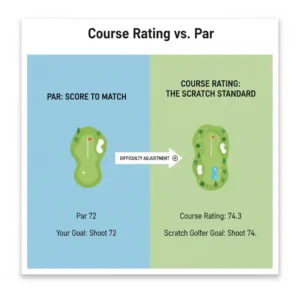
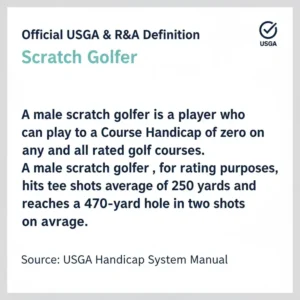
To get technical, the official scratch golfer definition according to the United States Golf Association (USGA) is a player who can play to a Course Handicap of zero on any and all rated golf courses. Essentially, this person is expected to shoot even par on a course of average difficulty. However, it is important to remember that a handicap is a measure of potential, not an average. A scratch player doesn’t shoot 72 every single time they step on the grass; rather, they have the capability to shoot 72 on a course where the rating is approximately 72.0.
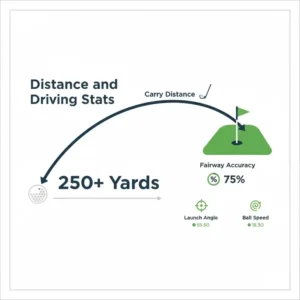
According to the USGA Handicap System, a scratch player is someone who can hit the ball consistently. For men, this means an average drive of 250 yards and the ability to reach a 470-yard hole in two shots. For women, it’s a 210-yard drive and reaching a 400-yard hole in two. It’s not just about power, though. It’s about the ability to navigate hazards and minimize mistakes. When someone asks “what is a scratch golfer,” they are really asking about the pinnacle of amateur consistency.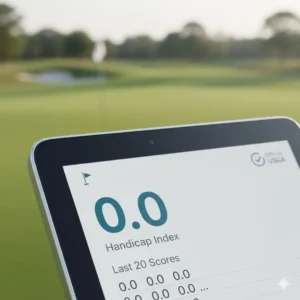
Top 7 Essential Gear for Scratch Players: Expert Analysis
If you want to play like a zero handicap player, you need to use the tools that provide the precision they require. I have researched the top products currently dominating the market in 2026 that help elites maintain their status.
1. Titleist Pro V1 Golf Balls
The Titleist Pro V1 Golf Balls remain the undisputed king for anyone serious about their game. For a scratch player, the ball is the only piece of equipment used on every single shot. The 2026 model features an updated high-gradient core technology that reduces long-game spin while maintaining that “drop-and-stop” control around the green.
-
Technical Specifications: 3-piece construction, Mid-flight trajectory, High short-game spin, Urethane elastomer cover.
-
Customer Review Analysis: Users consistently praise the “soft feel” and “predictable flight.” Many experts note that while they are pricey, the consistency in distance is unmatched.
-
Warranty Information: Standard manufacturer defect warranty (usually 1 year).
-
Professional Applications: Used by over 70% of professional tours globally.
-
Pros: Incredible greenside control; extremely durable for a premium ball.
-
Cons: High cost per dozen; can be easy to lose for high handicappers.
2. Bushnell Pro X3+ Laser Rangefinder
Precision is everything for a scratch player. The Bushnell Pro X3+ Laser Rangefinder is the most advanced optics tool available. It doesn’t just give you distance; it accounts for slope, temperature, and barometric pressure to give you a “play-as” distance.
-
Technical Specifications: 7x magnification, Dual Display tech, Slope with Elements, 600-yard range to flags.
-
Customer Review Analysis: Reviewers love the “Lock-on” vibration and the clarity of the lens. It’s cited as the most reliable unit in the wind.
-
Warranty Information: 2-year limited warranty.
-
Professional Applications: Essential for caddies and players during practice rounds to map courses.
-
Pros: Most accurate on the market; “Slope-Switch” makes it tournament-legal.
-
Cons: Heavy compared to budget models; very expensive.
3. TaylorMade P7MB Iron Set
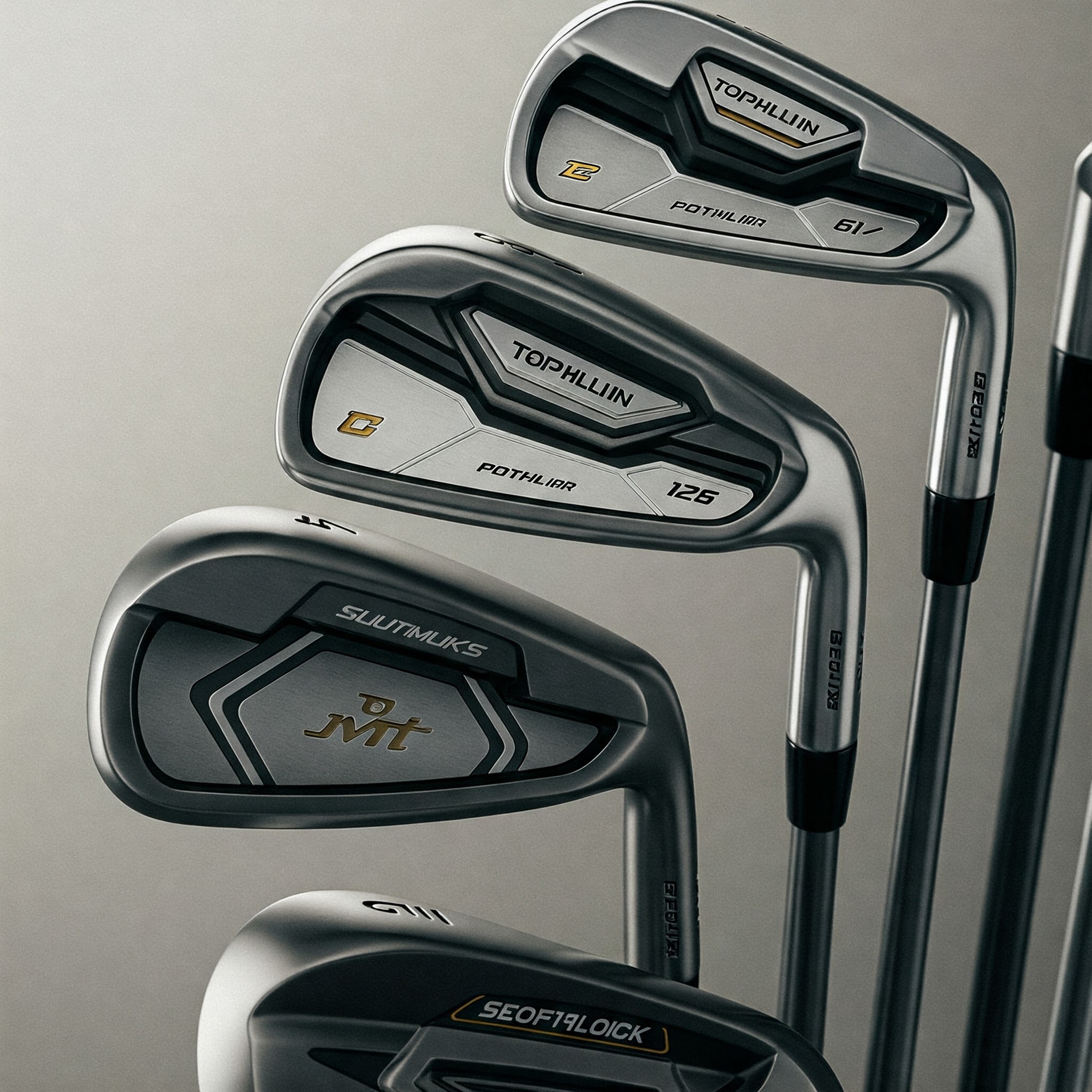
A scratch player usually prefers “blades” for the feedback and workability. The TaylorMade P7MB Iron Set is designed for the purist. These are thin, forged irons that offer zero forgiveness but maximum control.
-
Technical Specifications: 1025 carbon steel, Machine-milled face, Thin top line, Minimal offset.
-
Customer Review Analysis: Players describe the feel as “buttery.” However, they warn that if you don’t hit the center, you will lose significant distance.
-
Warranty Information: 2-year limited warranty on clubs.
-
Professional Applications: Targeted at Low-HDCP amateurs and Tour professionals.
-
Pros: Ultimate shot-shaping ability; sleek aesthetic.
-
Cons: Very difficult for mid-handicappers to hit; small “sweet spot.”
4. Garmin Approach S70 Golf Watch
For the data-driven scratch player, the Garmin Approach S70 Golf Watch is a wrist-mounted caddie. It features a stunning AMOLED display and pre-loaded maps of over 43,000 courses.
-
Technical Specifications: 1.4-inch display, Multi-band GNSS, Virtual Caddie, PlaysLike Distance.
-
Customer Review Analysis: Users appreciate the “Virtual Caddie” feature which suggests clubs based on historical performance. The battery life (up to 16 days in smartwatch mode) is a huge plus.
-
Warranty Information: 1-year limited warranty.
-
Professional Applications: Excellent for tracking fitness metrics and heart rate during stressful tournament rounds.
-
Pros: Comprehensive data tracking; doubles as a high-end fitness watch.
-
Cons: Software can be complex for non-techy users.
5. Arccos Caddie Smart Sensors (Gen 3+)
You can’t manage what you don’t measure. The Arccos Caddie Smart Sensors (Gen 3+) screw into the top of your grips and track every shot automatically via GPS.
-
Technical Specifications: 14 sensors included, AI-powered GPS rangefinder, Strokes Gained Analytics.
-
Customer Review Analysis: Customers rave about the “Strokes Gained” data which tells them exactly where they are losing shots (e.g., putting vs. driving).
-
Warranty Information: 1-year warranty on sensors.
-
Professional Applications: Used by coaches to analyze player performance over time.
-
Pros: No manual input required; incredible data visualization.
-
Cons: Requires a subscription fee after the first year; sensors add slight weight to the club.
6. Callaway Jaws Raw Face Wedges
Scoring happens within 100 yards. The Callaway Jaws Raw Face Wedges are designed to rust over time on the face to increase friction and spin.
-
Technical Specifications: Tungsten-balanced weight, Raw face, Groove-in-groove technology.
-
Customer Review Analysis: Most reviews highlight the “aggressive spin” on chips and pitches. The variety of “grinds” allows players to customize for their swing.
-
Warranty Information: 2-year manufacturer warranty.
-
Professional Applications: Popular among short-game specialists on the PGA Tour.
-
Pros: Exceptional spin in wet conditions; great weight balance.
-
Cons: The “rusting” look isn’t for everyone; grooves wear down faster than plated wedges.
7. Odyssey Ai-ONE Milled T Putter
The Odyssey Ai-ONE Milled T Putter uses Artificial Intelligence to design the insert, ensuring that even off-center putts finish close to the hole.
-
Technical Specifications: 100% milled stainless steel, AI-designed titanium insert, SL 90 Stroke Lab shaft.
-
Customer Review Analysis: Users are shocked at the “forgiveness” on a milled putter. It helps maintain ball speed even on mishits.
-
Warranty Information: 2-year limited warranty.
-
Professional Applications: Widely adopted on the greens by top-tier pros for its stability.
-
Pros: Stunning premium look; extremely consistent ball speeds.
-
Cons: Very high price point for a putter.
🚀 Optimize Your Performance!
Don’t leave your game to chance. The difference between a 10-handicap and a scratch player is often the quality of information you have on the course. Invest in the right technology and watch your scores tumble. Click on our recommended products to see what’s in stock for 2026! ✨
💬 Just one click – help others make better buying decisions too!😊
Technical Specifications Matrix
| Product | Main Benefit | Best For | Tech Highlight |
| Titleist Pro V1 | Consistency | All-around performance | High-gradient core |
| Bushnell Pro X3+ | Accuracy | Course management | Slope with Elements |
| TaylorMade P7MB | Workability | Advanced ball striking | 1025 Forged Steel |
| Garmin S70 | Convenience | Real-time yardages | AMOLED Mapping |
| Arccos Sensors | Analytics | Finding weaknesses | AI Strokes Gained |
| Callaway Jaws Raw | Spin | Greenside recovery | Raw Face Friction |
| Odyssey Ai-ONE | Precision | Putting consistency | AI-Milled Insert |
The Math of the Game: Course Rating and Slope
To truly understand what is a scratch golfer, you have to understand the yardstick they are measured by. Every golf course in the US has two numbers: the Course Rating and the Slope Rating.
-
Course Rating: This is the score a scratch player is expected to shoot. If a course is rated 73.5, a scratch player is expected to shoot roughly 1.5 strokes over par.
-
Slope Rating: This measures the relative difficulty for a “bogey golfer” compared to a scratch player. The average slope is 113. A higher slope (like 145) means the course gets exponentially harder for the average joe, while the scratch player is expected to handle it better.
I remember playing a course in South Carolina with a rating of 76.2. I thought I was hot stuff shooting an 80, but for a scratch golfer, an 80 on that course might actually result in their handicap rising because they were expected to shoot a 76. It’s a harsh world at the top!
Requirements for Success: The Skill Breakdown
If you look at a golf scratch player, you’ll notice they don’t necessarily do one thing perfectly; they do everything well enough to avoid disaster. Here is a breakdown of the requirements for reaching that level.
1. Off the Tee (The Power Factor)
While you don’t need to be Bryson DeChambeau, you cannot be short. A scratch golfer definition includes the ability to hit the ball at least 250 yards. Why? Because most par 4s are designed to require a mid-to-short iron for the second shot. If you are hitting a 5-iron into every green, your chances of staying at zero are slim.
2. The “GIR” Machine
Greens in Regulation (GIR) is the most important stat. A zero handicap golfer typically hits 11 to 12 greens per round. This means they are putting for birdie 12 times. Even if they 2-putt all of them, they are hovering around par.
3. Short Game Wizardry
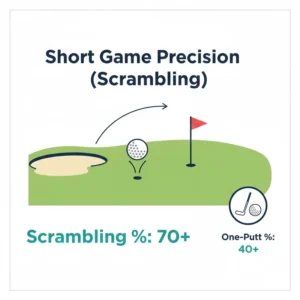
This is where the magic happens. When a scratch player misses a green (which happens about 6-7 times a round), they “scramble” or get up-and-down for par at least 50% of the time. This requires expert-level use of tools like the Callaway Jaws Raw Face Wedges to nip the ball off tight lies.
4. The “No 3-Putt” Rule
A scratch player rarely 3-putts. They are masters of lag putting. Their goal is to ensure that every first putt finishes within a 3-foot circle around the hole. Using high-MOI putters or the latest AI-driven tech like the Odyssey Ai-ONE Milled T Putter helps significantly in this department.
Performance Metrics: Comparison by Handicap
To understand how far you have to go, check out this performance metric comparison. This data is based on thousands of rounds tracked by Arccos Golf.
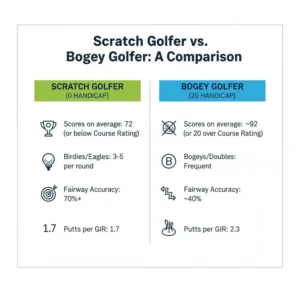
| Metric | Scratch (0) | 10 Handicap | 20 Handicap |
| Driving Accuracy | 55% | 45% | 35% |
| Average Drive Distance | 259 yards | 227 yards | 198 yards |
| GIR % | 56% | 36% | 18% |
| Putts per GIR | 1.8 | 2.0 | 2.2 |
| Birdies per Round | 2.2 | 0.8 | 0.2 |
Feature Matrix: Tech vs. Tradition
Some players believe in “feel,” while the modern scratch player embraces technology. Let’s compare the two approaches.
| Category | The “Old School” Scratch | The “Modern” Scratch Player |
| Yardage | Stepped out from bushes/sprinklers | Uses Bushnell Pro X3+ |
| Shot Tracking | Hand-written journal | Arccos Caddie Smart Sensors |
| Club Selection | Based on “gut feeling” | Data-driven from Garmin S70 |
| Balls | Whatever is on sale | Only Titleist Pro V1 |
| Practice | Hitting a bucket of balls | Launch monitor session (Trackman/GCQuad) |
How to Become a Zero Handicap Golfer: A 2026 Roadmap
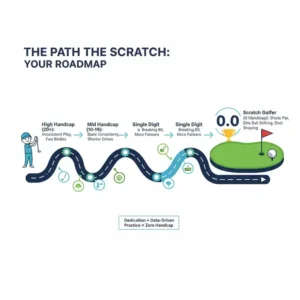
If you are currently sitting at a 10 or 15 handicap and asking yourself, “what is a scratch golfer and how do I become one?”, the path is simple but not easy.
Step 1: Fix Your “Strokes Gained”
Stop practicing your driver for two hours. According to PGA statistics, most amateur strokes are lost within 100 yards of the green. Use a system like Arccos Caddie Smart Sensors to find your “leak.” Are you missing short putts? Are you chunking chips? Fix the leak first.
Step 2: Course Management
A scratch player knows when to play boring golf. Instead of aiming at a flag tucked behind a bunker, they aim for the middle of the green. They choose the “fat” part of the fairway. They understand that a bogey is okay, but a double-bogey is a scorecard killer.
Step 3: Equipment Calibration
You cannot be a scratch player with clubs that don’t fit you. In 2026, custom fitting is more accessible than ever. Ensure your lie angles, shaft flex, and even your golf ball (like moving to the Titleist Pro V1) are optimized for your swing speed.
Step 4: Mental Resilience
I once saw a scratch player shank a ball into the woods. Instead of throwing his club, he took a deep breath, punched out to the fairway, wedged it close, and made a 15-foot putt for a “hero par.” That mental toughness is the true scratch golfer definition.
Benefits Comparison: Why Strive for Scratch?
| Benefit | Reaching Scratch | Staying at 10-15 HDCP |
| Social Status | You are the “A” player in every scramble | You are the “reliable” partner |
| Tournament Play | Can compete in State Amateurs | Limited to Net flight events |
| Game Enjoyment | High (Mastery of a craft) | Mixed (Frustration vs. Fun) |
| Consistency | You know what shot is coming | Every swing is a mystery |
User Compatibility Table: Is the Scratch Life for You?
| Player Profile | Compatibility | Reason |
| The Weekend Warrior | Low | Requires 10-15 hours of practice/week |
| The Data Nerd | High | Scratch golf is a game of probabilities |
| The Natural Athlete | Medium | Talent helps, but discipline wins |
| The Retired Pro-Am Enthusiast | High | Has the time and resources for the journey |
🔍 Ready to Start Your Journey to Scratch?
The path to a zero handicap starts with the right equipment. Don’t let inferior gear hold your talent back. Check out our top 7 expert-analyzed products on Amazon today and take the first step toward golfing greatness. Your best round ever is just one upgrade away! ✨
Conclusion
So, what is a scratch golfer? At the end of the day, it is someone who has mastered the art of “boring” golf. They don’t take unnecessary risks, they use the best equipment like the Bushnell Pro X3+ and TaylorMade P7MB irons to eliminate variables, and they have a mental game that is unshakable.
Becoming a zero handicap golfer is one of the hardest achievements in sports. It is a journey of thousands of swings, hundreds of hours on the putting green, and a relentless pursuit of incremental improvement. But when you finally stand on that 18th green, look at your scorecard, and see a 72? There is no feeling quite like it in the world.
Whether you are just starting your journey or you are a single-digit player looking for that final push, remember that the right gear and the right mindset are your best allies. Now, grab your clubs, head to the range, and start working toward that zero!
Frequently Asked Questions
✅ According to the USGA, only about 1.85% of male golfers and less than 1% of female golfers with a registered handicap reach scratch. It is an elite status that requires significant time, dedication, and professional-grade equipment...
✅ While possible, it's difficult. A scratch player generally needs to drive the ball at least 250 yards to make par-4s manageable. Short hitters must have an elite short game and rarely miss a putt to compensate...
✅ A scratch golfer has a zero handicap, meaning they shoot around par. A 'plus' handicap (e.g., +2) is even better—they are expected to shoot better than par. Most PGA Tour pros are +5 to +8...
✅ It can be. Maintaining this level usually requires premium equipment like Titleist Pro V1 balls, regular lessons, and frequent rounds at high-quality courses. The cost of technology like rangefinders and sensors also adds up...
✅ Most scratch players spend 10-20 hours a week on their game. This includes range sessions, short game practice, and playing at least 2-3 full rounds. Consistency is the byproduct of relentless, focused repetition over years... ❓ What percentage of golfers are scratch golfers?
❓ Can you be a scratch golfer without hitting the ball far?
❓ What is the difference between a scratch golfer and a plus handicap?
❓ Is it expensive to maintain a scratch handicap?
❓ How many hours a week does a scratch player practice?
Recommended for You
- Golf Quiet: 7 Revolutionary Silent Solutions Every Golfer Needs in 2025
- Custom Golf Towel: 7 Premium Picks That Golfers Love
- Infant Golf Outfit/Set: 7 Adorable Picks for Your Little Golfer [2025]
Disclaimer: This article contains affiliate links. If you purchase products through these links, we may earn a small commission at no additional cost to you.
✨ Found this helpful? Share it with your friends! 💬🤗