If you own a golf cart, chances are it’s a club car — the brand is practically synonymous with the category, the way “Kleenex” is with tissues. And once you’ve had one for a season or two, you start noticing the little things: the seat vinyl cracking in the sun, the battery charger that takes forever, the ride that feels a little too close to the ground when you cut across the back nine or your gravel driveway. That’s where the right accessories and parts come in.
What is club car? In short, Club Car is one of the oldest and most trusted American golf cart and personal transportation vehicle (PTV) manufacturers, known for the DS and Precedent platforms that dominate golf courses, gated communities, and campuses across the US. This guide isn’t about the cart itself — it’s about the real, purchasable upgrades that make an existing Club Car safer, more comfortable, and more capable, whether you’re rolling in a decade-old DS or a newer Precedent.
We dug into real spec sheets, real aggregated customer feedback, and the actual federal and state rules that govern how these vehicles are equipped (per Wikipedia’s overview of golf cart history and classification) to build a genuinely useful buying guide — not a rehashed parts catalog. Below you’ll find seven real products spanning entry-level to premium, honest comparisons, and practical guidance for getting the most out of your cart. As an Amazon Associate, this article contains affiliate links, and we may earn a commission from qualifying purchases — full disclosure is at the bottom of this piece.
Club Car Upgrades at a Glance
Before diving into the deep-dive reviews, here’s a quick-scan comparison of all seven picks so you can jump straight to the category you care about.
| Product | Category | Price Range | Best For |
|---|---|---|---|
| 10L0L Heavy-Duty Golf Cart Cover | Protection | Under $50 | Outdoor storage in any climate |
| 10L0L Front & Rear Seat Vinyl Cover Set | Cabin refresh | Around $60 | Budget interior facelift |
| CartClan Rear Axle Bearing & Oil Seal Kit | Maintenance | Around $40 | DIY drivetrain repair |
| Clear Foldable Windshield for Club Car | Weather/safety | Between $150 and $200 | Daily commuters and neighborhood use |
| Schauer 48-Volt Battery Charger (Round Plug) | Power system | Between $350 and $450 | Anyone still using an old, slow charger |
| 10L0L Front End Lift Block Kit | Light stance upgrade | Under $30 | Fitting slightly larger low-profile tires |
| Hardcore Parts 6″ A-Arm Suspension Lift Kit w/ Wheels | Full transformation | In the $900 range | Off-road and trail-ready builds |
Looking at the table, a clear pattern emerges: the cheapest fixes (covers, seat vinyl, bearing kits) solve everyday wear-and-tear, while the higher-ticket items — the charger and the lift kit — change how the cart actually performs. If you’re triaging a budget, the CartClan Rear Axle Bearing & Oil Seal Kit delivers the most noticeable ride-quality improvement per dollar, but if long-term battery health is your priority, the Schauer 48-Volt Battery Charger pays for itself in extended battery life. Owners chasing a true off-road setup should budget for the Hardcore Parts 6″ A-Arm Suspension Lift Kit, since it’s the only option here that changes ground clearance and tire size simultaneously.
💬 One click helps other Club Car owners make an informed choice too! 😊
Top 7 Club Car Accessories and Parts: Expert Analysis
1. 10L0L Heavy-Duty Golf Cart Cover — all-weather protection for storage
If your Club Car lives outdoors, this is the first accessory that pays for itself. The 420D oxford fabric is genuinely thick compared to the flimsy polyester covers that tear after one windy season.
Key features worth knowing: the waterproof-taped seams keep rain and dew out of the cabin, three zippered doors let you access the cart without pulling the whole cover off, and corner air vents fight the mildew smell that builds up under covers with zero airflow. In practice, that ventilation detail matters more than most buyers expect — a sealed cover in humid climates traps moisture against the vinyl seats and accelerates cracking, which defeats the purpose of covering the cart in the first place.
This cover is for the owner who parks outside year-round, whether that’s a driveway in Florida humidity or a carport in the Midwest that sees snow. If you store your cart in a garage, you can likely get away with a lighter, cheaper cover instead.
Reviews consistently report that the fit is snug on both DS and Precedent-style bodies and that the stitching holds up through at least one full season of daily sun exposure; a smaller subset of buyers note the zippers can stick if sand or dirt gets into the tracks, so a quick wipe-down before zipping helps.
Pros:
- ✅ Genuinely waterproof stitched seams, not just water-resistant fabric
- ✅ Vents reduce mildew buildup during long-term storage
- ✅ Three-zipper design allows quick access without full removal
Cons:
- ❌ Zippers can bind if dirt accumulates in the tracks
- ❌ Bulkier to fold and store than lightweight covers
Priced under $50, this is one of the most cost-effective ways to protect an investment worth thousands — for daily outdoor storage, it’s close to a no-brainer.
2. 10L0L Front & Rear Seat Vinyl Cover Set — budget cabin refresh
A cracked, sun-bleached seat is the single fastest way to make a well-maintained cart look neglected, and this cover set fixes that for less than the cost of a round of golf for two.
The set uses a no-staple installation design, which means you’re not fighting a staple gun and risking a torn seam — it stretches over the factory seat foam and clips into place. That matters in practice because most seat-cover failures on cheaper kits come from bad staple placement pulling the vinyl loose within weeks, not from the material itself wearing out. The double-stitched seams add durability where cheaper single-stitch covers typically split first, right along the bolster edge.
This is the right call for anyone with a Club Car DS or Precedent whose original vinyl has faded, cracked, or simply looks dated, especially if you’re planning to sell or hand the cart down and want it to look cared-for at a glance. It’s not a fix for torn foam underneath — that requires a foam replacement first.
Aggregated customer feedback frequently mentions that the color match to factory black-and-black-stitch trim is close enough that most buyers can’t tell it’s aftermarket from a few feet away; a smaller number of reviews mention the front bench can run slightly tight on wider factory seat bases, so double-checking your seat’s width before ordering helps.
Pros:
- ✅ No-staple design avoids common installation failures
- ✅ Double-stitched seams resist splitting at the bolster
- ✅ Close factory color match on black-and-black trim
Cons:
- ❌ Slight sizing variance on some wider factory seat bases
- ❌ Doesn’t address torn or collapsed foam underneath
At around $60 for a full front-and-rear set, this is one of the best value-for-money upgrades on this list if your cart’s biggest flaw is purely cosmetic.
3. CartClan Rear Axle Bearing & Oil Seal Kit — fixes the “clunk” for good
If your Club Car DS or Precedent has developed a knock or grinding sound from the rear end, this kit is very likely the fix, and it’s a genuine repair rather than a cosmetic upgrade.
The kit bundles the OEM-equivalent bearing, bushing, and oil seal in one purchase instead of forcing you to source three separate part numbers, which is the single biggest practical benefit here — it removes the guesswork of matching compatible parts across model years from 1986 through 2014. Worn rear axle bearings, if ignored, eventually lead to axle play that accelerates tire wear and can compromise handling at speed, so this is a maintenance item, not an optional accessory.
This is squarely aimed at the DIY-comfortable owner who’s willing to pull a wheel and do a bearing press themselves, or the hobbyist mechanic who services carts for friends and neighbors. If you’ve never done this kind of repair, budget extra time and consider watching an installation walkthrough first, since bearing seating needs to be precise.
Reviews consistently report that the kit resolves the classic rear-end clunk within one repair session and that the included seal prevents the gear oil leaks that often follow a bearing replacement done with mismatched parts; a handful of buyers note the bushing fit can run slightly tight and benefits from a light deburring before installation.
Pros:
- ✅ Bundles OEM-equivalent bearing, bushing, and seal together
- ✅ Covers a wide 1986–2014 model range
- ✅ Prevents the oil leaks common after mismatched bearing swaps
Cons:
- ❌ Requires DIY mechanical skill or a shop visit
- ❌ Bushing may need light deburring for a smooth fit
In the $30 to $50 range, this kit is dramatically cheaper than a shop diagnosis-and-repair visit, making it one of the strongest value plays for anyone comfortable with basic cart maintenance.
4. Clear Foldable Windshield for Club Car — instant weather and safety upgrade
A windshield is one of those upgrades that feels cosmetic until the first cold, buggy, or rainy drive convinces you otherwise — and this foldable, impact-resistant polycarbonate version is built for exactly that shift in perspective.
The PC (polycarbonate) material is genuinely more impact- and UV-resistant than the acrylic used in cheaper windshields, which matters because acrylic yellows and turns brittle within a season or two of full sun exposure in southern states. The heavy-duty hinge lets you fold it flat when you want an open-air ride, and the roughly 37.5-inch by 33.6-inch panel covers most factory Club Car frames without custom cutting.
This upgrade earns its keep for anyone who drives their cart on neighborhood streets or a daily commute route, since — as covered in the safety and regulations section further down — some vehicle classifications functionally require a windshield anyway. Purely on-course golfers who never drive in bad weather can reasonably skip this one.
Real aggregated review sentiment points to the clarity holding up well without noticeable warping, and multiple buyers specifically mention appreciating the fold-down hinge for storage; a common complaint in customer reviews is that the mounting hardware instructions are minimal, so first-time installers should expect to spend closer to 30 minutes than the advertised 10.
Pros:
- ✅ Impact- and UV-resistant polycarbonate beats acrylic long-term
- ✅ Heavy-duty hinge folds flat for open-air driving
- ✅ Correct factory-frame sizing avoids custom cutting
Cons:
- ❌ Installation instructions are thinner than ideal
- ❌ Folding hinge adds a failure point versus a fixed windshield
Between $150 and $200, it’s a mid-tier investment that pays off fastest for daily-driver carts rather than course-only carts.
5. Schauer 48-Volt Battery Charger (Round Plug) — smart charging that protects your pack
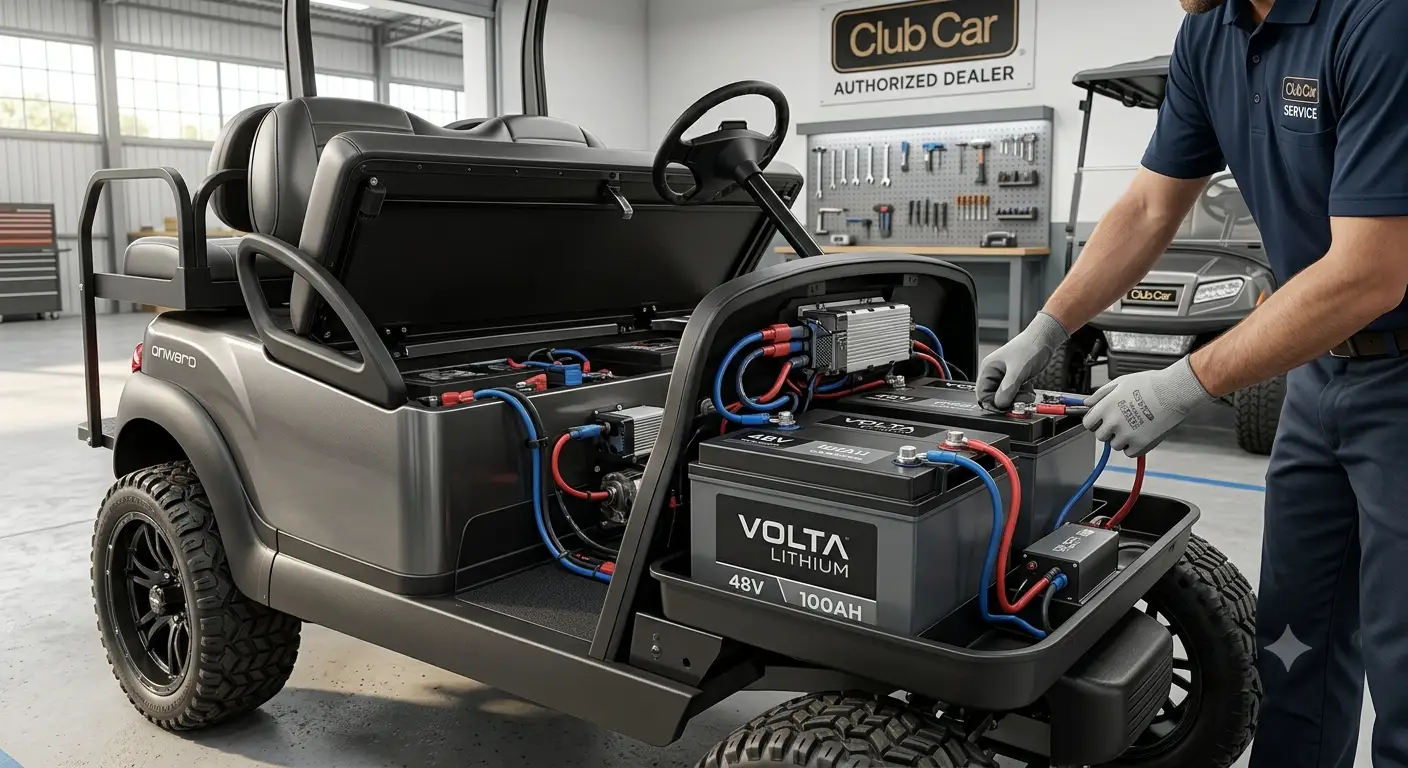
The stock or aging charger on an older Club Car is very often the single biggest threat to battery lifespan, and this fully automatic 3-stage smart charger is a legitimate fix, not a gimmick.
The three-stage charge cycle — bulk, absorption, and float — matters in practice because it prevents the overcharging that cooks lead-acid plates over time; the color-coded LED indicators (red for AC power, yellow for active charging, green for float mode) take the guesswork out of knowing whether your pack is actually done charging or just sitting at a partial state, which is exactly the kind of habit that shortens battery life when done wrong repeatedly. It’s built specifically for the round 3-prong plug used across 48-volt Club Car platforms, so compatibility isn’t a guessing game.
This charger is for the owner still using an original charger from a cart bought used, or anyone whose current charger takes an unreasonably long time or runs hot to the touch — both are signs of an aging or underpowered unit. If your cart already came with a modern smart charger, you likely don’t need to replace it yet.
Aggregated customer sentiment on smart 48-volt Club Car chargers in this category consistently highlights extended battery service life as the top benefit reported by long-term users, and the automatic float mode is repeatedly cited as the reason owners stop worrying about overcharging their pack overnight; a less common but real complaint is that the housing runs warm during peak bulk charging, which is expected behavior but can alarm first-time owners.
Pros:
- ✅ Three-stage charging protects long-term battery health
- ✅ Color-coded LEDs remove guesswork on charge state
- ✅ Purpose-built for the 48V round 3-prong Club Car plug
Cons:
- ❌ Higher upfront cost than a basic charger
- ❌ Housing runs warm during bulk-charge stage (normal, but noticeable)
In the $350 to $450 range, it’s the priciest accessory on this list, but when weighed against a $700-plus battery pack replacement, the math on protecting that investment is straightforward.
6. 10L0L Front End Lift Block Kit — entry-level stance upgrade
For owners who just want to fit slightly larger, low-profile 12- or 14-inch wheels without committing to a full suspension overhaul, this billet aluminum block kit is the lightest-touch option available.
At 0.6 inches of lift, the practical benefit is narrow but specific: it’s enough additional clearance to fit low-profile tires with a wider stance, without the geometry changes, alignment headaches, or shock-extension requirements that come with taller kits. It’s machined from a single piece of aluminum rather than cast, which matters for long-term durability under repeated flexing at the front leaf spring clamp. Installation requires no cutting or drilling, which keeps it firmly in DIY territory for anyone with basic hand tools.
This is the right pick for someone who wants a subtly more aggressive look and slightly better tire clearance on a Precedent-platform cart, but who has no interest in serious off-roading. It explicitly should not be paired with an already-installed lift kit, so know which category you’re in before ordering.
Customer feedback on this style of block kit tends to emphasize how quick the install is compared to A-arm kits, often cited at under an hour with basic tools; a smaller number of reviews note that at this modest lift height, the visual difference is subtle rather than dramatic, so buyers expecting a noticeably higher stance should look at a taller kit instead.
Pros:
- ✅ Billet aluminum construction resists long-term flex fatigue
- ✅ No cutting or drilling required for installation
- ✅ Fast install compared to full A-arm lift kits
Cons:
- ❌ Modest 0.6-inch lift gives a subtle, not dramatic, stance change
- ❌ Not compatible with carts that already have a lift kit installed
At under $30, it’s one of the cheapest ways to gain meaningful tire clearance, and it pairs naturally with a set of low-profile 12-inch wheels for a clean, budget-friendly refresh.
7. Hardcore Parts 6″ A-Arm Suspension Lift Kit with Lancer Wheels — full off-road transformation
This is the ceiling of this list: a complete 6-inch heavy-duty double A-arm suspension lift bundled with 10-inch machined Lancer wheels and 22×11-10 DOT-rated all-terrain tires, built specifically for the Club Car Precedent platform from 2004 onward.
The double A-arm design is the meaningful upgrade here over a simpler spindle lift, because it preserves more of the factory suspension geometry through the full range of travel, which translates to noticeably less bounce and sway on uneven terrain than cheaper single-arm kits. Pairing the lift with DOT-rated all-terrain tires — rather than leaving buyers to source tires separately — means the ground clearance gain is immediately usable rather than theoretical, since correctly sized tires are what actually let the extra clearance do its job over roots, ruts, and loose gravel.
This kit is built for the owner who genuinely uses their Club Car off pavement: hunting leases, large rural properties, or trail use where stock ground clearance simply isn’t enough. It is not a practical purchase for a cart that only ever sees a flat golf course or a smooth neighborhood street, where the added height mostly just adds cost and a rougher on-road ride.
Reviews consistently report that alignment holds well after the recommended professional front-end check, which the manufacturer explicitly calls for post-installation, and buyers frequently mention that the machined wheel finish looks noticeably more premium than the cast wheels bundled with cheaper competing kits; a common complaint is that the ride firms up noticeably on paved surfaces compared to the stock suspension, which is an expected trade-off for the added capability.
Pros:
- ✅ Double A-arm geometry outperforms basic spindle lifts on rough terrain
- ✅ DOT-rated all-terrain tires included, not sold separately
- ✅ Premium machined wheel finish versus typical cast alternatives
Cons:
- ❌ Noticeably firmer, rougher ride on smooth pavement
- ❌ Requires a professional alignment check after installation
In the $900 range, this is a genuine investment, but for a Club Car Precedent headed for real off-road use, it’s the only kit on this list that fully delivers the ground clearance and traction to match.
Getting Started: Your First 30 Days With New Club Car Upgrades
Installing new parts is only half the job — the first month of use is when small mistakes turn into recurring problems, so a little discipline early pays off for years.
Start with a torque check. Whatever you install — a lift kit, a lift block, or even seat covers with metal clips — give every bolt a second look after the first 20 to 30 miles of driving. Vibration loosens fresh hardware faster than most owners expect, and this single habit prevents the majority of early failures reported in aftermarket-part reviews. Next, if you installed any suspension component, book a professional front-end alignment within the first week rather than waiting for uneven tire wear to force the issue; it’s far cheaper to align now than to replace prematurely worn tires later.
For anything electrical — particularly a new charger — run a full charge cycle and watch it complete the entire bulk-to-float sequence at least once before leaving it unattended overnight. This confirms the unit is communicating correctly with your battery pack’s condition rather than assuming compatibility from the spec sheet alone. If you’re unsure how your specific cart should be operated safely during this break-in period, campus and facility guidelines like Cedarville University’s golf and utility cart operation guidelines offer a genuinely useful, plain-language refresher on safe operating habits that apply just as well to a driveway or private property as to a campus.
Finally, keep your original parts and hardware for at least 30 days. If a lift kit or bracket doesn’t feel right, having the stock components on hand makes reversal dramatically simpler and can matter for warranty or resale purposes down the line.
Real-World Scenarios: Which Club Car Upgrades Fit Your Lifestyle
Different owners get very different value out of the same parts list, so here’s how three common Club Car owner profiles should prioritize their budget.
The daily neighborhood commuter. If you’re using your Club Car DS several times a week for short trips — the mailbox, a friend’s house, the community pool — comfort and weather protection matter more than off-road capability. Prioritize the Clear Foldable Windshield for Club Car and the 10L0L Front & Rear Seat Vinyl Cover Set first; together they cost less than $250 and directly improve every single trip you take, rain or shine.
The budget-conscious weekend golfer. If your cart mostly sees the course a couple of times a month and lives outside the rest of the time, protection and maintenance beat cosmetics. The 10L0L Heavy-Duty Golf Cart Cover paired with the CartClan Rear Axle Bearing & Oil Seal Kit addresses the two most common causes of premature wear — weather exposure and drivetrain neglect — for under $100 combined.
The rural or off-road enthusiast. If your Club Car Precedent regularly leaves pavement for a large property, hunting lease, or unpaved trail, the calculus flips entirely toward capability. The Hardcore Parts 6″ A-Arm Suspension Lift Kit is the anchor purchase here, and pairing it with the Schauer 48-Volt Battery Charger makes sense too, since off-road use typically drains the battery faster and rewards a charger that protects pack health over the long run.
How to Choose Club Car Accessories and Parts
Sorting through club car parts listings can get overwhelming fast, so here’s a practical, five-step framework for narrowing the field.
- Confirm your exact model and year first. Club Car DS and Precedent platforms use different mounting points, bearing part numbers, and even plug shapes on chargers — a part that fits a 2010 Precedent may not fit a 1998 DS.
- Separate cosmetic wants from mechanical needs. A clunking rear axle or a dying charger is a need; new seat vinyl is a want. Fund needs first, since deferred maintenance items tend to get more expensive the longer they’re ignored.
- Check gas versus electric compatibility. Several parts, especially engine-adjacent kits, are drivetrain-specific — always double-check listings explicitly state electric or gas compatibility for your specific Club Car.
- Weigh installation difficulty honestly. A seat cover swap takes minutes; a suspension lift kit can take an afternoon and typically calls for a follow-up alignment. Factor your own time and comfort level, or a shop’s labor cost, into the real price.
- Read the aggregated review pattern, not just the star average. A 4.5-star product with a recurring, specific complaint (loose hardware, tight bushings) tells you more than a single average number — look for what real owners repeat across multiple reviews.
Buyers who work through this framework in order tend to spend their first accessory dollars on the part that actually solves a problem, rather than the flashiest listing on the page.
Common Mistakes to Avoid When Buying Club Car Parts
Even careful shoppers trip over the same handful of avoidable errors when buying club car accessories, so it’s worth calling them out directly.
The most common mistake is buying a “universal” part without verifying DS versus Precedent compatibility, since the two platforms diverge on more mounting points than most buyers assume. A close second is skipping the voltage and plug-shape check on chargers — 48-volt systems use different plug configurations across model years, and a mismatched charger, at best, won’t connect, and at worst, can damage a battery pack over repeated improper cycles.
Another frequent misstep is installing a lift kit without budgeting for the follow-up alignment, which several manufacturers explicitly recommend and which cheap installers sometimes skip to save time — this shows up later as uneven, accelerated tire wear that costs more than the alignment would have. Buyers also regularly underestimate installation time on anything more complex than a seat cover, leading to rushed jobs and the loosened-hardware issue covered in the getting-started section above.
Finally, many shoppers chase the lowest price on safety-adjacent parts like windshields or bearing kits without checking whether the listing actually specifies DOT compliance or OEM-equivalent specs — a few dollars saved isn’t worth a part that doesn’t perform as expected when it matters.
Club Car Accessories vs Generic Universal Golf Cart Accessories
A recurring question from Club Car owners is whether Club Car-specific parts are worth the price premium over generic “fits all brands” listings, and the honest answer is: it depends heavily on the part category.
For accessories with minimal mechanical stress — cup holders, phone mounts, cosmetic trim — generic universal parts genuinely perform just as well, since the tolerances involved are forgiving. Where the distinction matters is anything load-bearing or safety-related: bearing kits, lift kits, and windshields. A generic bearing kit not specced to Club Car’s exact axle dimensions can introduce play or premature wear that a Club Car-specific kit, like the CartClan Rear Axle Bearing & Oil Seal Kit, is engineered to avoid entirely. Similarly, a universal windshield often requires more improvised mounting than the Clear Foldable Windshield for Club Car, which is cut to match factory frame dimensions.
The practical rule of thumb: spend the premium on brand-specific parts anywhere structural fit or safety is involved, and feel comfortable saving money on generic accessories anywhere it’s purely cosmetic or low-stress. Buyers who apply this filter consistently tend to report far fewer fitment headaches during installation than those who default to whatever’s cheapest across the board.
✨ Ready to build your ideal Club Car? Compare today’s top picks and lock in the upgrades that fit your driving style! 🏌️♂️
Long-Term Cost and Maintenance for Your Club Car
The sticker price on any single accessory is only part of the real cost picture — total cost of ownership over several years tells a more useful story.
A neglected battery pack is the single most expensive line item most Club Car owners face, often running into the several-hundred-dollar range to replace a full set. This is precisely why a smart charger like the Schauer 48-Volt Battery Charger functions less like an accessory and more like an insurance policy: extending pack life by even a year or two comfortably offsets its own purchase price. Similarly, a bearing and seal kit addressed early, before a worn bearing damages the axle housing itself, costs a fraction of what a full axle replacement would run.
Cosmetic items like seat covers and cart covers have a different cost logic — they primarily protect resale value rather than prevent a mechanical failure. A cart with cracked, sun-damaged vinyl and a faded body typically sells for noticeably less than an otherwise identical cart that’s been kept covered and refreshed, meaning these lower-cost items often deliver outsized returns at trade-in or resale time.
Lift kits sit in their own category: they’re a capability upgrade, not a cost-avoidance one, and they do introduce ongoing considerations — alignment checks, potentially faster tire wear on pavement, and a firmer ride that some owners eventually reverse. Budgeting for at least one professional alignment in year one is the realistic total cost of a lift kit, not just the sticker price of the hardware itself.
Safety, Regulations, and Standards for Club Car Owners
Because Club Cars increasingly leave the golf course for neighborhood streets, understanding the actual regulatory landscape matters more than most owners realize.
Under federal law, a standard golf cart and a Low-Speed Vehicle (LSV) are treated very differently. Per NHTSA’s guidance on the federal low-speed vehicle definition, a vehicle only qualifies as an LSV if it can travel faster than 20 mph but no more than 25 mph on a paved level surface, and any vehicle meeting that definition must be manufactured to comply with Federal Motor Vehicle Safety Standard No. 500 — which specifically requires equipment like headlamps, turn signals, a windshield conforming to federal glazing standards, mirrors, a parking brake, and seat belts at every designated seating position. A stock golf-course-only Club Car generally does not meet this classification and isn’t legally required to carry this equipment, but the moment you’re driving on public roads, state law typically takes over, and requirements vary significantly by state, from simple permit systems to full LSV registration.
This is also why accessories like the Clear Foldable Windshield for Club Car aren’t purely cosmetic for road-going carts — in many states, a compliant windshield is part of the actual legal equipment list for any golf cart or LSV operated on public streets, alongside working lights, mirrors, and reflectors. Before adding any road-use accessories, check your specific state and local ordinances, since some jurisdictions cap golf cart use to daylight hours only or restrict speeds and routes regardless of how the cart is equipped.
The U.S. Consumer Product Safety Commission continues to actively monitor golf cart safety, including issuing periodic recall alerts for fall and injury hazards on various golf cart models, which is a useful reminder that this category of vehicle, while low-speed, isn’t risk-free. Basic habits — hands and feet inside the cart while moving, no passengers beyond the seated capacity, and a complete stop before anyone boards or exits — remain the highest-value safety practices regardless of which accessories are installed.
Frequently Asked Questions
❓ Are Club Car accessories interchangeable between the DS and Precedent models?
✅ Not always. Many parts — especially bearings, lift kits, and windshields — are model-specific due to different frame and mounting dimensions. Always confirm your exact model and year before ordering…
❓ How much does it cost to upgrade a Club Car with new accessories?
✅ It depends heavily on scope. Cosmetic refreshes like seat covers and a cart cover can run under $100 combined, while a full suspension lift kit with wheels and tires typically falls in the $900 range…
❓ Do I need a special charger for a 48-volt Club Car battery?
✅ Yes, voltage and plug shape both need to match your specific cart. A mismatched charger may not connect properly, and repeated improper charging cycles can shorten battery life…
❓ Can I legally drive my Club Car on the street after adding a lift kit and windshield?
✅ Accessories alone don't make a golf cart street-legal. Street or LSV use depends on your state's registration, permit, and equipment rules, which vary widely, so check local ordinances first…
❓ How long does a Club Car battery pack typically last with proper maintenance?
✅ A well-maintained lead-acid pack, kept on a smart charger and never left partially discharged for long periods, commonly lasts several years longer than a neglected pack on a basic charger…
Conclusion
A Club Car is a long-term investment, and the accessories and parts you choose can either protect that investment or quietly let it wear down faster than it should. From the budget-friendly 10L0L Heavy-Duty Golf Cart Cover protecting your cart from the elements, to the CartClan Rear Axle Bearing & Oil Seal Kit solving a real mechanical problem, all the way up to the Hardcore Parts 6″ A-Arm Suspension Lift Kit for genuine off-road capability, the right pick really does come down to how you actually use your cart day to day.
If comfort and weather protection top your list, start with the Clear Foldable Windshield for Club Car and the 10L0L Front & Rear Seat Vinyl Cover Set. If your priority is protecting the expensive stuff — the battery pack — the Schauer 48-Volt Battery Charger deserves serious consideration. And if your cart’s job is trail duty rather than fairway duty, the 10L0L Front End Lift Block Kit or the full Hardcore Parts setup will get you there, at two very different price points and capability levels.
Whatever you choose, keep safety front and center — golf carts remain a category the Consumer Product Safety Commission actively monitors for fall and injury hazards, so pair any upgrade with sound operating habits.
✨ Don’t miss these exclusive deals!
🔍 Take your club car to the next level with this carefully curated lineup. Click a highlighted item to check current pricing and availability. These picks will help you get a smoother, safer, more comfortable ride the whole family will enjoy!
Recommended for You
- Club Car Golf Carts: The Best 2025 Buying Guide | Top Models, Maintenance & Expert Tips
- Golf Trunk Organizer: 7 Top Picks Transform Your Car
- Golf Trunk Organizer: 7 Top Picks Transform Your Car
Disclaimer: This post contains affiliate links. As an Amazon Associate, I earn from qualifying purchases made through these links, at no additional cost to you.
✨ Found this article helpful? Share it with someone who needs it! 💬🤗