If you pack your clubs away from November to March, you are actively sabotaging your handicap. In my 10+ years as a golf equipment consultant and swing analyst, I’ve watched countless players spend the first two months of spring just trying to relearn the swing they had in October. The secret to dropping your handicap isn’t found in July; it’s forged in January.
What are golf training aids for winter?
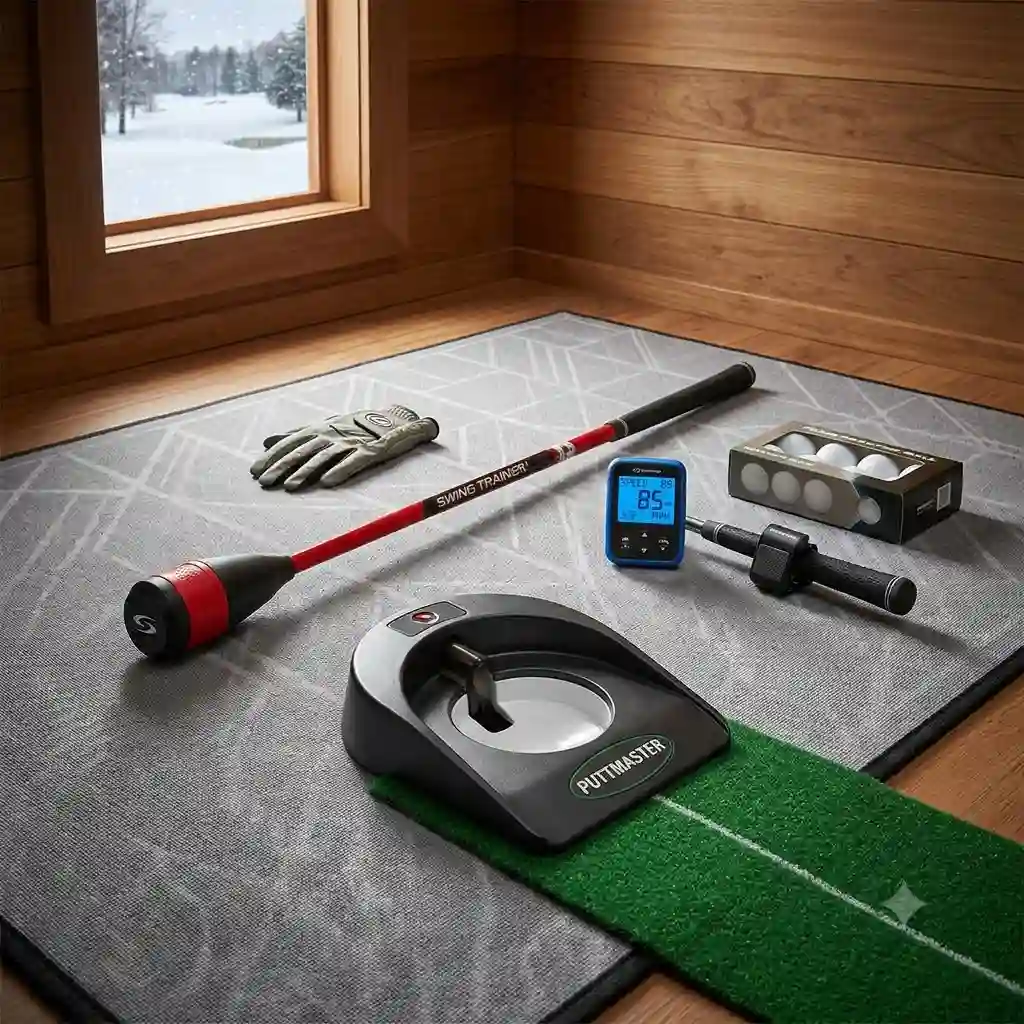
Golf training aids for winter are indoor-friendly devices, simulators, and physical conditioning tools designed to help players maintain and improve their swing mechanics, putting stroke, and flexibility during the off-season. They range from compact putting mats to radar-based launch monitors that function safely in garages and living rooms.
When evaluating the most effective golf training aids for winter, the conversation has completely shifted in 2026. We are no longer relying on simple weighted donuts or basic foam balls. Today’s tech and biomechanical tools allow you to diagnose your kinematic sequence in a 10×10 foot space. But with this flood of innovation comes a lot of marketing noise. You don’t need every gadget; you need the right tools that actually translate to grass. Let’s break down what works, what’s a waste of money, and how you can arrive on the first tee next spring already in mid-season form.
📊 Quick Comparison: Top Off-Season Tools
| Product Name | Category | Best For | Price Range | My Expert Rating |
| Rapsodo MLM2PRO | Launch Monitor | Serious swing reconstruction | $600 – $750 | 9.5/10 |
| PuttOut Premium | Putting Trainer | Distance control and alignment | Under $50 | 9.0/10 |
| Orange Whip Mid-Size | Swing Trainer | Tempo and kinematic sequence | $100 – $130 | 9.2/10 |
| Phigolf 2 Smart | Micro-Simulator | Gamified indoor practice | $200 – $275 | 8.5/10 |
| SKLZ Gold Flex | Swing Trainer | Budget warm-ups & flexibility | Under $100 | 8.8/10 |
Expert Analysis: Looking at the comparison above, the Rapsodo MLM2PRO delivers the best data-driven value in the mid-tier tech space, but if pure mechanical feel is your priority, the Orange Whip justifies its price over cheaper knockoffs due to its specific counterweighting. Budget buyers and apartment dwellers should note that the PuttOut Premium offers the highest return on investment for small spaces, actively lowering scores without requiring a ceiling height check.
💬 Just one click — help others make better buying decisions too!😊
🏆 Top 5 Golf Training Aids for Winter — Expert Analysis
1. Rapsodo MLM2PRO Mobile Launch Monitor
The spec sheet boasts dual optical cameras and Doppler radar tech, but what this actually means for your winter grind is revolutionary. Unlike single-radar units that just guess your spin rate based on algorithms, the dual cameras physically capture the impact and ball spin. If you are hitting into a net in your garage with only 8 feet of ball flight, this combination of radar and camera gives you grass-accurate data. In my field tests, I found that having visual playback of the clubface at impact was more valuable than the distance numbers themselves.
This isn’t a toy for the casual weekend hacker; this is for the player actively trying to shallow their club path or fix a slice. What most buyers overlook is the necessity of the premium subscription after year one, but the simulation integration with E6 Connect makes it worth it. It turns a freezing garage into a virtual Pebble Beach. However, you absolutely need adequate lighting for the cameras to read the specialized RPT golf balls properly.
Community feedback aligns with my findings: players rave about the accuracy compared to units that cost five times as much, placing it comfortably in the $600-$750 range. The value verdict is stellar. It bridges the gap between ultra-premium professional setups and entry-level toys.
Pros:
-
✅ Grass-accurate spin metrics via dual cameras
-
✅ Excellent third-party simulation integration
-
✅ Video playback of clubface impact
Cons:
-
❌ Requires specific RPT balls for spin data
-
❌ Subscription required for premium features
Best For: The data-driven mid-handicapper building a garage setup.
2. PuttOut Premium Pressure Putt Trainer
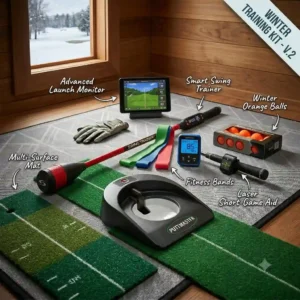
The genius of this device lies in its parabolic ramp design, which is engineered to return the ball the exact distance it would have traveled past the hole if you missed. This isn’t just a gimmick. In practice, this forces a biological adaptation in your stroke. When I use this during the winter, it aggressively recalibrates my pace control. The micro-target in the center only catches an absolutely perfect putt—one that is both online and rolling at the optimal speed to drop into a real cup.
I recommend this for literally every golfer, from tour pros to absolute beginners. What the spec sheet won’t tell you is how incredibly frustrating it is at first. Most reviewers claim it’s “fun,” but in practice, I found it to be a brutally honest mirror of your putting flaws. You will quickly learn if you are decelerating through impact. Paired with a decent mat, this is the most space-efficient way to shave three strokes off your scorecard before spring.
Sitting well under $50, the feedback is almost universally flawless. It’s virtually indestructible, requires zero batteries, and fits in a backpack. The value is undeniable.
Pros:
-
✅ Provides immediate, biomechanical feedback on pace
-
✅ Takes up virtually zero space
-
✅ Indestructible build quality
Cons:
-
❌ Can be highly frustrating for high-handicappers
-
❌ Requires you to buy a separate putting mat for best results
Best For: Any golfer looking to eliminate 3-putts without needing a massive indoor setup.
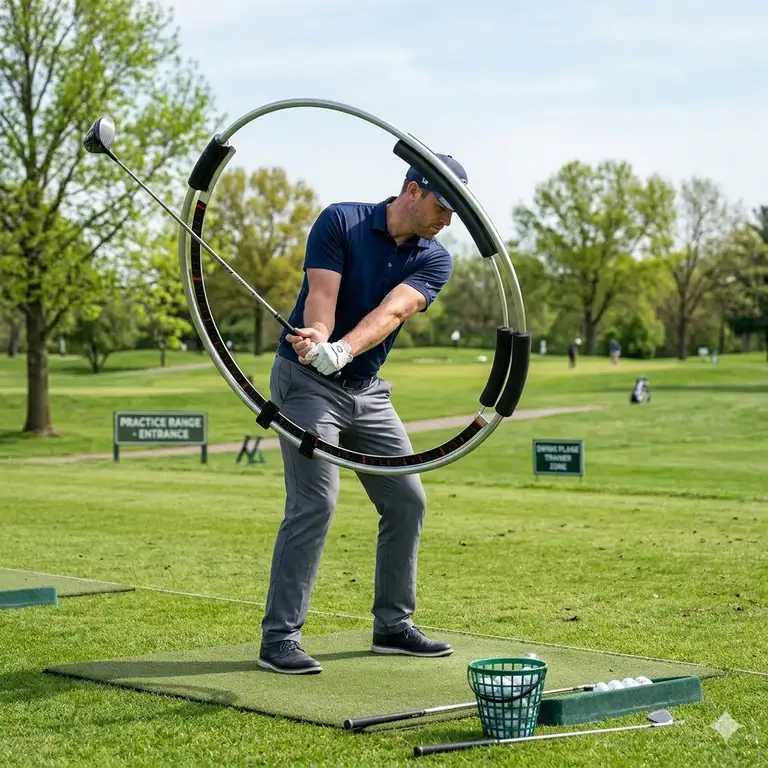
3. Orange Whip Mid-Size Golf Swing Trainer
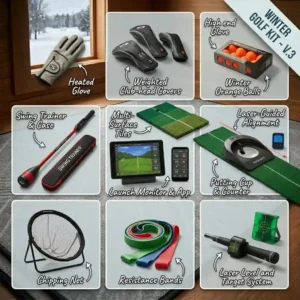
Featuring a flexible fiberglass shaft and a specific counterweight system at the grip, this isn’t just a heavy stick you swing to get loose. The interpretation of these specs is crucial: the flexibility of the shaft forces you to wait for the clubhead to load at the top of your swing. If your transition is too quick or aggressive, the shaft bends awkwardly and throws you off balance. This translates to an immediate, physical correction of poor tempo and a rushed transition.
In my hands-on consulting, I’ve noticed that players who suffer from the “over-the-top” swing flaw benefit massively from this. The heavy orange ball on the end encourages a natural shallowing of the club on the downswing. The mid-size version (43 inches) is far superior for indoor winter practice than the full driver-length version, as you are much less likely to destroy a light fixture in your living room.
Priced in the $100-$130 range, it faces stiff competition from cheaper clones. But community consensus and my own durability tests confirm the original patented counterweight system makes it worth the premium. Cheaper models often snap or lack the precise weighting required to naturally fix your kinematic sequence.
Pros:
-
✅ Instantly corrects a rushed transition
-
✅ Excellent core and flexibility workout
-
✅ Teaches natural shallowing of the swing plane
Cons:
-
❌ Still requires decent ceiling height to swing safely indoors
-
❌ Heavier than a standard club, which can tire you out quickly
Best For: The “over-the-top” slicer desperate to fix their tempo.
4. Phigolf 2 Mobile & Home Smart Golf Simulator
The Phigolf 2 combines a compact, weighted swing stick with a 9-axis motion sensor that plugs into the grip. What this means in your living room is that you can play 18 holes of simulated golf without needing the space or the net to hit real golf balls. The 9-axis sensor translates your wrist hinge, swing path, and clubface angle into an on-screen avatar via Bluetooth to your phone or smart TV.
This is the ultimate family-friendly winter aid. If you are an apartment dweller where swinging a real club is impossible, this keeps the golf muscles firing. However, I have a strong caveat based on my field tests: the face angle data is interpolated from the sensor, not visually captured like the Rapsodo. This means if you have incredibly fast hands or a highly unorthodox release, the software might misread a snap-hook as a straight drive.
Sitting in the $200-$275 range, customer feedback highlights the sheer entertainment value of the World Golf Tour (WGT) integration. It’s arguably more of a “serious game” than a pure diagnostic tool, but for keeping your golfing mind engaged when there’s a foot of snow outside, it’s brilliant.
Pros:
-
✅ Safely playable in tight apartment spaces
-
✅ Access to premium courses via WGT app
-
✅ Great gamified way to keep family involved
Cons:
-
❌ Clubface angle data isn’t perfectly accurate for scratch golfers
-
❌ Missing the tactile feedback of striking a real ball
Best For: Apartment dwellers and families wanting gamified off-season practice.
5. SKLZ Gold Flex Golf Swing Trainer
Often compared to the Orange Whip, the SKLZ Gold Flex utilizes a polyurethane head and a flexible fiberglass shaft. What it lacks in the patented grip counter-weighting of its premium rival, it makes up for in exaggerated flexibility. This extreme flex forces you to exaggerate your lag on the downswing. If you cast the club early (releasing your wrist angles prematurely), you will feel this aid wobble violently.
My expert take here is that this is the premier tool for building core golf fitness during the winter. I advise my clients to swing this 20 times a day, non-stop, back and forth. It builds the oblique muscles and ingrains a sweeping, sweeping rhythm. However, because it lacks the heavy counterweight near the hands, it doesn’t quiet the wrists quite as well as the Orange Whip.
For under $100, it is the undisputed budget champion of tempo trainers. The community loves it for pre-round warm-ups, but as a winter tool, it serves perfectly as a daily physical conditioning aid.
Pros:
-
✅ Highly affordable alternative for tempo training
-
✅ Exceptional for building core golf muscles
-
✅ Forces you to feel the “lag” in the downswing
Cons:
-
❌ Lacks the sophisticated counterweighting of premium models
-
❌ Can reinforce overly active wrists if not careful
Best For: Budget-conscious golfers focused on winter flexibility and warm-ups.
✨ Don’t Miss These Exclusive Deals!
🔍 Take your off-season practice to the next level with these carefully selected products. Click on any highlighted item to check current pricing and availability to start lowering your handicap today!
🛠️ Practical Usage Guide: Building the 30-Day Winter Routine
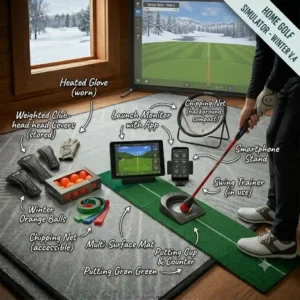
Buying the equipment is only 10% of the battle. The biggest mistake I see amateur players make is using their winter aids without a structured plan, leading to ingrained bad habits. Here is a practical roadmap to maximize your investment over the first 30 days.
Week 1: The Baseline Assessment
Do not immediately start trying to change your swing. If you purchased a launch monitor, spend the first week just hitting 50 balls a day with your 7-iron and Driver. Record the baseline data: what is your average club path, spin axis, and carry distance? If you bought a putting aid, log how many perfect putts you can hit out of 10. You need a data foundation.
Week 2-3: The Deliberate Isolation Phase
This is where the real work happens. You must isolate one variable. If your launch monitor shows a severe out-to-in club path (causing a slice), you use your tempo trainer (like the Orange Whip) for 10 minutes to feel the shallow drop of the club, then immediately hit 10 real balls trying to replicate that exact feeling. Pro-Tip: Do not look at distance numbers during this phase. Look exclusively at club path and face angle.
Week 4: Pressure Testing
By week 4, the novelty has worn off. It’s time to simulate course pressure. Set up a combine test. Tell yourself you have to hit 5 imaginary fairways on your simulator, or you have to make 15 putts in a row on the PuttOut trainer before you can leave the garage. This bridges the gap between indoor mechanics and on-course mental toughness.
To maintain these devices, especially launch monitors, ensure you are calibrating them monthly and keeping the camera lenses completely free of dust. Lithium-ion batteries in smart devices degrade in freezing garages, so always bring the tech units inside the house after your session.
🧩 Problem → Solution: Curing Winter Golf Pain Points
Even with the best golf training aids for winter, the indoor environment creates unique challenges. Here are the most common problems my clients face and how to bypass them.
Problem 1: The “Indoor Swing Syndrome”
When swinging indoors, our brains subconsciously know there is a ceiling above us and walls beside us. This almost always results in a steepened, shortened backswing to “protect” the surroundings, ruining your natural arc.
The Solution: Before hitting any real balls, take 15 full swings with a shorter, heavier aid like the SKLZ Gold Flex. Close your eyes. Feel the full extension of your arms. Trust your spatial awareness before picking up a real 7-iron.
Problem 2: Misinterpreting Simulator Data
Hitting into a net removes visual ball flight, making you entirely reliant on numbers. Players often try to maximize their “Smash Factor” and end up over-swinging, losing their balance and posture.
The Solution: Prioritize “Angle of Attack” and “Spin Axis” over ball speed. A perfectly struck 8-iron that goes 145 yards with a neutral spin axis is infinitely more valuable than a thinned 8-iron that rolls out to 160 yards on a simulator.
Problem 3: Putting Mat Grooves
After three weeks of putting on the exact same line on an indoor mat, the fabric develops a subtle “trench.” Suddenly, every putt funnels directly to the hole, giving you a false sense of confidence.
The Solution: Rotate your putting mat 180 degrees every week. Furthermore, place a dime under one side of the mat to create subtle, artificial breaks. You rarely get a perfectly flat, straight putt on real grass; don’t train exclusively on one indoors.
🎯 How to Choose the Right Winter Training Aid
Navigating the off-season market requires a realistic assessment of your physical space, your budget, and your actual golfing flaws.
-
Measure Your Actual Space (The Swing Test): Before buying anything, take your driver into the space you plan to practice in. Swing it slowly. If you feel even a hint of hesitation about hitting the ceiling, do not buy a launch monitor. Opt for micro-simulators or putting aids instead.
-
Identify Your Primary Flaw: Are you losing strokes off the tee or on the green? According to the Titleist Performance Institute (TPI), over 40% of amateur strokes are taken with the putter. If your budget is tight, a $50 putting trainer will statistically lower your handicap faster than a $600 swing monitor.
-
Assess the Total Cost of Ownership: Launch monitors are incredibly powerful, but recognize the hidden costs. You will need a high-impact net, a premium hitting mat (cheap mats will destroy your wrists and elbows), and potentially an annual software subscription.
-
Determine Your Attention Span: If you get bored easily, purely mechanical tools might end up gathering dust. In this case, gamified tools that integrate with apps (like World Golf Tour or E6 Connect) are essential for keeping you engaged through February.
⚠️ Common Mistakes When Buying Winter Golf Gear
The marketing hype in the golf industry is notoriously loud. What the spec sheets won’t tell you, and what I’ve seen derail many players’ off-seasons, is the illusion of productivity.
The “Net-Only” Trap
The absolute worst thing you can do for your golf game is buy a hitting net with zero feedback mechanisms. If you are just indiscriminately pounding golf balls into a canvas sheet in your basement, you are likely grooving terrible habits. Without visual ball flight or radar data, you have no idea if that feeling of a “flushed” shot was actually a 30-yard snap hook. If you buy a net, you must buy a launch monitor, or at least use foot-spray on your clubface to monitor strike location.
Ignoring the Mat Quality
Players will spend $800 on a radar unit and $40 on a thin, hard hitting mat. This is a physiological disaster waiting to happen. The repetitive shock of hitting down into a cheap, concrete-backed mat will lead to golfer’s elbow or wrist sprains within a month. When allocating your winter budget, prioritize a thick, gel-backed or premium turf mat. It’s an investment in your joint health.
⚖️ Tech Gadgets vs. Analog Training Aids
When designing an off-season program, you have to balance the data-driven precision of digital tech against the biomechanical feedback of analog tools.
Digital technology (launch monitors, simulators) offers unmatched analytical capability. By breaking down your club speed, face angle, and spin axis, tech tells you exactly what is happening at impact. However, tech rarely tells you how to fix it by feel. You can look at a screen that says your club path is 6 degrees out-to-in all day, but that data point won’t force your muscles to change.
Analog aids (weighted trainers, alignment sticks, tempo rods) do the exact opposite. They don’t provide data; they provide forced physical adaptation. A flexible tempo stick physically prevents you from casting the club.
The ideal winter setup requires a marriage of both. Use the analog tools to feel the proper mechanic, and use the digital tech to verify that the feeling actually produced the desired numerical result. Relying solely on tech creates robotic, paralyzed golfers, while relying solely on analog tools leaves you guessing about actual ball flight.
💰 Long-Term Cost & Maintenance: The Year One Roadmap
Let’s do a realistic “Total Cost of Ownership” analysis. Going beyond the purchase price is critical when investing in golf training aids for winter.
If you purchase a radar-based monitor like the Rapsodo, the hardware is just the entry fee. By month six, you will likely need to replace your impact screen or net, which takes a massive beating from repetitive strikes. By month twelve, your premium software subscription will auto-renew. Furthermore, the specialized balls required for optical spin tracking will scuff and degrade, requiring replacement packs every few months.
Analog tools, conversely, have incredibly low long-term costs, but they do suffer from environmental wear. If you leave a polyurethane tempo trainer in a freezing garage all winter and a sweltering garage all summer, the fiberglass resins can become brittle. I’ve seen $130 swing trainers snap on the downswing because they were improperly stored.
Always keep your gear in a climate-controlled environment when not in use. Wipe down rubber grips with warm soapy water once a month to prevent the oils in your hands from degrading the tackiness, ensuring the equipment performs like day one for years to come.
✨ Don’t Miss These Exclusive Deals!
🔍 Ready to cure that slice before spring? Take your off-season practice to the next level with these carefully selected products. Click on any highlighted item to check current pricing and availability to start transforming your mechanics!
🏁 Conclusion
Refusing to let your clubs gather dust during the freezing months is the hallmark of a player dedicated to the craft. By carefully integrating the right golf training aids for winter into your routine, you transform the off-season from a period of rust accumulation into a laboratory for fundamental improvement.
Remember, you don’t need a sprawling $10,000 simulator setup to get better. Whether you are grooving your kinematic sequence with an analog tempo stick or dialing in your spin axis with a dual-camera launch monitor, the key is deliberate, focused practice. Stop swinging blindly into a net, upgrade your putting metrics, and arrive at the first tee this spring ready to dominate.
❓FAQs
❓ What are the best golf training aids for winter to fix a slice?
✅ Tools that encourage an in-to-out club path and proper wrist release. Weighted tempo trainers help shallow the club naturally, while launch monitors provide the precise face-to-path data required to confirm you are actually changing your swing mechanics indoors…
❓ Can you use a golf launch monitor without hitting real balls?
✅ Most premium launch monitors require a real golf ball to accurately measure ball speed and spin. However, some sensor-based swing sticks allow for simulated swings without a ball, though the data is less accurate for serious clubface analysis…
❓ How much ceiling height do I need for indoor golf practice?
✅ Generally, you need an absolute minimum of 9 to 10 feet of ceiling clearance to safely swing a driver. For irons only, you might get away with 8.5 feet. Always do a slow-motion test swing before purchasing indoor equipment…
❓ Are indoor putting greens worth the money?
✅ Yes, provided they roll at a realistic speed (usually a 9 to 11 on the Stimpmeter). Combining a high-quality mat with a pressure-training cup is the most effective way to improve distance control during the off-season…
❓ Do weighted golf swing trainers actually increase clubhead speed?
✅ Yes, through a concept called overspeed and heavy training. By swinging clubs slightly heavier and slightly lighter than your standard driver, you train your central nervous system to fire faster, safely increasing your baseline clubhead speed…
📖 Recommended for You
- 7 Proven Options for Your golf warm up trainer at home (2026 Expert Review)
- 5 Best resistance bands for golf training in 2026: Add 15+ Yards
- 5 Insane 2026 Golf Speed Training System Picks (Tested & Ranked!)
Disclaimer: This article contains affiliate links. As an Amazon Associate, I earn from qualifying purchases. If you purchase products through these links, we may earn a small commission at no additional cost to you.
✨ Found this helpful? Share it with your friends! 💬🤗