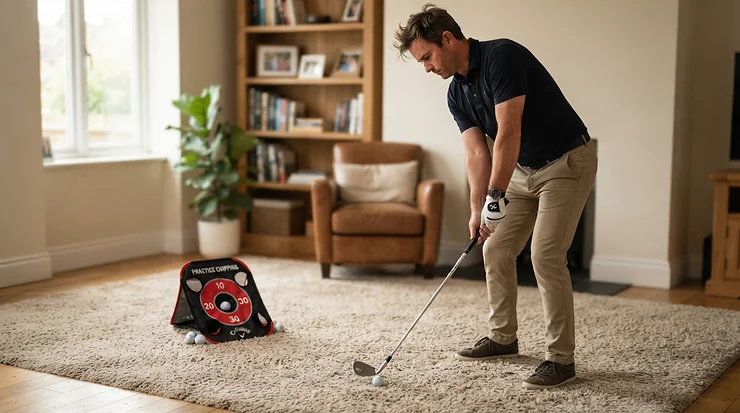
Which chipping clubs actually take the chunks and thins out of a short game: a chipper, a wide-soled wedge, or the 8-iron already in your bag? Each one works for somebody. The right pick depends on your lies, your home course and how much you like to improvise, so this 2027 guide matches five real clubs, from around $50 to around $200, to five kinds of golfer instead of ranking them by brand.
Golf Monthly’s chipper roundup frames the trade: a chipper leans on something close to a putting stroke and is most effective from about 10 to 15 yards out, but it is not a versatile club, so a couple of wedges still have to stay in the bag. The tester notes below belong to Golf Monthly, Plugged In Golf and MyGolfSpy, the owner comments to two public forum threads, and the spec lines to maker and retailer pages; no club was swung for this guide.
The order is simple: what separates the clubs, five situations with one pick each, where testers and owners disagree, and what the rulebook allows.
Chipper, wedge or 8-iron: loft, lie and sole make the call
Typing chipping clubs golf into a search bar returns two families of club: purpose-built chippers, and wedges sold for greenside work. Three physical differences separate them, and each one changes how the ball behaves.
Loft and lie angle set the shot
MyGolfSpy’s chipper guide describes a chipper as a cross between a putter and a wedge, with loft generally between 30 and 40 degrees and a lie angle of 68 to 70 degrees, close to a putter’s. That upright lie lets you stand tall and swing the way you putt. The PING ChipR measures 38.5 degrees, roughly a 9-iron, and the Wilson Harmonized Chipper is sold with the loft of a typical 7-iron. The wedges later in this guide run from 46 to 60 degrees.
The flight that results is low. MyGolfSpy says the ball bounces once or twice and then rolls, and GolfLink estimates a chipper shot rolls roughly three to four times as far as it carries. Plan around that roll whenever a bunker, a slope or water sits between you and the hole.
Sole width decides how forgiving a mishit is
Golf Monthly’s review of the Cleveland Smart Sole 4 passes along a coaching idea: chips work best when the bounce, not the leading edge, meets the turf. A wide, rounded sole does that for you, which is why chippers and chipper-style wedges feel safe on tight lies and why a blade wedge with a narrow sole asks more of your hands. The trade is creativity. The same review says the wide-soled design is less suited to inventive shots, where a narrower sole with more heel relief works better.
Versatility is the price of simplicity
A chipper cannot open its face for a flop or vary its trajectory the way a wedge can, GolfLink points out, and MyGolfSpy lists lower spin, a lower flight and no full-swing use among the drawbacks. It adds that Callaway, Mizuno and Titleist do not make one and that tour professionals do not play them. Members of The Sand Trap forum were blunter in an August 2021 thread: several called chippers one-dimensional or unnecessary, one returned a borrowed chipper after stubbing and thinning shots, and another member said he might consider one as he ages.
The 8-iron already in the bag is the cheapest test. In a mid-2022 MyGolfSpy forum thread, a member using a PING ChipR said it matched an 8-iron on well-struck fringe shots but did better on mishits and thick rough, while another member argued an 8-iron can do the same job if you trust it. Golf Monthly adds that a hybrid or fairway wood can stand in with a chipper-style address, provided you avoid heavy swings and divots near the green.
Best chipping clubs for five different short games
Each pick below starts from a situation and works back to the club. Prices are ranges from the pages opened, and they shift, so read them as a tier rather than a quote.
Club
Type
Loft
Length and lie
Price tier
Wilson Harmonized Chipper
Chipper
Same as a typical 7-iron
35 in; lie not listed
Around $50 to $70
PING ChipR
Chipper
38.5°
35 in; 70°
Around $180 to $200
Cleveland Smart Sole 4 C
Chipper wedge
42°
34 in; 66°
Roughly $90 to $130
Cleveland CBX Full-Face 2
Cavity-back wedge
50° to 60°
Varies by loft and shaft
Check the current price on Amazon.com
Cleveland RTX 6 ZipCore
Blade wedge
46° to 60°
Varies by loft and shaft
Around $130 to $170
Loft sorts the five more cleanly than price does. The two chippers and the chipper-style Cleveland Smart Sole 4 C sit between 7-iron and pitching-wedge loft and want a rolling shot, while the two other Cleveland wedges start at 46 and 50 degrees and reach 60, which is where flop shots and bunker play live. The PING ChipR is the price outlier among the three low-loft clubs.
Check current availability on Amazon.com before narrowing the list.
Around $50 to $70 buys the lowest-cost trial of a putting-style chip in this guide. The Wilson Harmonized Chipper is 35 inches long with the loft of a typical 7-iron, a round iron-style grip and an alignment aid on the head. Carl’s Golfland’s product copy adds a wide, flat sole meant to glide over turf and cut down on fat shots, and an ALS listing mentions heel-toe weighting. MyGolfSpy files it among the budget-friendly chippers for golfers who care less about premium looks.
Retailer pages disagree in places. Golfers Authority says the head has no face insert, while an Australian retailer describing the 2025 version mentions a soft urethane insert, so the version in the listing matters. Hand availability is murky too: Golfers Authority mentions no left-handed option, but a UK retailer lists one. Golfers Authority’s page carries no ratings or drawbacks, which leaves durability without any independent evidence here.
The loft deserves the most thought. A 7-iron loft keeps the ball low and running, which suits fringe shots with open green ahead and works against you the moment a bunker or a slope has to be carried.
Wilson Harmonized ChipperSee current price, sizes and reviews on Amazon.
2. PING ChipR — iron-style looks at a premium price
Sticker shock was the first reaction one MyGolfSpy forum member posted about the PING ChipR: close to $200 seemed steep beside cheaper chippers. The thread, which ran from July to September 2022, otherwise reads as a debate about spin.
Golf Monthly lists the club at 35 inches, 38.5 degrees, a 70-degree lie and a 325-gram head. Its tester, Mark Townsend, treated it as an extension of the putter, said the upright lie keeps the toe from digging, and found it effective from greenside rough and on a tricky 40-yard chip. In its current chipper roundup, Golf Monthly names the ChipR its top pick and lists limited versatility as the one drawback.
Owners split on spin. One member who tested it in a lab session said the ball tends to roll out because it creates little spin, while another said it checked up more than he expected. A third reported getting up and down four times out of five with it against about three out of five with his regular wedges, a single owner’s tally that proves little on its own.
Pros:
✅ Looks like a regular iron in the bag, per Golf Monthly
✅ Cambered sole and upright lie helped from rough in Golf Monthly’s test
✅ Steel and graphite shafts are offered, per an Australian retailer
Cons:
❌ Around $180 to $200, the priciest of the five
❌ Limited versatility, says Golf Monthly
❌ One forum tester reports low spin and roll-out
Members suggested spending about an hour practicing around the green before judging it.
PING ChipRSee current price, sizes and reviews on Amazon.
Chipping yips are the problem this wide-soled design is built around, and Golf Monthly’s Joel Tadman tried the idea on a friend who had fought them for about six years. The friend used the 50-degree wedge from the same Cleveland Smart Sole 4 family, not the 42-degree C, and said that focusing on the sole eased his dread; he still chunked or thinned the odd chip but no longer stood over the ball afraid. That was one player’s account, published in May 2023.
The C model is the chipper of the family: 42 degrees, 34 inches, a 66-degree lie and a three-tiered sole with leading-edge bounce, offered with steel or graphite shafts and for right- and left-handers, with a Golf Pride Tour Velvet 360 grip, according to a GlobalGolf listing. MyGolfSpy’s chipper guide calls out its extra-wide sole, softer feel and consistency on short chips.
Forum members split. One preferred its sole to the ChipR’s because it forgave more, while another picked the ChipR because the Cleveland’s sole is very wide and the ChipR is more traditional with plenty of bounce. Retail pages checked show roughly $90 to $130 depending on finish and shaft. Golf Monthly’s verdict on the family is that it helps high handicappers and golfers with the yips but suits creative short-game shots less well.
Only three lofts are offered across the family: 42, 50 and 58 degrees.
Cleveland Smart Sole 4 CSee current price, sizes and reviews on Amazon.
A chipper rolls the ball; a full-face wedge lifts it. The Cleveland CBX Full-Face 2 sits in the second camp, with lofts from 50 to 60 degrees, 12 degrees of bounce, grooves that run full width into the toe and a TPU gel insert in the cavity, as Golf Monthly’s Martin Hopley lists them. Cleveland claims 13 percent more contact area than its earlier Cleveland RTX Full-Face wedge, according to Plugged In Golf.
Hopley says the deep, tightly spaced grooves give plenty of spin in any conditions, and he found the 60-degree an escape club from tight and heavy lies thanks to its wide sole and extra loft. Plugged In Golf’s launch-monitor session kept ball speed within about 1 mph on good shots, saw tight dispersion and credited the sole with resisting digging, while adding that the wedge will not rescue a poor swing. Golf Monthly says the cavity back suits mid and high handicappers.
Check the current price on Amazon.com, since neither review lists one. Hopley’s one criticism is feel: very good for a cavity back, though not as sharp as a blade.
Cleveland CBX Full-Face 2See current price, sizes and reviews on Amazon.
Skill is the entry fee for the Cleveland RTX 6 ZipCore, a blade wedge that tells you exactly how well you struck it. Plugged In Golf’s Matt Saternus describes a firm, low-pitched click and feedback that separates pure strikes from mishits, and when a bogey golfer asked about playing it, he pointed toward cavity backs for more forgiveness. Lofts run from 46 to 60 degrees, and the grinds are Low, Mid, Full and a newer Low+, which carries two more degrees of bounce than Low.
On spin, Saternus saw virtually no loss when he sprayed face and ball with water, and he praised it for recovery shots from long, dewy grass. Golf Monthly’s Hopley called spin excellent across shots but found the stock 126-gram steel shaft a little heavy; a lighter graphite option exists. MyGolfSpy ranked it fifth overall in its 2023 wedge test with a 9.3 score.
Pros:
✅ Spin held up in Plugged In Golf’s wet test
✅ Four grinds to match turf and swing
✅ Wide range of lofts, 46 to 60 degrees
Cons:
❌ Blunt feedback on mishits
❌ Heavy stock steel shaft, per Golf Monthly
Pages Golf Monthly cites put it at around $130 to $170, and Plugged In Golf recommends a fitting for lofts and soles.
Cleveland RTX 6 ZipCoreSee current price, sizes and reviews on Amazon.
Chipping clubs reviews: where testers and owners disagree
Spin is where the sources diverge most. Golf Monthly credits the ChipR’s MicroMax grooves with solid spin, says the Odyssey Chipper it tested sent shots out flat with minimal spin and plenty of release, and found that the budget Mazel Golf Chipper, which comes in lofts from 35 to 60 degrees, spun more than expected. Inside the MyGolfSpy thread, two owners of the same ChipR disagree. Spin seems to belong to the loft, the groove pattern and the swing, not to the word chipper.
Rough is the second split. Golf Monthly’s testers found the Odyssey struggled from long grass, while Townsend found the ChipR strong from greenside rough with more effective loft than expected. A chipper tested only from a clean fringe says little about the lie you will actually face.
The learning curve gets less attention than it deserves. Golf Monthly says the ChipR took some time to get used to before it became highly effective, and the forum member who liked it most recommended about an hour of practice before judging it. A borrowed club is a poor test: the Sand Trap member who borrowed one said he stubbed or thinned shots and handed it back, a single report that fits the warning.
Treat chipping clubs reviews, this one included, as a shortlist rather than a verdict. Before spending, run the clubs for chipping already in your bag against each other from one fringe lie: an 8-iron, a pitching wedge and your sand wedge. A budget chipper is the next experiment, and a near-$200 one comes only after the shot has earned it.
What chipping clubs in golf may carry: heel shafts, round grips and one face
Chippers are legal when they follow the equipment rules for irons rather than putters. Golf Monthly’s chipper page says so, and MyGolfSpy repeats the checklist. The USGA’s equipment FAQ confirms that a shaft must attach at the heel through a single plain neck or socket, a freedom reserved for putters, and that clubs other than putters cannot exceed 48 inches. None of this makes chipping clubs in golf exotic; the rule set is the one that covers your irons.
Four things turn a legal club into an illegal or an unused one:
A putter grip. Golf Monthly says every grip other than a putter grip must be round. Its Odyssey tester liked the putter-style grip for adjusting playing length, yet the same page says USGA rules do not allow a putter grip on a chipper.
A second face. Two-way chippers do not conform, MyGolfSpy notes, because an iron may have only one striking face and loft must exceed 10 degrees.
A bunker-heavy course. GolfLink says courses with many greenside bunkers, berms or creeks favor a wedge’s finesse over a chipper’s roll.
A scarce bag slot. The 14-club limit applies, and Sand Trap members cite the slot a chipper occupies as its cost.
Loft, legality and the crossword clue: quick answers
❓ Which club is easiest for a beginner to chip with?
✅ Golf Monthly and MyGolfSpy both point golfers who chunk or thin chips toward a lofted chipper or a wide-soled wedge. A chipper adds a putting-style stroke but gives up flop shots and bunker play, so keep at least one wedge in the bag.
❓ Which clubs for chipping do golfers use besides a chipper?
✅ Wedges are the default, from pitching to sand wedge. Forum members also report using an 8-iron for low running shots from the fringe, and Golf Monthly says a hybrid or fairway wood can stand in when you carry no chipper, provided you avoid heavy swings near the green.
❓ What is the answer to the chipping clubs crossword clue?
✅ For the clue Chipping club, Crossword King lists WEDGE, five letters, from the Universal Crossword of April 13, 2025. A 2019 L.A. Times puzzle answered Club used for chipping with IRON, so check your grid's letter count before filling in.
❓ Are chippers legal in golf?
✅ Yes, when they follow the equipment rules for irons: one striking face, a shaft attached at the heel, a round grip rather than a putter grip, and loft above 10 degrees. Two-way chippers do not conform, MyGolfSpy notes.
❓ Is a chipper better than a wedge for chipping?
✅ For short shots with a clear path, a chipper can be steadier because it uses a putting-style stroke, but a wedge is far more versatile. Golf Monthly notes you still need a couple of wedges for longer approaches, so a chipper adds to the bag rather than replacing it.
Settling on a club: match it to the shot you miss
Start with the miss. If you stub or thin chips from tight lies, your course lets the ball run and a putting stroke appeals, the cheapest sensible test among chipping clubs is the Wilson Harmonized Chipper, with the PING ChipR as the step up once the shot has proven itself. If chunks and nerves are the problem and you still want some loft, the Cleveland Smart Sole 4 C puts a very wide sole under the ball. If you need to lift the ball over trouble, the Cleveland CBX Full-Face 2 adds forgiveness to a wedge, and the Cleveland RTX 6 ZipCore suits golfers who want spin, grind choices and honest feedback. Current availability and each club’s hand, loft and shaft options sit on its Amazon.com listing, so compare them before you order.
Disclaimer: This post contains affiliate links. As an Amazon Associate, I earn from qualifying purchases made through these links, at no additional cost to you.
Check current availability, then give your shortlist an hour on the practice green. ⛳