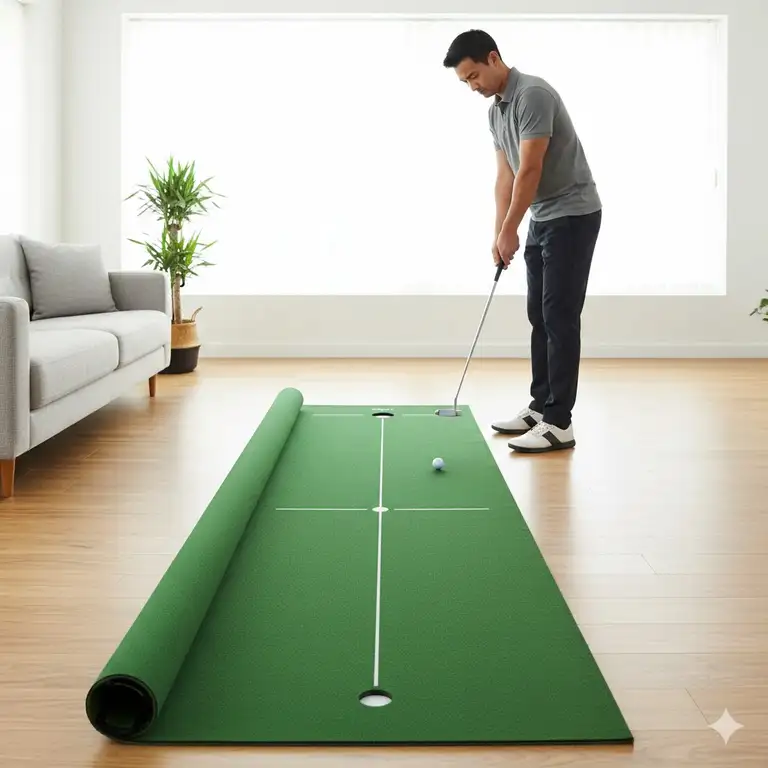
Choose your floor before you choose among golf putting mats, because the same mat can roll about two Stimp points slower over plush carpet than on a hard surface. A Golf Insider test of the PuttOUT Medium Putting Mat measured roughly 9.5 to 10 on a hard floor and under 8 over fluffy carpet, a gap wider than most of the differences between the speeds printed on competing mats.
This 2027 guide treats the purchase as a short method instead of a ranking: measure the room, test the floor, pick a speed, decide on a cup and ball return, then give the mat time to lie flat. The best golf putting mats for a given home are the ones that survive those five checks, and the four below each solve a different one. The findings rest on maker pages, tests from Golf Monthly, Golfers Authority, Golf Insider and Plugged In Golf, and buyer comments attributed by name, and no mat was putted on for this guide.
Prices are ranges drawn from review pages and move often, so Amazon.com may show something different.
The method: floor check to first putt
Each step narrows the next, so the order is part of the advice.
Measure the room before the mat. Golf Monthly’s buying notes open with exactly that, and they add that long greens help with pace and distance control while mats with holes build confidence. The four mats here run about 8 to 10 feet, from the 7 ft 11 in PuttOUT Medium Putting Mat to the 10-foot Wellputt Classic Green 10ft, and they are narrow: Golfers Authority lists the Perfect Practice Putting Mat at 12 inches wide. Leave space to stand and for a missed putt to roll past the end. Shopping under putting green golf headings mixes these slim strips with BirdieBall foam greens sold in sizes up to 4 by 30 feet, so filter by length early.
Test the floor.Golf Geeks’ carpet guide says tightly woven, low-pile carpet over a firm subfloor works reasonably well, while plush, shag or padded carpet does not, and it suggests pressing a palm into the pile: if it sinks or springs, the mat will behave the same way under the ball. Its fix for soft floors is a sheet of plywood or MDF beneath the mat. It also describes a quick audit: roll five balls straight down the mat, and if they drift the same way every time, the floor is the problem, not your stroke. Golfers Authority’s review of a thin, long mat adds grout lines and carpet dips to the hazards.
Pick a speed, then discount it. Green speed comes from a Stimpmeter, a 36-inch ramp raised to 20 degrees that releases a ball onto a level patch; three balls are rolled each way, and the average distance in feet becomes the rating. Golf.com puts slow greens at about 8 to 8.5 and fast ones at 12 or more. Mat makers and reviewers quote numbers on the same scale, from about 9 to 11.5 for most of the mats here, but the floor shifts them, and testers don’t always match the box: Golf Monthly’s tester put the PuttOUT Medium Putting Mat closer to 9 than the 9-to-10 range it is said to run. Match the number to the greens you play most, and expect the floor to shave a point or two.
Choose between a cup and a clean strip. Cups and a return keep the reps flowing; a bare strip with printed targets keeps the price down. The Perfect Practice Putting Mat has two cups and a return ramp, the SKLZ Accelerator Pro Putting Mat has a single cup and a gravity track, and the PuttOUT Medium Putting Mat and Wellputt Classic Green 10ft have neither, according to Golfers Authority, so every set ends with a walk to collect balls.
Give it time to flatten. Plugged In Golf’s reviewer worried about bumps in a two-hole mat, then found it rolled very true after about 30 minutes under heavy books. Golfers Authority puts the V5 edition of the Perfect Practice Putting Mat at about 24 hours, with ends that can curl, and GolfLink’s tester found creases caused by the way a mat was wrapped around its hole end in the box. BirdieBall’s foam mats have a rule of their own: Plugged In Golf says one stored smooth side out will not lie flat when unrolled. Judge any mat after a day, not a minute.
How the four mats line up against those checks
Mat
Length
Speed in sources
Cup and return
Price range
PuttOUT Medium Putting Mat
7 ft 11 in
Rated 9 to 10; under 8 over fluffy carpet
None
Between $60 and $80
Wellputt Classic Green 10ft
10 ft
10 one way, 11.5 the other
None, printed targets
Around $150
SKLZ Accelerator Pro Putting Mat
9 ft
10 to 11
One cup, gravity return
Around $50 to $55
Perfect Practice Putting Mat
About 9.5 ft
10 to 11, or 10 to 14
Two cups, magnetic return
Between $130 and $150
Cost and hardware don’t line up. The cheapest mat carries a cup and a return, while one of the two priciest has neither, because its money goes into a two-speed surface and a drill app. The speed column also shows how loosely numbers travel: the same mat gets two different ranges in two reviews.
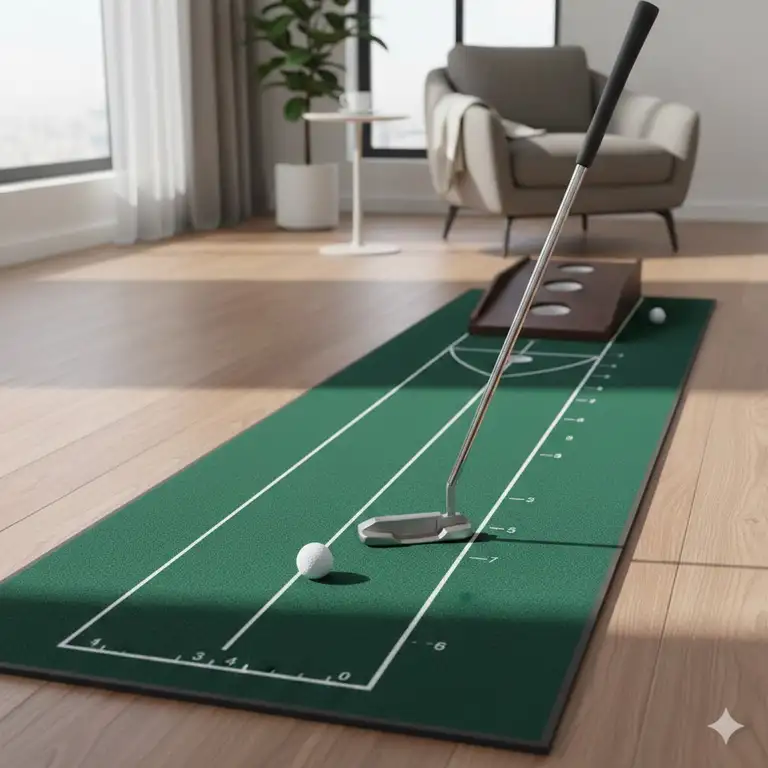
Backing is the case for the PuttOUT Medium Putting Mat, and it speaks to steps two and five. Golfers Authority credits an extra-thick TPR backing with lying flat straight from its cardboard cylinder, Golf Monthly’s tester points to the rubber base for the same reason, and Golf Geeks relays Plugged In Golf’s Matt Saternus describing it as the heavier, flatter-lying option, which is why that guide recommends it for carpet. It measures 7.9 feet by 1.6 feet, with distance markers every foot up to six feet, and sources put it between about $60 and $80.
Speed is the caution. Golf Insider’s test read about 9.5 to 10 on a hard floor and under 8 over fluffy carpet, and Golf Monthly’s tester felt it ran nearer 9 than its printed range. Golfers Authority adds that it has no hole or return, is designed to pair with a separate trainer costing roughly $30 to $40, and collects dust and pet hair.
Pros:
✅ Thick rubber backing lies flat out of the cylinder, per Golfers Authority and Golf Monthly
✅ Distance markers every foot up to six feet
✅ Among the lowest prices of the four
Cons:
❌ No hole or ball return
❌ Reads under 8 over fluffy carpet in Golf Insider’s test
❌ Attracts dust and pet hair, per Golfers Authority
PuttOUT Medium Putting MatSee current price, sizes and reviews on Amazon.
Two speeds on one strip is the idea here, and it answers step three. Putting toward the target end rolls near 10 for accuracy work, and putting the other way rolls near 11.5 for distance control, as Golf Geeks describes it, and that guide names the mat its overall pick for hard floors. Golfers Authority scores it 4.7 out of 5, says it lies flat with no conditioning period, and credits printed target zones and a free app with 54 exercises.
The limits are familiar. Golfers Authority notes no physical hole, no ball return, a faster roll on hardwood, spills that are hard to clean and a need for a solid subfloor. Around $150 is the going figure in the sources, so the premium pays for the speed split and the drills, not for a cup. Ten feet of length is also the most any mat here asks of your room.
Wellputt Classic Green 10ftSee current price, sizes and reviews on Amazon.
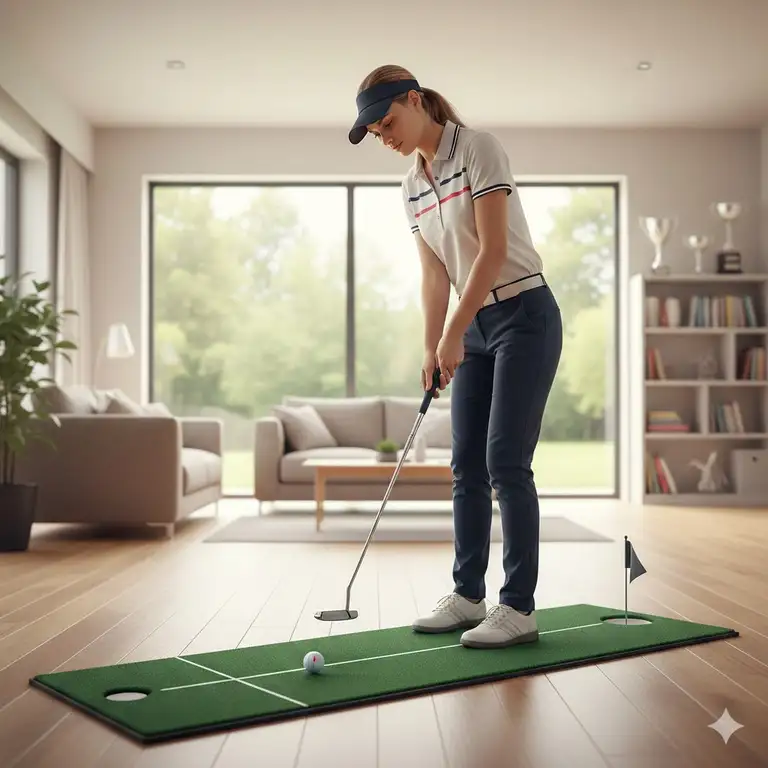
Around $50 to $55 makes the SKLZ Accelerator Pro Putting Mat the least expensive way here to get a cup and a ball return, which is step four at its smallest budget. SKLZ lists it at 9 feet by 16.25 inches, with alignment guides at 3, 5 and 7 feet and an upslope at the cup. Breaking Eighty’s tester names it his best cheap pick, says it rolls true and works on hard and soft floors, but calls the mat thin and the plastic return and collection cup cheap, and he finds it plays faster on his basement floor than on carpet.
The return is the weak link. Golfers Authority scores the mat 4.6 out of 5 yet reports that the return works about a third of the time, rolls back slowly another third and jams the rest, and that the steep upslope doesn’t mimic a flat green. One owner on SKLZ’s own page says a ball sticks now and then until a second ball pushes it down the track. That is a single report, but it matches the pattern. Treat the return as a convenience, not the reason to buy.
SKLZ Accelerator Pro Putting MatSee current price, sizes and reviews on Amazon.
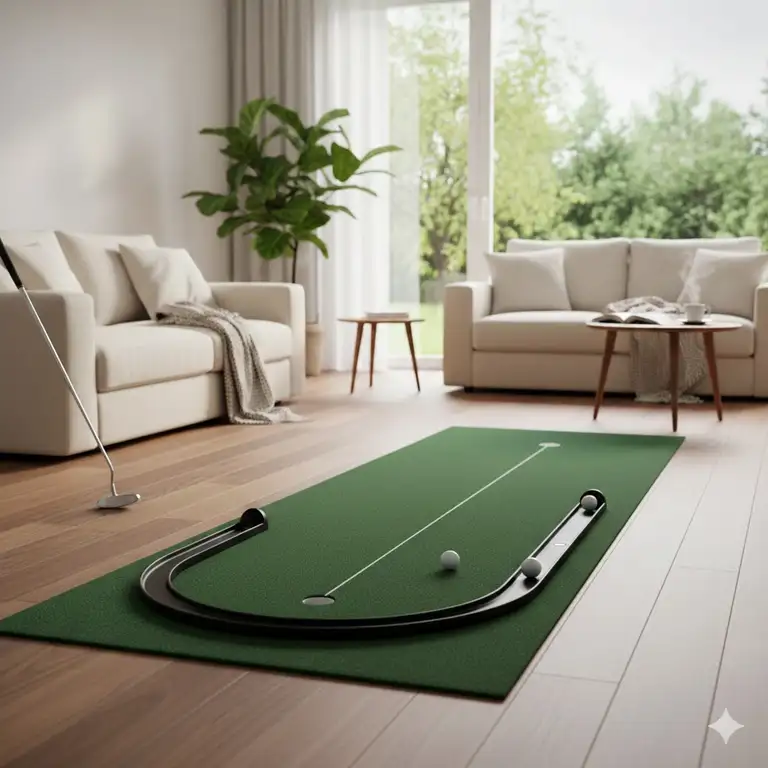
Floor space and patience are what the Perfect Practice Putting Mat asks for. Golf Monthly calls it the best for holing putts and lists it near 9.6 feet, with a raised wooden end carrying two holes, train-track alignment lines and a ramp that sends every ball back to your feet, holed or not; its only con is the amount of floor it needs. Breaking Eighty’s tester found that two holes of different sizes made the regulation cup feel bigger and lifted his confidence, though he calls the turf average and carpet-like and the mat narrower than rivals. Sources put it between $130 and $150.
Flatness is the weak spot. Plugged In Golf’s review praised the adjustable-length magnetic return and a setup of no more than two minutes, then worked through the wrinkle worry with books. Readers in its comments reported loud ball drops and magnets that came loose from the wooden strips, which are unverified reader reports. Golfers Authority’s V5 write-up asks for about 24 hours before the ends settle and says the roll trails the most realistic mats it tested. Stimp figures conflict too, with Golf Monthly giving 10 to 14 and Golfers Authority 10 to 11, so read the label. Plugged In Golf’s V5 review says the update changed the putting surface, which makes older flattening reports worth weighing against the edition on the listing.
Pros:
✅ Two cups, one regulation size and one about half size, per Plugged In Golf
✅ Return length adjusts to the putt, per Plugged In Golf
✅ Works on tile and carpet, Golf Monthly’s tester says
Cons:
❌ About 24 hours to flatten, according to Golfers Authority
❌ Reader reports of loud ball drops and loose magnets
❌ Needs more floor than a bare strip
Perfect Practice Putting MatSee current price, sizes and reviews on Amazon.
Where putting mat purchases go wrong, and how to recover
Putting on a mat that is still creased
GolfLink’s tester says a mat full of ridges from being rolled up is nearly impossible to practice on. The remedy is time and weight, the same books Plugged In Golf used, and a day of patience before judging the roll.
Storing it the wrong way round
Golfers Authority warns that a BirdieBall foam mat rolled the wrong way can take about 90 minutes to flatten, and Plugged In Golf’s review of that brand says the included instructions explain the right direction. Keep the box insert or note the direction on day one.
Blaming your stroke for the floor
Golf Geeks’ five-ball test exists because a mat conforms to whatever is under it. Golfers Authority’s review of a thin 16-foot mat makes the same point: when the surface is thin, you can’t always tell whether a miss came from the floor or from you.
Cleaning it the wrong way
Care differs by construction. BirdieBall’s page tells owners of its foam mat to sweep with a stiff broom, spot-clean with mild soap and never vacuum, because a rotating drum can damage the surface, while The Left Rough says the Perfect Practice Putting Mat can be vacuumed without harm. Read the maker’s care page before reaching for the vacuum or an iron.
Putting and chipping mat golf: where one surface stops working
Shoppers searching for a putting and chipping mat golf setup should separate two jobs. BirdieBall’s page lists chipping on the surface among the things to avoid on its foam mat, alongside walking in putting lines and wearing high heels, and labels that mat indoor only. Golf Monthly’s best-overall pick, the PuttOUT AirBreak Putting Mat, does double as a chipping green, but it is a large platform with air-adjustable contours and a battery ball return, and it costs well above any of the four mats here in both reviews that list it. None of the pages opened for the four mats above describes chipping as an intended use, so treat them as putting tools. Golf Monthly’s indoor putting green roundup is the place to start for a combined short-game setup.
What golf putting mats reviews agree on, and where they split
Flatness draws the most agreement. Golf Monthly’s buying notes say cheaper mats can wear faster and roll inconsistently with daily use, and a good mat keeps the ball rolling level. GolfLink, Plugged In Golf and Golfers Authority all describe creases or curl on at least one mat in this guide before the surface settled.
Speed claims and ball returns are where the reports split. Golf Monthly’s tester read the PuttOUT Medium Putting Mat below its printed range, Golf Insider’s carpet reading fell under 8, and two reviews give the Perfect Practice Putting Mat different Stimp ranges. On returns, Plugged In Golf found the magnetic return on that mat worked very well, while Golfers Authority found the gravity track on the SKLZ Accelerator Pro Putting Mat unreliable, which suggests the cheaper track is the likelier source of frustration. That reading is mine, drawn from two separate reports.
Length, carpet, wrinkles and speed: quick answers
❓ How long should a putting mat be for home practice?
✅ Mats in this guide run about 8 to 10 feet. Golf Monthly says longer greens help with pace and distance control, while mats with holes build confidence. Measure your room first, leaving space to stand and for a missed putt to roll past the end.
❓ Does a putting mat work on carpet?
✅ Only on the right carpet. Golf Geeks says tight, low-pile carpet over a firm floor works, while plush or padded carpet does not, and a plywood sheet underneath helps. Golf Insider's test of one mat read under 8 on fluffy carpet.
❓ How do I get wrinkles out of a putting mat?
✅ Unroll it flat and weigh it down. Plugged In Golf's reviewer got a two-hole mat rolling true after about 30 minutes under heavy books, and Golfers Authority reports about 24 hours for a newer edition. Check the maker's care page before using heat.
❓ What Stimp speed should a putting mat have?
✅ Match it to the greens you play. Mats in this guide claim roughly 9 to 11.5, and Golf Monthly's tester put one closer to 9 than its range. Floors shift the number further, so judge a mat by its roll, not its label.
❓ What is the difference between a putting mat and a golf putting green?
✅ Listings use the terms loosely, but mats are portable roll-outs while installed greens are turf surfaces. BirdieBall's FAQ says its foam mats are indoor only and points outdoor buyers to a separate turf option.
Which mat to buy, and how to decide
Pick the floor first, then buy the mat built for it. Among golf putting mats, the Wellputt Classic Green 10ft suits a hard floor and speed work, the PuttOUT Medium Putting Mat suits a floor that tends to wrinkle or a tighter budget, the Perfect Practice Putting Mat suits anyone with the space for two cups and a return, and the SKLZ Accelerator Pro Putting Mat is the lowest-cost way to get a return at all.
The best golf putting mat 2027 buyers will find is the one that lies flat on their own floor, and none of these four wins without that. For a first mat on an unknown floor I’d start with the PuttOUT Medium Putting Mat, since it lies flat at once and costs less than the Perfect Practice Putting Mat or the Wellputt Classic Green 10ft. Add a plywood sheet if the carpet is thick.
Disclaimer: This post contains affiliate links. As an Amazon Associate, I earn from qualifying purchases made through these links, at no additional cost to you.
Run the five-ball test on your floor before you order a mat.