Put a fresh set of Golf Pride Tour Velvet grips on your clubs, in the size your hand measures for, and change brands only when a specific problem pushes you to. That is the safest answer among golf club grips, and the reasoning is plain: MyGolfSpy reports that 20 of the top 50 players use a version of it, and describes its core design as virtually unchanged since 1995. Size, age and cleanliness matter more than the logo, so the 2027 shortlist below ties each of seven options to a hand, a climate or a habit. Anyone hunting for the best golf club grips for sweaty hands, sore joints or a habit of squeezing too hard will find those covered, along with extension options, shop prices and a replacement method.
The findings come from desk research: Golf Monthly’s multi-week grip test, MyGolfSpy’s roundups, USGA equipment pages, retailer service pages and owner threads on The Sand Trap and Team Titleist. Prices appear as ranges only, and where two sources disagree the text says so.
Size, material and firmness: what separates golf club grips
Hand size comes first. MyGolfSpy’s sizing guide measures from the tip of the middle finger to the base of the palm where it meets the wrist: 5 to 6.5 inches points to undersize, 6.5 to 7.5 to standard, 7.5 to 9 to midsize, and anything over 9 to jumbo. Between sizes, tape wraps fill the gap. Global Golf’s regripping service says each wrap adds 1/64 inch and includes up to six wraps free. The same MyGolfSpy guide notes that some players grip less tightly with a slightly larger grip.
Material is the second split. Rubber is the most common, tacky and firm, and it holds its texture. Cord blends rubber with a cord-like fiber for extra traction, which suits players who skip the glove. Synthetic compounds trade some firmness for shock absorption, the category MyGolfSpy links to golfers with wrist pain or finger arthritis.
Firmness decides how a grip ages. Soft, cushioned grips feel plush on day one, but the owner reports further down show them wearing faster. Firm cord lasts longer and is harder on the hands. Golf Monthly’s reviewer says feel matters most and advises handling several models, and adds that good grips last for years, so a little extra spend on durability is reasonable.
Pick
Suits
Feel
Watch for
Golf Pride Tour Velvet
A first full set, all-weather play
Medium, all-rubber
Dirt and oil dull traction
Golf Pride MCC Plus4
Wet weather, a tight top hand
Firm, cord top, rubber below
Cost across a full bag
Lamkin Crossline
Value, drivers
Firm, less tacky
One color only
Golf Pride CPX
Soft-feel seekers
Soft and tacky
Sources split on wear
Winn Dri-Tac
Sore hands, hot days
Plush, cushioned
Short life in owner threads
Golf Pride ZGrip Cord
Sweaty hands
Firmest cord in the line
Hard on the hands
SuperStroke Zenergy Pistol Tour
Putters
Tacky outer, firm core
Putter-only shape
The table splits by what each grip trades away. The Golf Pride Tour Velvet and Lamkin Crossline give up a little softness for longevity, the Winn Dri-Tac and Golf Pride CPX give up some life for comfort, and the Golf Pride ZGrip Cord gives up comfort for traction. Decide which of those trades you can live with before you look at colors.
The best golf club grips for seven kinds of hand and swing
MyGolfSpy’s Amazon roundup calls it the “gold standard” and says it earns the title: tacky out of the box, excellent traction, and sold in nearly every size. Golf Monthly’s entry lists it from junior to jumbo, all-rubber with a medium feel, with or without Align ridge technology, and marks it down only for limited color choice. MyGolfSpy adds that Aaron Rai won the 2025 PGA Championship with a Tour Velvet Standard and two pieces of tape.
Owners split on feel. In a Team Titleist thread, one poster praised its weather performance, easy cleaning and low price, while another disliked the feel and moved to the Golf Pride MCC Plus4. Care matters more than with some rivals: MyGolfSpy warns that dirt and oil noticeably reduce its grip, so regular cleaning is part of the deal. Cost is modest. Global Golf’s own worked example pairs a Tour Velvet with its $4 install and lands under $10 for the club.
Squeezing too hard is the habit this one targets. MyGolfSpy’s writers name it the pick for reducing tension: a hybrid material soft enough for comfort that still controls the face through impact, with a larger lower-hand section that encourages lighter pressure. The flip side is that heavy top-hand tension wears the traction faster, so a lighter hold extends its life.
Golf Monthly’s entry for the MCC line describes brushed cotton on the top half for glove-hand traction and rubber on the lower half for feel, firm overall, available with Align and Plus4 versions, and recommended for wet conditions. The drawback it flags is cost if every club in the bag gets one. A small Team Titleist thread offers a durability signal: all three posters who used the MCC Plus4 were positive about wear, and one switched to it from a Winn Dri-Tac because it felt similar and lasted longer. Three posters is a small sample, though it points the same way as the other owner reports here. Look up current pricing on Amazon.com.
One color and a less tacky surface are the limits to know first. Golf Monthly’s reviewers gave it their best-value label, describing a firmer feel than many rivals, a good match for drivers, and durability. It comes in a single color, so matching a bag’s look is not an option.
A Team Titleist poster who had used Tour Velvet grips for years said the Lamkin Crossline would be his closest substitute if they ever became unavailable, which is one owner’s view rather than a trend. Check the current price on Amazon.com.
4. Golf Pride CPX — soft diamond pattern, mixed durability
Two respected outlets read this grip differently. Golf Monthly made it the top pick of its Golf Pride roundup and its wider test, praising a tacky feel, an EXO diamond-quilted pattern and sizes from undersize to jumbo, with the main negative being wet-weather performance. MyGolfSpy’s writers found the standard CPX plush but said its rubber wears away quickly, which costs traction and face control.
The gap probably reflects how each outlet judged it: one weighs feel in weeks of range and course testing, the other flags longevity. That is reasoning, not a measured result.
Pros:
✅ Top pick in Golf Monthly’s test, with a tacky feel
✅ Four sizes, undersize through jumbo
Cons:
❌ MyGolfSpy says the rubber wears quickly
❌ Golf Monthly notes it is not the best in wet conditions
5. Winn Dri-Tac — cushioned comfort that wears faster
Comfort is the whole pitch. MyGolfSpy names it the best grip for arthritis, with a large profile and shock-absorbing technology, plus a dry, tacky feel in warm conditions. Its Amazon roundup calls the Winn Dri-Tac a solid upgrade for golfers who put comfort ahead of firmness.
Durability is where owners push back. In a 2021 Sand Trap thread of about 11 participants, several posters said Winn grips wear out quickly, one got 15 rounds in a season before planning a regrip, and the original poster had back-seam tears on four of seven grips. He suspected counterfeits from an online marketplace, which he could not verify, and Winn sent replacements. One poster agreed on wear but said the grips hold well wet or dry. Two Team Titleist posters liked the midsize feel and doubted it would last.
MyGolfSpy’s own writer got roughly 1.5 years from a set, so wear seems to depend on how often and how hard a golfer plays. Buy from a reputable seller, given the counterfeit worry in that thread.
Golfers whose palms run wet are the audience. Golf Monthly’s pick for sweaty hands has heavy cord throughout, two layers of texturing and a deep z-shaped pattern, in standard and midsize, and it is the firmest cord grip in the Golf Pride range. MyGolfSpy’s writers agree it is durable and performs well, yet found it hard on the hands and preferred the softer Golf Pride CP2 Wrap.
Pros:
✅ Cord throughout for traction when hands sweat
✅ Durable, per MyGolfSpy
Cons:
❌ Both outlets flag comfort
❌ Only standard and midsize on the page Golf Monthly reviewed
Putter grips follow different rules, which is why this one sits apart. Only putters may carry a non-round grip, and MyGolfSpy notes that a putter grip with a flat side cannot legally go on other clubs. Golf Monthly’s top putter grip pairs a tacky outer with a firmer core and varied texture, and it can be counterweighted. MyGolfSpy’s Amazon reviewer calls it a personal putter choice, with a traditional pistol shape plus No Taper and SPYNE technologies aimed at quieter hands.
Sizing works differently here. MyGolfSpy says putter size depends more on feel and consistency than hand measurement, so even small-handed golfers may like a jumbo. Alternatives from Golf Monthly’s test include the thin Ping PP58 and the Golf Pride Reverse Taper, which the reviewer picked for comfort. The Zenergy line comes in many variants, so confirm the exact one on the listing before ordering.
What the golf club grips reviews agree on, and where they split
Three sources, three methods. Golf Monthly’s test, led by a PGA professional and a former EuroPro Tour player, put nine grips through days or weeks on the range and course in hot, cold, wet and sweaty conditions. MyGolfSpy’s “Golf Grips We Love” sorts its picks by category, and its Amazon roundup covers five options including the SuperStroke REVL Comfort Midsize, which the reviewer calls one of the most underrated recent releases, and the Saplize CC01, a 13-pack the reviewer pegs as a budget choice for occasional players.
The overlap is the useful part. Golf Pride appears on all three lists, and ridge-style alignment grips earn praise twice: Golf Monthly says the pronounced ridge on the Golf Pride Align Max works almost as a training aid, while MyGolfSpy names the Golf Pride Tour Velvet ALIGN best for consistency. Golf Monthly also singles out the SuperStroke S-Tech as a middle ground in softness with cross-traction for wet weather, and the Iomic Sticky 2.3 for very tacky grip with minimal twisting, though not for large hands.
The splits are the Golf Pride CPX on wear, the Winn Dri-Tac on durability and cord grips on comfort. Neither Golf Monthly nor MyGolfSpy publishes prices or measured grip-pressure data, and Golf Monthly’s 30 percent dispersion claim for the Iomic Sticky 2.3 comes with no stated method. Treat these golf club grips reviews as expert opinion, and weigh them against the owner threads above.
Extension grip for golf clubs: when length is the problem
An extension grip for golf clubs usually means one of two things: a butt extender that adds shaft length under the grip, or extra tape that adds thickness. They solve different problems.
Butt extenders fit inside the open end of the shaft. A steel version at Grips4less comes as a double-length piece you cut in half, each half a 6-inch piece with a 3-inch tapered section inside the shaft and 3 inches outside. The listing says to measure the shaft’s inside diameter, sand lightly, bond it with shafting epoxy and cut to length after it cures, and it warns that an improperly installed extension can come loose and cause injury, recommending a club-building professional if you are unsure. It is listed at under $10. The GolfWorks universal plastic extension sold through AdoreGolfGrips fits butt diameters from about 0.475 to 0.585 inches on graphite or steel, and its page warns that adding more than 2 inches may weaken the shaft.
Length changes balance. Grips4less’s Q&A says each half inch added raises swing weight by about 3 points, so an extended club feels heavier in the head. Shops handle the work: Golf Galaxy’s service page lists lengthening a shaft without regripping at about $8, with the new grip priced separately.
Rules matter too. Australian Golf Digest explains that temporary, non-permanent butt-end attachments such as ID tags, tees, ball retrievers and Arccos or ShotScope sensors are allowed, but a performance-enhancing extender on a driver already near the 48-inch limit is not covered by that exception. If you only want a thicker handle, tape wraps are the simpler route, within the 1.75-inch diameter cap in the USGA’s grip rule.
The cost of putting a new grip on a golf club, shop versus garage
At a shop, the cost of putting a new grip on a golf club is mostly the grip itself, with labor the small part. Golf Galaxy’s service page lists standard grip installation at around $4 a club and long or belly putter grips at around $6, with removing and keeping an older grip at about $6 and a 24-hour guarantee. Global Golf charges $4 a club on top of the grip, with its example of a Tour Velvet on a driver coming in under $10 for the grip and install together, and its service page adds that wraps are free.
Run the arithmetic for a full bag: 14 clubs at around $4 of labor is roughly $55 before a single grip is bought. Grip prices vary widely by model, so look up current pricing on Amazon.com for the one you choose. MyGolfSpy’s Amazon roundup describes the Golf Pride Tour Velvet as affordable and the Saplize CC01 13-pack as budget-friendly.
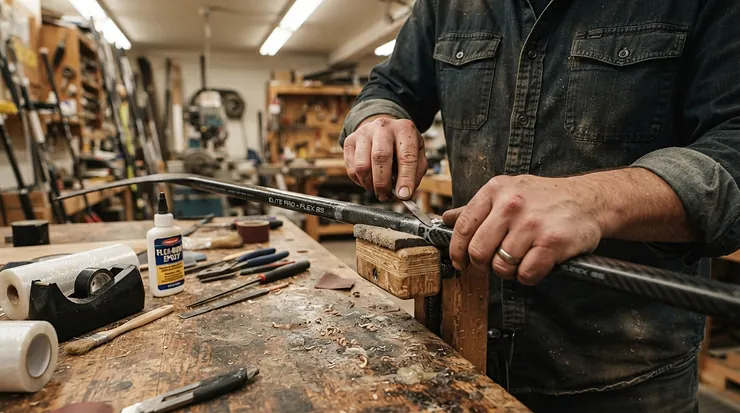
Doing it yourself removes labor but adds tools: a hook-blade knife, a vise with a rubber shaft holder, two-sided grip tape and solvent, with a heat gun optional. On a single club, shop labor is the cheaper route. Across a full set, the saving builds, and the method below takes a beginner about 10 to 15 minutes per club.
Golf club grips how to replace: a garage-bench method
Lay out the hook-blade knife, vise with shaft holder, tape, grips and solvent before you start; mineral spirits can stand in for solvent.
Cut the old grip lengthwise from the bottom toward the top, taking care not to cut into a graphite shaft, then peel it away.
Strip the old tape, warming it evenly with a moving heat gun; leftover tape makes the new grip thicker and changes its feel.
Wipe the shaft clean and let it dry, since solvent left behind stops new tape from sticking.
Mark the grip length on the shaft and apply two-sided tape, leaving about half an inch overhanging the tip, then tuck the excess into the shaft.
Spray solvent on the tape and inside the grip; more solvent makes sliding easier but takes longer to dry.
Slide the grip on in one smooth motion until it sits flush at the butt end with no play, and align it before the solvent sets.
Stand the club head-up briefly so trapped air does not push the grip up, then let it dry for 10 to 15 minutes.
Two warnings from the same source: don’t overtighten a shaft in the vise, and expect putter grips, which are more rigid, to need more solvent. A stuck grip can be freed with an air compressor or a removal tool, and cutting it off is the fallback.
Golf grip aid: training grips, glove wraps and the rulebook
A golf grip aid can mean a trainer that shapes the hold, a wrap that keeps the hands secure, or the supplies that help you install a grip. The first kind needs a rules check.
Plugged In Golf’s review of the Golf-Grip training aid describes a snap-on trainer of about 20 grams that fits any grip size and any full-swing club but not putters. It lines up with a square clubface by default and can be set stronger or weaker. The reviewer found his own grip was stronger than he realized with the driver, and noted that the alignment takes time to set and the device can shift slightly during a swing. The review does not address on-course use, and the rules do.
MyGolfSpy’s grip rules chart says training grips with molded finger placement are non-conforming and should come off before a round. The USGA’s grip rule says a grip cannot be molded for the hands, meaning it cannot let a player place the hands by feel alone, while subtle texture changes and visual markings are generally acceptable. Non-putter grips also have to be circular in cross-section, apart from one slightly raised straight rib, no thicker than 1.75 inches, and at least 7 inches long.
The second kind is the Grip Wrap by Gary Wiren, which AskJAN lists as a one-size-fits-all strap that attaches to a golf glove’s Velcro tab and locks the lead hand to the club. AskJAN describes it as suited to arthritis or hand injury and to golfers who want a firmer connection without gripping too tightly. Treat it as a practice and comfort tool and check its legality with a rules official before a competitive round.
Three ways a fresh set of grips disappoints
The first is the wrong size. A grip that does not match the hand changes how much control the player has to release the club, a point MyGolfSpy ties directly to proper sizing. Measure before ordering and use tape wraps to fine-tune rather than buying another set.
The second is letting dirt and oil win. MyGolfSpy’s Amazon reviewer notes that grime noticeably reduces Golf Pride Tour Velvet traction, and the how-to recommends warm soapy water and a nylon brush, rinsed thoroughly. The same site tells serious golfers to replace grips at least once a year, sooner if you are squeezing harder to control the club or the surface has lost its tack.
The third is expecting every soft grip to last. The Winn Dri-Tac threads above show how short that life can be for some golfers, and MyGolfSpy says heavy top-hand tension wears out the Golf Pride MCC Plus4 faster. Lighter pressure extends life, which is another reason to size correctly.
Sizing, lifespan, legality and cost: golf club grips answered
❓ How often should golf club grips be replaced?
✅ MyGolfSpy advises serious golfers to change them at least once a year. Replace sooner if you must squeeze harder to control the club, the surface feels slick or loses tack, or you notice control slipping at impact.
❓ What size golf grip do I need?
✅ MyGolfSpy's method measures from the middle fingertip to the base of the palm: 5 to 6.5 inches suggests undersize, 6.5 to 7.5 standard, 7.5 to 9 midsize, and over 9 jumbo. Extra tape wraps fine-tune between sizes.
❓ Is regripping a club at home realistic?
✅ You need a hook-blade knife, double-sided grip tape and solvent; a vise with a rubber shaft holder and a heat gun make it easier. MyGolfSpy puts beginners at 10 to 15 minutes per club, and mineral spirits can replace solvent.
❓ Are training grips legal during a round?
✅ No, not if they are molded for the fingers or hands. The Equipment Rules bar grips that let a player place the hands by feel alone, so take a trainer that guides finger placement off before play. Subtle texture and visual markings are generally acceptable.
❓ What does regripping a full set cost at a shop?
✅ Labor runs around $4 a club at Golf Galaxy and Global Golf, so a 14-club set adds roughly $55 before the grips themselves. Removing and keeping old grips, or lengthening a shaft, cost extra on Golf Galaxy's service page.
Which grip goes on your clubs first
Start with your hand, not the brand. Measure it, choose a size, and put the Golf Pride Tour Velvet on every club unless a specific problem says otherwise. Squeezing too hard or playing in rain points to the Golf Pride MCC Plus4. Tight budgets and drivers suit the Lamkin Crossline, sore hands and hot days suit the Winn Dri-Tac with a shorter replacement cycle, and sweaty palms suit the Golf Pride ZGrip Cord. A putter deserves its own choice, like the SuperStroke Zenergy Pistol Tour. Whichever set of golf club grips you pick, shop labor for a full bag is modest next to the grips themselves, so do not let the install price decide the model.
Disclaimer: This post contains affiliate links. As an Amazon Associate, I earn from qualifying purchases made through these links, at no additional cost to you.
Measure one hand, buy one set, and let your next round settle the rest.
At GolfEquipHub, we bring expert insights, reviews, and guides on the best golf equipment to enhance your game. Our team is dedicated to helping golfers of all skill levels find the perfect clubs, accessories, and gear for peak performance on the course.