A golf hitting net for backyard use can fail in three different ways: a skied shot clears the top, a gust flattens the frame, or the netting wears through. Testers at MyGolfSpy and Golf Monthly, along with forum owners, flagged all three, which is why this 2027 guide sorts four nets by the kind of yard they suit instead of crowning one winner.
No net was set up on a lawn for this guide. The findings come from MyGolfSpy’s scored 2021 test, Golf Monthly’s five-net test, maker pages, a long-running forum and retailer listings, and every opinion about feel is credited to the person who held it. Prices are ranges drawn from those pages, so the current figure on Amazon.com may differ.
The four picks for a backyard golf practice net cover an evening-session lawn, a fixed hitting corner with a mat, a spot where the net never comes down, and a tight budget.
Depth, wind, shanks and rebound: what separates backyard nets
Spec sheets for golf practice hitting nets for backyard use all read alike: a frame, some mesh, a carry bag. Four differences show up once testers and owners get involved.
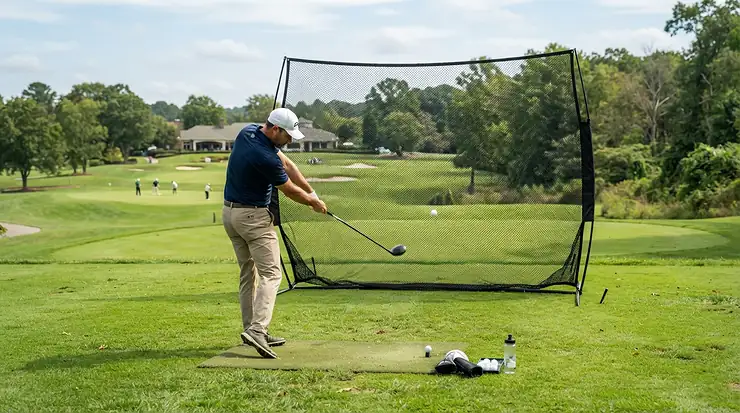
Depth comes first. The maker’s page for the Spornia SPG-7 asks for at least 10 feet of hitting depth, and MyGolfSpy tells buyers to leave extra room behind any net.
Wind comes second. MyGolfSpy says single-piece nets can behave like a trampoline in a gust and even become airborne, while open designs with large holes resist wind better and many nets accept stakes.
Then there is protection above and beside you. Golf Monthly’s tester found that one budget pop-up had no side cover and felt uneasy hitting wedges into it, and that a low-roofed net risks the club striking the top piece.
Rebound is last. A ball return is a sloped base that rolls the shot back to your feet, and it saves walking, but the same tension that catches a driver can also send a thin shot back hard.
Model
Size (W × H × D)
Weight
Ball return
Roof or side cover
Price range
Spornia SPG-7
7 × 7 × 7 ft plus 1 ft roof (maker)
25 lb (maker)
Yes
Roof attachment included
$300 to $350
Rukket Haack Pro
9 × 7 × 3 ft
About 15 lb (MyGolfSpy)
Yes (MyGolfSpy)
Cage design, no add-on panels listed
Low $200s
Net Return Pro Series V2
8 × 7.5 × 3.5 ft
28 lb (maker)
Yes, no motor
Side barriers and roof sold apart
$640 to $800
Amazon Basics Golf Hitting Net
10 × 7 × 3 ft
About 18 lb
Sources disagree
None
Under $100
The table shows weight and footprint pulling in opposite directions. The 28-pound Net Return Pro Series V2 is the most planted of the four, while the Rukket Haack Pro is the lightest of the group in MyGolfSpy’s figures. Which is the best golf hitting net for backyard use depends on which row matches your lawn, because a net that suits a 10-foot-deep patio can be wrong for a narrow side yard.
Matching a net to your yard: from a quick evening lawn to a permanent corner
1. Spornia SPG-7 — a ball return that earns its keep
Short sessions on a lawn you would rather not cross after every swing are what this net is built for. Spornia’s page says it returns the ball to your feet after each shot, and Golf Monthly’s tester credits a steeply angled floor for gathering balls close to the hitter. In the box, per the maker, are a noise-reducing target sheet, a roof attachment, a circular chipping basket and a carry bag.
Weight and dimensions are one place where sources disagree: Spornia lists 25 pounds and a 7-foot cube, while MyGolfSpy’s table shows 20 pounds and a different footprint. The maker’s numbers are the safer ones to plan around.
MyGolfSpy’s testers scored it first for ease of use and features and praised its quiet impact. They also named two drawbacks: it takes practice to fold down, and it will not hold up in strong wind. Golf Monthly agreed on takedown, saying it demands “serious origami skills” and some hand strength to fight the frame tension. One reader in MyGolfSpy’s comments says theirs leans slightly to the right, which is a single report.
Budget between $300 and $350, since Golf Monthly put it near $300 and the maker’s page shows a little more. The netting carries a 60-day warranty and the frame a year, a much shorter window than Net Return offers.
Pros:
✅ Ball rolls back to your feet after a shot
✅ Roof attachment included, and Golf Monthly found the side cover ample
✅ Quiet impact, per MyGolfSpy’s testers
Cons:
❌ Takedown is fiddly, according to two independent testers
❌ MyGolfSpy says it will not hold up in strong wind
❌ A footprint seven feet deep can rule out narrow side yards
Spornia SPG-7See current price, sizes and reviews on Amazon.
Price puts this one below the Spornia SPG-7 and the Net Return Pro Series V2: the two retailer pages checked sit in the low $200s. It measures 9 × 7 × 3 feet, comes with a hanging target and carry bag, and one retailer sells a version bundled with a hitting mat. Rukket advertises a lifetime warranty on its nets.
MyGolfSpy’s testers liked the wide, sturdy base and muted sound, and they scored it second for ease of use but fourth for stability and features. Its main complaint is setup time, and the Spornia SPG-7 drew a similar one about takedown. A 2017 thread on The Sand Trap adds a hands-on voice about the standard Rukket Haack Golf Net, a different, 10-foot-wide model. One owner, using it in a garage with a mat, says the base is heavy enough not to tip and the ball rolls back, and a second member says the same. Two members is thin evidence, and the thread is old.
The retailer page that was opened for the Pro shows no ratings or review count, so MyGolfSpy remains the main independent source. Rukket also sells a Pro variant with steel netting under its own listing, a separate product with its own price.
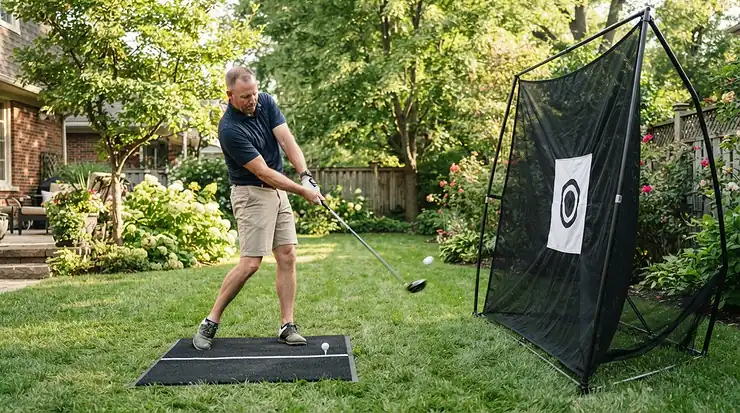
A fixed corner beside a fence, with a mat down and the net stored after each session, is where its wide base and low cost fit best. The frame folds into the carry bag that ships with it.
Rukket Haack ProSee current price, sizes and reviews on Amazon.
Net Return backs its netting for three years or 250,000 shots, whichever comes first, a term the Spornia page’s 60-day netting warranty cannot match. The frame is freestanding powder-coated aluminum with color-coded stainless push buttons, the sleeve is UV-protected polyester, and the maker lists 8 feet wide, 7 feet 6 inches tall and 3 feet 6 inches deep at 28 pounds.
Plugged In Golf’s reviewer assembled it in under five minutes the first time, against a maker claim of under 30 minutes, and said it caught a mix of balls and pucks without fuss. MyGolfSpy’s testers rated it first for both durability and stability, and also named its limited portability and high price. A reader there says the center sags four to six inches over time, which lowers the effective height; that is one report, not a pattern.
Add-ons change the math. The maker’s page prices side barriers at around $200 and its Net Return Pro Turf mat at around $480, and it lists an outdoor cover as its only weather accessory, with no wind rating given. The net itself runs between about $640 and $800, since the maker’s page shows a markdown while press reviews cite a higher figure.
Take a hypothetical hitting corner beside a shed that gets used year-round: that is where the weight and cost make sense. Plugged In Golf’s reviewer suggests the optional roof attachment for shots that go over the top.
Net Return Pro Series V2See current price, sizes and reviews on Amazon.
No side netting, and sources disagree on whether there is a ball return at all. MyGolfSpy’s table lists one and named this net its Best Value, while a GolferHive review says balls simply collect at the base. Both agree on the size, 10 × 7 × 3 feet, and a weight of about 18 pounds.
MyGolfSpy’s testers found it easy to set up, compact and surprisingly durable, with a frame that held in wind, and they said it offers few features. A reader there adds that Amazon does not sell replacement nets and that balls bounced back hard. The GolferHive reviewer reports more than 500 real-ball driver hits at roughly 105 to 110 mph without tears, but also says the supplied stakes are too short for hard or windy ground and that the frame slid an inch or two on smooth garage concrete.
The same review cites users whose fiberglass poles splintered after a year or more outdoors, and advises against leaving it out permanently. Expect to pay under $100.
Pros:
✅ Widest hitting area of the four at a low cost
✅ Sets up in a few minutes without tools, per GolferHive’s timing
✅ MyGolfSpy rated it a Best Value
Cons:
❌ No side netting for shanks
❌ Ball return is disputed between sources, and one reader reports hard rebounds
❌ Stakes and poles reported as weak points outdoors
Amazon Basics Golf Hitting NetSee current price, sizes and reviews on Amazon.
Golf matt and net for backyard: the mat decides how long your lawn survives
MyGolfSpy’s net testers say to use a mat in front of a backyard net because grass wears away quickly. The mat is a real line item in any golf matt and net for backyard budget, and the maker-branded ones can cost more than the cheapest net above.
Size is the first choice. MyGolfSpy’s hitting mat guide notes that most driving ranges use 5 × 5 foot mats, but it suggests a smaller, more portable mat for an outdoor net.
Stability is the second. The same guide says the mat must not move during the swing, and it found the Rukket Twin Turf shifts a lot when you hit into the grain, while the larger Rukket XL Tri Turf, at 36 × 24 inches, is steadier than the regular Rukket Tri Turf. A poster in The Sand Trap’s backyard-net thread says a long hitting strip slid on wet grass and fixed it by nailing it to a wooden tile; that thread dates from 2011 to 2013, so treat the product details as old.
Wear is the third. MyGolfSpy says plush turf can last close to 10,000 shots before iron-strike dents get bad, and that rotating a worn 5 × 5 mat a quarter turn clockwise gives a fresh hitting area. It also notes that firmer mats send more shock into wrists and elbows, and that most modern mats include built-in shock absorption.
On price, the maker of the Net Return Pro Series V2 sells its Net Return Pro Turf for around $480. The standard Rukket Tri Turf measures 25 × 16 inches, according to MyGolfSpy’s guide, which is why the XL’s extra footprint matters.
What a finished setup costs once the add-ons are in
Headline ranges hide the real spread between these nets, because the premium one is sold in pieces. Stacking the Net Return Pro Series V2 at $640 to $800 with side barriers at around $200 and its Net Return Pro Turf at around $480 lands at roughly $1,320 to $1,480 (my arithmetic from the maker’s page and Plugged In Golf).
The Spornia SPG-7 goes the other way. Its roof attachment, target sheet and chipping basket are already in the box, per the maker, so the first extra purchase is a mat, and the $300 to $350 range covers everything else.
The two cheaper nets sit at the opposite end: the Rukket Haack Pro in the low $200s and the Amazon Basics Golf Hitting Net under $100. A hypothetical buyer who hits mostly irons with plenty of clear lawn behind the net could reasonably spend less. One who swings a driver beside a fence line has more reason to put budget into side and roof cover, the area where Golf Monthly’s tester rated nets for safety.
Backyard golf net setup: space behind the net, anchoring and slack
A good backyard golf net setup is mostly about where the net sits and how it is held down. The order below follows what makers and testers emphasize.
Measure the depth first. Count the net’s footprint, your stance, and the clear lawn behind it; the Spornia SPG-7 page asks for at least 10 feet of hitting depth.
Point the net away from windows, cars and the neighbor’s fence. MyGolfSpy says to leave extra room behind it, and one budget net’s hanging target in Golf Monthly’s test pops audibly at impact, which matters if neighbors are close.
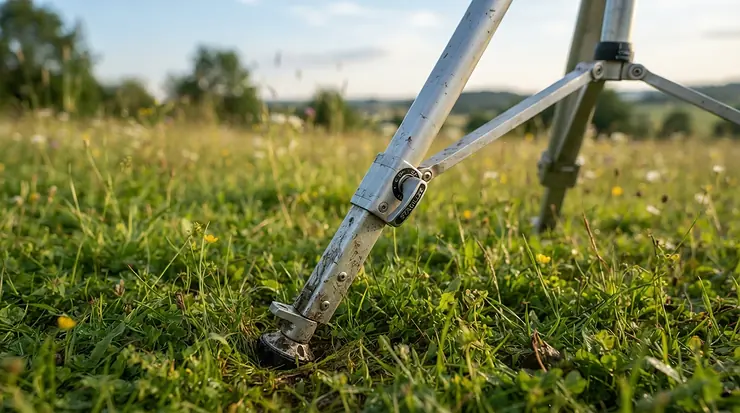
Anchor it. MyGolfSpy says many nets can be staked, and that weights work when the ground is too hard. The GolferHive reviewer found the stakes in the Amazon Basics Golf Hitting Net too thin for windy sites.
Hang it with some give. Owners on The Sand Trap say stretched netting is more likely to get punched through, and that a foot or two of slack along the bottom helps catch skulled shots.
Level the mat and keep foam balls in reserve. MyGolfSpy suggests foam balls for beginners or tight spaces.
Staking advice conflicts, and the owners say so themselves. One poster says staking the bottom pulls the net taut, while another suggests staking the back side to stop pass-through. One owner of a freestanding pop-up in the older thread says it blows over like other big nets and that a single bungee on the back leg steadied it.
Golf Monthly’s tester also warns that a lighter pop-up is not suited to permanent outdoor use in windy spots and recommends heavier pegs. Check local rules or HOA terms before leaving any structure in place, since they vary.
Golf hitting net for backyard reviews: where cheaper nets give out first
Across golf hitting net for backyard reviews from testers and owners, the weak points of cheaper nets repeat in the same three places: netting, poles and the area where the frame meets the roof.
On netting, MyGolfSpy’s scoring ranked the Amazon Basics Golf Hitting Net eighth for durability, while the Net Return Pro Series V2 ranked first. A poster in The Sand Trap’s older backyard thread reports that a roughly $100 net snagged and tore over time, and used large tarps hung behind it as a buffer. That is one owner, but it matches the pattern in the scores.
On poles, GolferHive’s review cites splintering fiberglass after a year or more outdoors, a failure the reviewer ties to sun and rain.
On roof geometry, Golf Monthly’s tester said a low budget net left no padding where its poles cross, raising ricochet concerns, and another with a low top piece could be hit by the club.
Slack in the netting, a mat that stays put and foam balls for tight spaces are the inexpensive fixes that testers and owners keep returning to.
Size, wind, mats and rebound: straight answers on a backyard golf practice net
❓ How much room does a backyard golf net need?
✅ Plan for the net's footprint plus clear space behind it. The nets above are 3 to 7 feet deep, and Spornia asks for at least 10 feet of hitting depth. MyGolfSpy also advises leaving extra room behind any net for stray shots.
❓ Can a golf hitting net stay up outdoors all year?
✅ Only some can. MyGolfSpy warns that light, single-piece nets can lift in wind, and Golf Monthly's tester rated one pop-up net as unsuitable for permanent use in windy spots. Freestanding aluminum frames with a UV-protected sleeve, such as Net Return's, are sold for outdoor use.
❓ Do I need a hitting mat with a backyard net?
✅ Yes, if you want to keep the lawn. MyGolfSpy says grass wears away quickly under repeated hits, and it suggests a smaller, portable mat for outdoor nets. Rotate the mat to spread out wear, and anchor it so it cannot shift mid-swing.
❓ Should I hit real golf balls or foam balls into it?
✅ Most nets here are built for real balls, but MyGolfSpy suggests foam balls for beginners or cramped spaces. Whichever you choose, hit a few half-speed wedges first to see where rebounds land before taking full swings.
❓ Do I need a roof or side panels on a backyard net?
✅ They help if your swing sends shots high or wide. Golf Monthly's tester found one budget net had no side protection and felt uneasy hitting wedges into it, while a model with roof and side panels earned praise. Some makers sell side barriers as add-ons.
Choosing by yard, not by star rating
Choosing a golf hitting net for backyard use starts with space, not stars. With at least 10 feet of hitting depth and a dislike of chasing balls, the Spornia SPG-7 suits sessions a few evenings a week. For a fixed corner with a mat down, the Rukket Haack Pro offers a wide, sturdy base at a lower cost. If the net stays up year-round, the Net Return Pro Series V2 ranked first for durability and stability in MyGolfSpy’s test and carries a three-year netting warranty. The Amazon Basics Golf Hitting Net fits occasional swings when the budget is tight and a ball return is not essential.
Whichever you pick, plan for a mat, some slack in the netting and clear lawn behind it. Measure the space first, then hold each net’s footprint against it before you click through.
Disclaimer: This post contains affiliate links. As an Amazon Associate, I earn from qualifying purchases made through these links, at no additional cost to you.
Before you order, compare the exact model name and dimensions on the listing, since Spornia, Rukket and Net Return each sell more than one size.