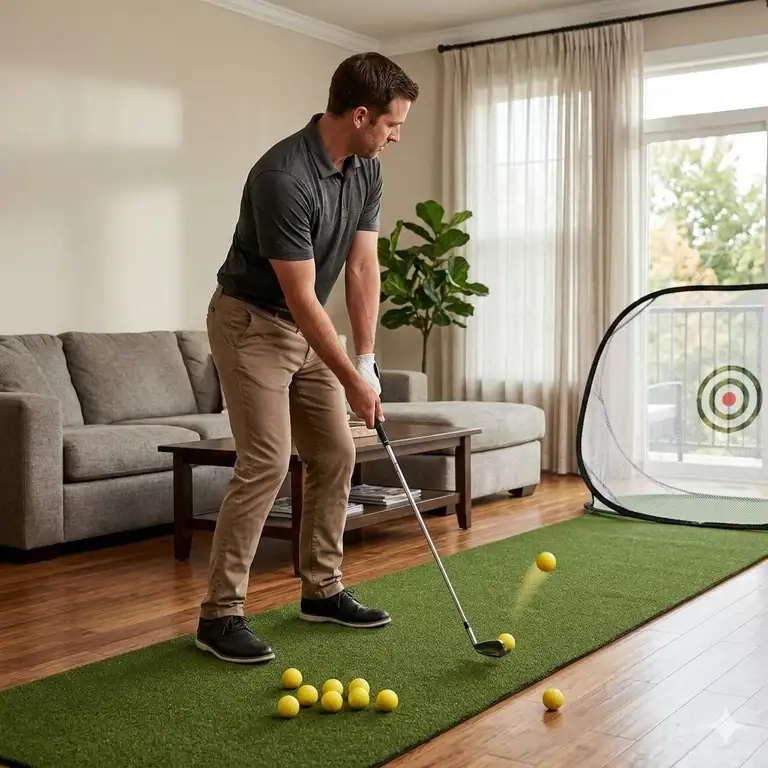
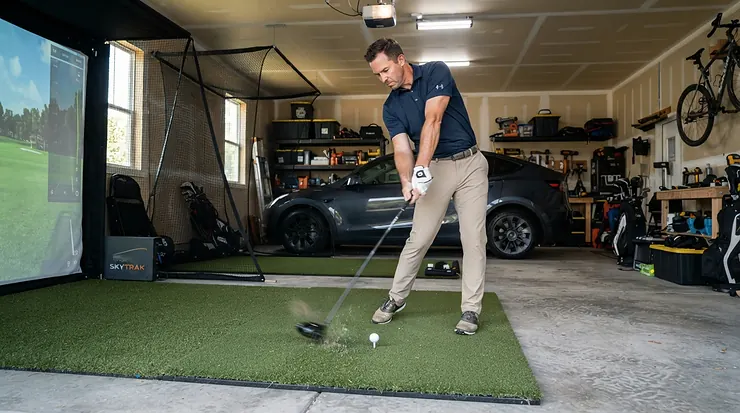
Buy the wrong practice golf balls and you pay twice: once at checkout, and again in a dented ceiling or a winter of feedback that tells you nothing about your swing. The category looks uniform in a mesh bag, yet a firm limited-flight ball that suits an open yard can be the wrong thing to swing near a window, and a soft foam ball that is safe in a basement says little about a driver. Space decides which type works, so the right practice golf balls for you depend on the clearance you actually have.
This 2027 guide matches five products to the spaces they suit. The findings lean on independent reviewers’ notes, the makers’ own pages and long owner threads on golf forums, and wherever a claim rests on a single reviewer, the text says so. Prices appear as ranges because sellers change them.
Flight, feel and impact: what separates one practice ball from another
Distance comes first, because it decides whether a ball fits your space. Golfers Authority’s reviewer measured the AlmostGolf Practice Balls at roughly 50 to 60 yards with a 7-iron and 80 to 95 yards with a driver, about a third of what a regulation ball travels. A reviewer of the BirdieBall Full-Swing Limited Flight Balls saw 40 to 55 yards from mid-irons and 25 to 40 from wedges, and the maker’s page states a flight of about 40 yards on a full swing. Sources disagree on how much of a real ball’s distance a softer foam ball keeps: Sports Illustrated’s roundup puts Callaway’s foam at 60 to 70 percent, while the test of the AlmostGolf Practice Balls lands nearer one-third. Treat every figure as a range and pace out the first session in your own yard.
Feel and spin feedback come second. Rapsodo’s explainer notes that foam balls travel the shortest distance, which makes them weak for judging shot quality but good for swing technique, while plastic balls fly farther yet are meant mainly for indoor use because wind carries them off line. A ball that visibly curves is the one that teaches face and path. The same reviewer of the BirdieBall Full-Swing Limited Flight Balls reports that watching a fade bend helped him turn it into a small draw, and that the change carried over to the range.
Impact tolerance is third. The reviewer of the AlmostGolf Practice Balls lists density as a drawback indoors, the reviewer of the SKLZ Limited-Flight Practice Balls advises against indoor hitting without a net or barrier, and the reviewer of the GoSports Foam Practice Balls saw no wall damage but warns that a flush strike can knock over lightweight objects. Durability and temperature close the list: the maker of the BirdieBall Full-Swing Limited Flight Balls tells owners not to hit below 45°F and to retire any ball that cracks, while a Sports Illustrated roundup says that ball holds up in hot and cold weather without warping. Those two statements point in different directions, so read the maker’s care notes.
Ball
Type
Reported flight
Space it needs
Typical pack price
BirdieBall Full-Swing Limited Flight Balls
Hard limited-flight polymer
About 40 yards; mid-irons 40 to 55 per one reviewer
Open yard or park; net indoors
Around $30 to $40 a dozen
AlmostGolf Practice Balls
Dense foam-type, about 13.5 g
50 to 60 yards with a 7-iron; 80 to 95 with a driver
Park or long yard; reviewer calls it too dense for indoors
Around $20 to $30 for 10
GoSports Foam Practice Balls
Soft dimpled foam
40 to 60 yards with a pitching wedge; driver near 80
Basement, garage or yard
Around $8 to $12 for 16
SKLZ Limited-Flight Practice Balls
Firm, full-size, dent-resistant
About 45 yards
Yard, or indoors only with a net or barrier
Around $13 to $18 a dozen
The pattern is plain: the more a ball resembles a real one in feel, the more room and the more cautious setup it demands. GoSports Foam Practice Balls sit at the safe, cheap end, BirdieBall Full-Swing Limited Flight Balls at the realistic end, and the other two fall between them. Pack prices come from the makers’ pages and the Sports Illustrated roundup, so confirm the current figure on Amazon.com before ordering.
How are practice golf balls different from range and course balls?
Three families get lumped together. Range balls are the heavy, thick-covered balls from the bucket at a driving range, and Rapsodo describes them as built with a thick outer layer and a cheaper rubber core to take a beating. Foam and plastic balls are the home-practice tier. Limited-flight balls such as the BirdieBall Full-Swing Limited Flight Balls sit in between, shaped or weighted to fly a fraction of normal distance.
Range balls are not a perfect stand-in for premium balls either. In Golf.com’s launch-monitor test, range balls left the driver at 162.7 mph against 168.7 mph for Titleist Pro V1s, and carry fell from 298 to 280 yards, a 6 percent drop. Foresight Sports’ help article cites a Today’s Golfer comparison in which wedges produced about 60 percent less backspin and roughly 15 yards less carry with a range ball, while irons lost only 1 to 2 yards. Foresight’s advice is to use range balls for tempo and shot shape, and to save premium balls for gapping and wedge calibration.
One more category matters for simulators. Rapsodo points out that its MLM2PRO tracks a pattern printed under the clear coat of the Callaway RPT Chrome Soft X, and Sports Illustrated says the Titleist Pro V1 RCT carries a core marker that radar launch monitors can read, at around $65 to $75 a dozen. Everything else on this page is a technique tool, and Rapsodo itself advises treating speed, spin and distance readings from practice balls with caution.
Best practice golf balls for each setup, matched to your space
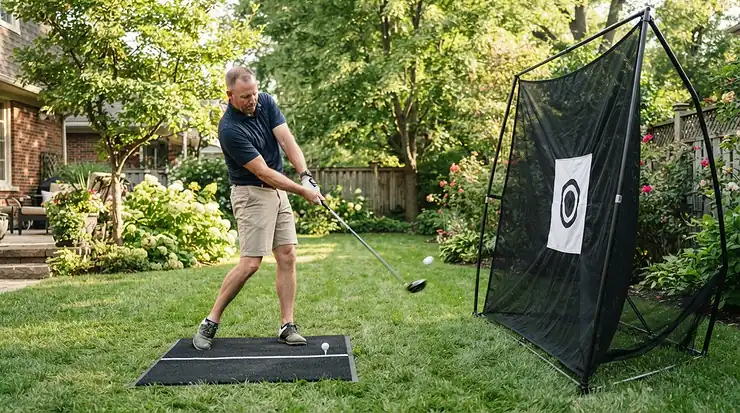
A backyard with 60 yards of clearance is where this ball earns its reputation. The maker lists a flight of about 40 yards, a cylindrical shape and a durable polymer body about half the weight of a golf ball, while Golfers Authority’s reviewer calls the material hard PVC-like plastic. That reviewer hit mid-irons 40 to 55 yards in a yard, at a park and on a football field, found impact feel and sound close to a real ball, and could read mishits easily. Wind moves the ball more than a real one, and teed driver shots need the separately sold Velocity Tee, which the reviewer did not test.
Durability is the open question. The maker’s FAQ, as relayed by the reviewer, promises a few hundred solid shots before cracking, and the same reviewer saw no wear after hundreds of strikes. The maker’s own product page shows a rating of about 4.9 out of 5 from 283 reviews, though one titled entry asks whether durability is an issue. That is one maker-hosted page, so weigh it accordingly, and note the page flagged the dozen as backordered at the time of writing.
Pros:
✅ Visible shot shape that shows path and face errors
✅ Impact sound and feel close to a real ball, per one reviewer
✅ Works with an indoor net, according to the reviewer’s FAQ summary
Cons:
❌ Cracks eventually, and the maker advises against hitting below 45°F
❌ Standard tees do not fit; teed shots need a separate tee
Compare the exact model number before buying, since the brand also sells school and instruction sets under similar names.
BirdieBall Full-Swing Limited Flight BallsSee current price, sizes and reviews on Amazon.
Indoors is where this ball struggles, and the reviewer says so plainly. Golfers Authority’s test lists density among the cons for indoor use, along with wind drift and an unexplained launch-monitor incompatibility. Outdoors, the same reviewer counts about 200 full swings over several sessions with only minor scuffs, mostly from sand, and no cracking; the review adds that hundreds of balls a day on hard mats would likely wear them faster.
At roughly 13.5 grams each, the ball feels like dense foam and sounds like a golf ball at impact, according to that review. Fades, draws and slices showed up clearly, and shots into a wooden fence left no marks. Sports Illustrated’s roundup lists it second, behind the BirdieBall Full-Swing Limited Flight Balls, and notes less spin feedback, and prices a 10-pack around $20 to $30. Larger packs lower the per-ball cost, but the reviewer warns that shipping can cancel the saving. A park, a school field or a long lot gives these balls the room they need.
AlmostGolf Practice BallsSee current price, sizes and reviews on Amazon.
At around $8 to $12 for 16 balls, this is the cheapest way into regular indoor swings in this guide. Golfers Authority’s reviewer hit about 50 chips in one evening and then dozens of indoor sessions in a basement with a mat and a chipping net, and found no scuffs or dents on walls the balls struck. The same reviewer warns that a flush hit can topple light objects, so move fragile items out of the way.
The weak spot is the long game. With a pitching wedge the reviewer got 40 to 60 yards, with a driver close to 80, and called the full-swing feedback “so different from a real ball” that it was not very useful. Sports Illustrated agrees the ball trails the BirdieBall Full-Swing Limited Flight Balls and AlmostGolf Practice Balls for distance and accuracy but names it the best value, with soft dimpled foam and a carry bag. The review body reports no cracks after several weeks, while its FAQ estimates a life of six to twelve months with regular use. A step-up foam option is the Callaway HX Soft Flight Foam Balls, which Sports Illustrated says fly straighter than typical foam thanks to HEX dimples, at around $10 to $15 for nine.
GoSports Foam Practice BallsSee current price, sizes and reviews on Amazon.
Golfers who want something heavier than foam, and the look of a regulation ball on the mat, are the target here. Sports Illustrated describes a solid feel with a pop-back that signals clean contact, a flight up to about 45 yards, and dent resistance that outlasts cheap plastic packs; the 12-pack costs around $13 to $18. Golfers Authority’s reviewer calls the ball full-size and firm, between foam and a real one, and reports no marks on nets, fences or siding, but gives no hit count and adds that long-term testing is missing.
Firmness cuts both ways. The reviewer would not recommend hitting them indoors without a net or barrier, says cold weather shortens flight and hardens the ball, and mentions they are heavier than a normal ball and hard to spot in grass.
Pros:
✅ Full-size and firm, closer to a real ball than most foam
✅ Resists denting, per Sports Illustrated’s roundup
✅ Shows no marks on nets or fences, per one reviewer
Cons:
❌ Needs a net or barrier indoors
❌ Flight and feel change in cold weather
SKLZ Limited-Flight Practice BallsSee current price, sizes and reviews on Amazon.
A golf practice net and mat bundle makes sense when the ball is only half the problem. Golf Monthly’s review describes a fibreglass frame with a nylon and polyester net that stands just over six feet high, ten feet wide and six feet deep, comes with a practice mat and three foam balls, and goes up in about ten minutes. The reviewer found it sturdy for iron shots with standard balls outdoors and used the foam balls to hit harder indoors. The verdict flags one limit: it felt a little flimsy under full-power driver swings.
This is the only independent write-up I could open for the kit, and the review links to the listing without stating a price, so check the current price on Amazon.com. Forum owners add context for any net-and-mat setup. A Sand Trap member who keeps a net in a basement hits foam rather than real balls and says that keeps the net lasting longer, and a Practical Golf forum member reports that real balls hit into a pop-up net can still strike the garage floor and shoot back out. Another Sand Trap thread suggests a tub lined with a blanket under the net to dampen those rebounds. For a golf net practice and mat kit, foam balls and a catch for rebounds matter as much as the frame.
Dexon 3M Golf NetSee current price, sizes and reviews on Amazon.
Golf practice indoor: ceilings, floors and what gets dented
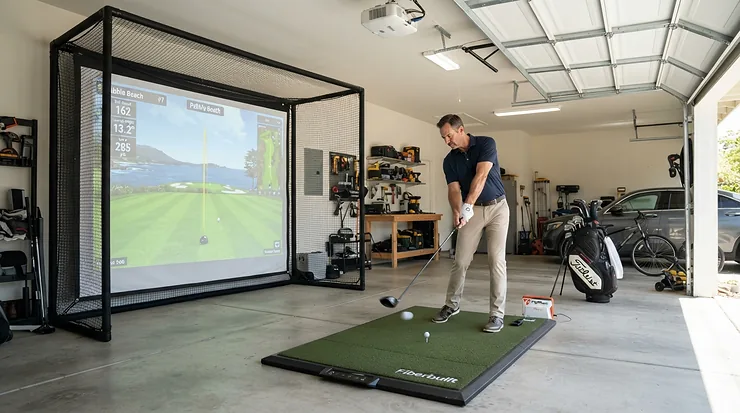
Ceiling height is the number worth checking before anything else. A Golf Simulator Forum member who set up a net and mat in a garage reported about a dozen ball dents in his drywall ceiling after kids and guests took swings, and another, who is 6 feet 3 inches tall, says his basement ceiling limits him to a 6-iron or shorter. A Golfers Authority review of the BirdieBall Full-Swing Limited Flight Balls suggests roughly 10 feet long, 8 feet wide and 8 feet tall for a net setup, and the Dexon 3M Golf Net stands just over six feet. Measure your swing arc before you buy a frame.
Rebound is the second surprise. Real balls bounce off concrete and nets, which is why a Sand Trap member lines a tub with a blanket under the net, and a Golf Simulator Forum member warns that a metal garage door behind the net may interfere with a radar launch monitor. Foam balls sidestep much of this, at the cost of readings: a Sand Trap member warns that foam gives odd reads on a simulator, and another Golf Simulator Forum member who hit ten Chrome Soft balls and ten foam balls through the same sensor saw a fair disparity. Foam suits rhythm and contact work, and the numbers can wait for a real ball.
Practice golf balls reviews: what testers and owners keep reporting
Read across the sources and a few findings repeat. Reviewers agree that distance is the trade for safety: roughly a third of normal for the AlmostGolf Practice Balls, about 40 yards for the BirdieBall Full-Swing Limited Flight Balls and roughly 45 for the SKLZ Limited-Flight Practice Balls. They agree that wind pushes the lightest balls around, and that foam gives less spin feedback than real balls. One Golf Simulator Forum member states the foam spin gap bluntly, and Rapsodo reaches the same conclusion about shot-quality work.
Durability reports are more mixed. The maker of the BirdieBall Full-Swing Limited Flight Balls admits they can crack, Golfers Authority’s reviewer reports sand scuffs but no cracking on the AlmostGolf Practice Balls after about 200 swings, and the reviewer of the GoSports Foam Practice Balls saw no damage after weeks of use. Plastic balls are where sources split: Sports Illustrated says the Joyberg Practice Golf Balls, a 24-pack priced under $10, get banged up over time, while another Golfers Authority review describes the same brand surviving more than 500 hits. Because those two outlets share an author, they are one voice, not independent confirmation.
Where the wrong ball goes wrong: wind, walls and winter
Matching the ball to the space prevents most failures. A hard ball indoors without a net is the expensive one: two of the reviewers above warn about exactly that. A foam ball used to judge a driver swing is the useless one, since the reviewer of the GoSports Foam Practice Balls found full-swing feedback unhelpful. Cold is the quiet one: the maker of the BirdieBall Full-Swing Limited Flight Balls sets a 45°F floor and a reviewer of the SKLZ Limited-Flight Practice Balls says cold hardens the ball and shortens flight, so a garage in January behaves differently from a yard in June.
Mixing ball types in one session muddies the picture. Foresight Sports advises using one type per session and discarding scuffed or cracked balls, and that rule applies to home practice as much as to a launch-monitor bay.
Foam, plastic, launch monitors and distance: straight answers
❓ How are practice golf balls different from regular golf balls?
✅ Regular balls are built for performance, while practice balls trade it for safety or durability. Foam and limited-flight models fly roughly 40 to 95 yards, and range balls have thicker covers and cheaper cores, so they spin less and carry shorter than premium balls.
❓ Can I use real golf balls in a hitting net instead?
✅ Yes, if the net is built for them. Golf Monthly found one kit sturdy for iron shots with standard balls outdoors but less convincing under full driver swings, and a Practical Golf forum member reports real balls bouncing off the floor and out. Foam is the safer choice in tight rooms.
❓ Do practice golf balls work with launch monitors and simulators?
✅ Mostly not well. One reviewer lists launch monitor incompatibility as a drawback of a foam-type ball, and a Sand Trap member warns that foam gives odd reads. Premium balls with a built-in tracking marker work with radar monitors but cost far more.
❓ How long do practice balls last?
✅ It depends on the material. One maker says its balls can crack and have a finite life, one FAQ estimates six to twelve months of regular use for foam, and a reviewer saw only minor scuffs after about 200 swings.
❓ Are practice golf balls good for driver practice?
✅ Less so. A reviewer found foam unhelpful on full swings because the feedback differed too much from a real ball, and another says driver work with a limited-flight ball needs a separate tee. Wedges and short irons suit foam best.
Space first, feel second: the pick for each setup
Start with your clearance. A long yard or park suits BirdieBall Full-Swing Limited Flight Balls for realistic curvature or AlmostGolf Practice Balls for a cheaper, denser foam flight. A basement, garage or living room points to GoSports Foam Practice Balls, and a firm full-size ball like the SKLZ Limited-Flight Practice Balls belongs outdoors or behind a net. For a winter setup, the Dexon 3M Golf Net gives you the frame, mat and foam balls together.
Whichever route you take, remember that practice golf balls teach tempo, contact and shot shape, not distances you can carry to the course. Keep a sleeve of real balls for calibration, and expect lower spin and shorter flight from anything labeled foam. Read each listing’s pack size and material notes before you order, because they decide whether a ball fits your ceiling.
Disclaimer: This post contains affiliate links. As an Amazon Associate, I earn from qualifying purchases made through these links, at no additional cost to you.
Found your match? Measure the ceiling once, then swing as many times as you like. ⛳
At GolfEquipHub, we bring expert insights, reviews, and guides on the best golf equipment to enhance your game. Our team is dedicated to helping golfers of all skill levels find the perfect clubs, accessories, and gear for peak performance on the course.