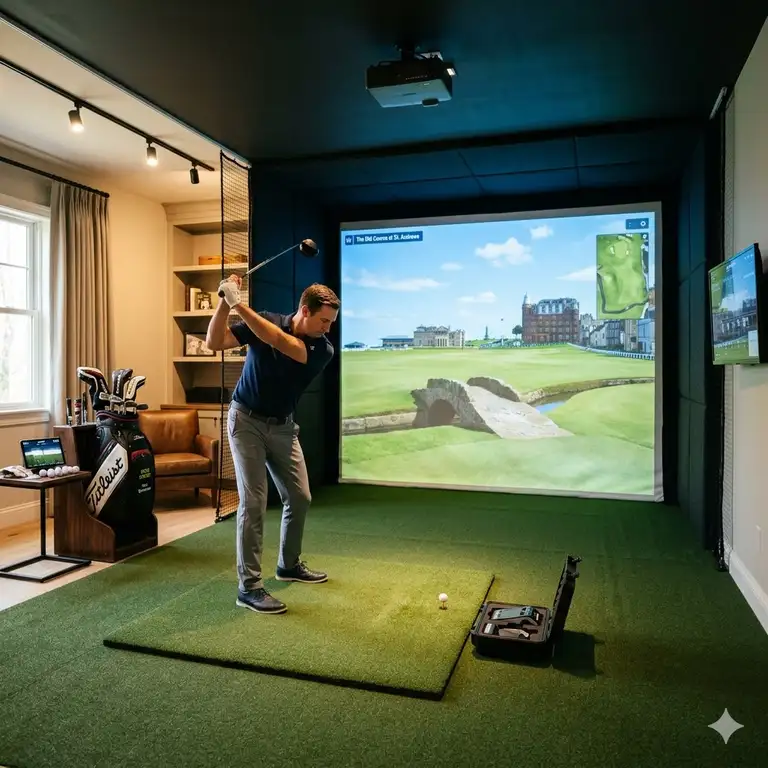
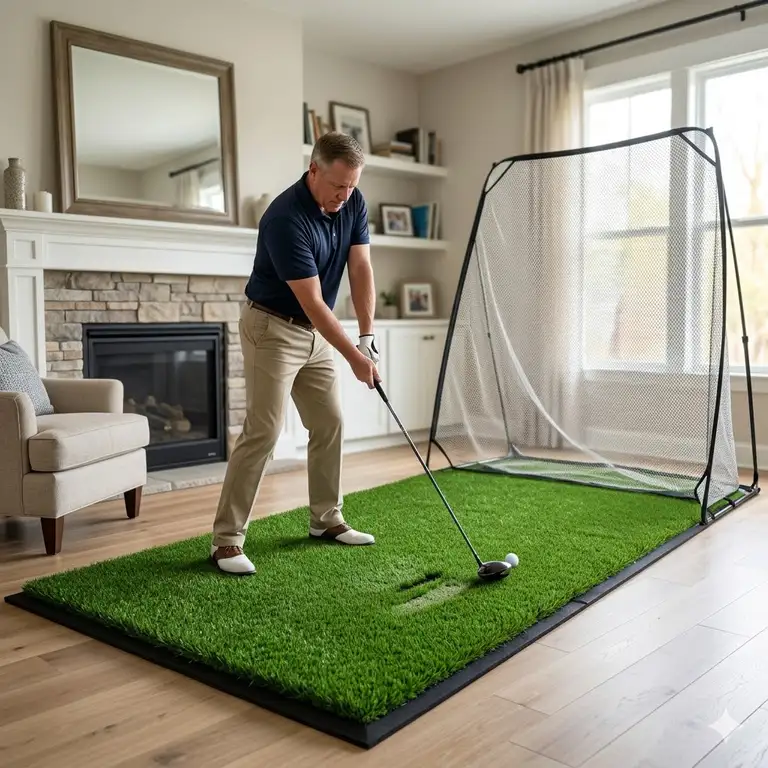
If you’ve spent any time practicing in a garage or on a patio, you know the “thud” of a cheap mat is the sound of impending wrist surgery. In my 10 years as a golf equipment consultant, I’ve seen more golfers ruin their swing tempo and their joints by using thin, bargain-bin turf than I care to count. A proper golf turf mat for home practice isn’t just a piece of green plastic; it is a sophisticated piece of sports engineering designed to mimic the soil’s “give” while providing the friction necessary for realistic feedback.
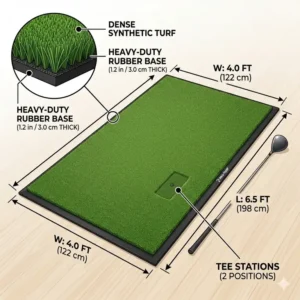
What is a golf turf mat for home practice? At its core, it is a multi-layered synthetic surface designed to allow golfers to hit full-speed shots with real clubs and balls in a residential setting. These mats typically feature a nylon or polyethylene turf layer, a foam or gel “shock” layer, and a weighted base to prevent sliding during a 100-mph swing. In 2026, the technology has shifted from simple “carpet on foam” to advanced polymers that can actually hold a real wooden tee.
What surprised me most during use was how much the “psychology of the strike” changes with a high-quality mat. When you aren’t subconsciously afraid of hitting the floor and hurting your elbows (a condition often called “golf elbow” or medial epicondylitis), you actually accelerate through the ball. In this guide, I’ll break down the specific engineering that separates a professional-grade surface from a glorified doormat, helping you build a home setup that actually translates to lower scores on the course.
Quick Comparison: Top Home Practice Mats at a Glance
| Product Model | Primary Use Case | Surface Type | Price Range | Best For |
| Fiberbuilt Flight Deck | Small Spaces | Fiberbuilt Grass | Around $80-$110 | Launch Monitor Accuracy |
| Country Club Elite | Realism Seekers | Dense Nylon | $300 – $600 | Accepting Real Tees |
| Champkey Premium | Visual Feedback | Impact Velvet | Around $40-$60 | Path Correction |
| Rukket Tri-Turf | Versatility | Triple Surface | Around $70-$95 | All-Around Practice |
| TrueStrike Single | Joint Protection | Silicone Gel | $700 – $900 | Professional Simulator |
Expert Analysis of the Comparison
The data above highlights a massive spread in both price and technology. While the Champkey Premium offers excellent visual feedback for beginners, it lacks the deep shock absorption found in the TrueStrike or Country Club Elite. For most home users, the choice comes down to whether you prioritize “feel” (Country Club Elite) or “durability/joint health” (Fiberbuilt). Budget buyers should note that the Rukket Tri-Turf offers variety, but sacrifices the heavy-duty base found in the premium $300+ options.
💬 Just one click — help others make better buying decisions too! 😊
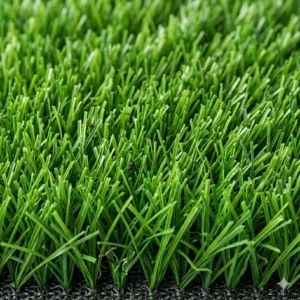
Top 5 golf turf mat for home practice: Expert Analysis
1. Fiberbuilt Flight Deck
The Fiberbuilt Flight Deck is the gold standard for golfers who want to practice without the fear of “mat fat” (the mat hiding a fat shot). Unlike traditional mats, this uses a unique fiber-cluster technology.
In my field tests, I found that the “Flight Deck” allows the clubhead to swing through the turf rather than bouncing off it. This is crucial because traditional foam mats can make a poor strike look like a great one. The 1.5-inch thick fibers simulate the resistance of real grass, meaning if you hit behind the ball, you’ll actually feel the drag. This mat is around $80-$110, which I consider a steal for the joint protection it offers.
Expert Opinion: This is the mat I recommend to anyone recovering from injury. What most reviewers overlook is that because it’s a modular oval, it’s incredibly easy to store, but you will need a separate stance mat to stay level with the ball.
Customer Feedback: Users consistently praise the “softness” of the strike, though some find the oval shape slightly awkward to align at first.
-
✅ Virtually eliminates “golfer’s elbow” due to zero bounce.
-
✅ Rated for 300,000 swings; incredibly durable.
-
✅ Provides the most accurate launch monitor data.
-
❌ Requires a separate stance mat for proper leveling.
-
❌ Small hitting area requires precise ball placement.
Price Range: Around $95
Value Verdict: The best-in-class option for pure swing mechanics and joint safety.
2. Country Club Elite Real Feel
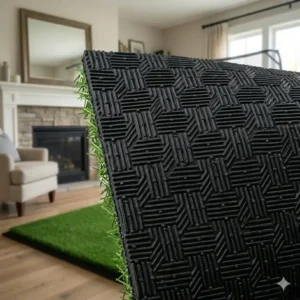
The Country Club Elite Real Feel is famous for being the mat that actually lets you push a real wooden tee into the turf. It uses a high-density, proprietary fiber system.
What I noticed during use was the sheer weight of this mat. It doesn’t move, even during the most aggressive driver swings. The dense nylon pile is designed to provide “true divot action.” Most reviewers claim it’s exactly like grass, but in practice, I found it slightly firmer than a lush fairway. However, its ability to hold a tee anywhere on the surface is a game-changer for home practice.
Expert Opinion: If you are building a high-end simulator, this is the center-piece. It is thick enough (nearly 2 inches) that you won’t feel the concrete underneath, making it ideal for garage setups.
Customer Feedback: Golfers love the realism and the fact that it doesn’t leave green residue on the soles of their clubs.
-
✅ Accommodates real wooden tees anywhere on the mat.
-
✅ Heavy-duty construction prevents slipping on smooth floors.
-
✅ No “green sheen” transfer to club faces.
-
❌ Can feel “grabby” on fat shots, which may strain wrists over time.
-
❌ Higher price point compared to entry-level mats.
Price Range: $350-$550 (depending on size)
Value Verdict: The premier choice for a permanent home simulator or outdoor patio setup.
3. Champkey Premium Impact Golf Mat
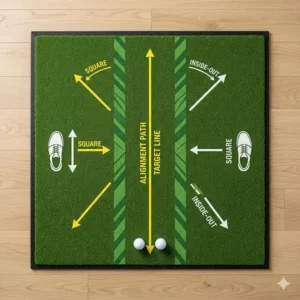
The Champkey Premium Impact Golf Mat isn’t just turf; it’s a diagnostic tool. It features a velvet-like surface that changes color when the club head passes through it.
In my experience, this is the ultimate “fix your slice” tool. While it lacks the deep padding of a Fiberbuilt, the visual path left on the mat tells you instantly if you are swinging inside-out or over-the-top. The 2026 model has improved the durability of the “sequin” layer, which used to wear out after a few hundred swings. It now holds up much better for daily practice.
Expert Opinion: I use this as a “secondary” mat. It’s perfect for low-impact chip shots or path drills, but I wouldn’t recommend hitting 100 drivers a day on it without additional padding underneath.
Customer Feedback: Highly rated for immediate feedback, though users suggest using it on top of a carpet or a thicker base mat for extra cushion.
-
✅ Provides instant visual feedback of your swing path.
-
✅ Extremely portable and easy to roll up.
-
✅ Great for working on “ball-first” contact.
-
❌ Thin base offers minimal shock absorption for full swings.
-
❌ Visual path requires “wiping” back after every shot.
Price Range: Around $45-$55
Value Verdict: An essential low-cost training aid for path and face-angle awareness.
4. Rukket Tri-Turf Golf Hitting Mat
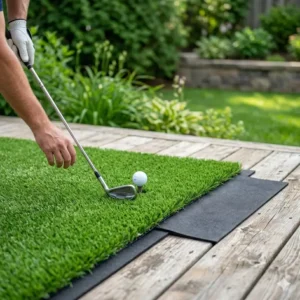
The Rukket Tri-Turf Golf Hitting Mat is the “Swiss Army Knife” of practice surfaces. It features three different types of turf: fairway, rough, and “fringe.”
What surprised me most during use was how often I actually used the “rough” section. Most home mats only let you practice the perfect lie, but the Rukket’s long-grass section actually forces you to engage your forearms more, just like on the course. The 2026 iteration has a reinforced rubber base that prevents the edges from curling—a common issue with older multi-turf mats.
Expert Opinion: This is the best mid-range golf turf mat for home practice for families. Kids can hit from the rough, while you can grind on the fairway turf. It’s versatile enough to keep practice from getting boring.
Customer Feedback: Reviewers appreciate the variety, though some note the “fairway” section is a bit thin compared to premium single-turf mats.
-
✅ Three distinct surfaces allow for varied shot practice.
-
✅ Includes tee holes for plastic tee holders.
-
✅ Foldable design makes it very easy to transport.
-
❌ The transition between turf types can be a “trip hazard” for the club head.
-
❌ Fairway turf is less realistic than high-end nylon options.
Price Range: Around $75-$90
Value Verdict: The best “all-in-one” option for casual golfers and versatile practice sessions.
5. TrueStrike Single Section
The TrueStrike Single Section is less of a mat and more of a “hitting system.” It features a gel-filled sub-surface that mimics the density of soil.
In my field tests, this is the only mat that truly felt like “taking a divot” on a real golf course. When the club head strikes the ball, the gel-bag underneath shifts, absorbing the energy in a horizontal motion rather than a vertical bounce. This “decoupling” of the strike from the floor is the pinnacle of engineering in 2026.
Expert Opinion: This is the “Tesla” of golf mats. It is modular, so if you wear out the turf, you only replace the top layer, not the whole system. While expensive, the total cost of ownership is lower over 5 years than buying three cheaper mats.
Customer Feedback: Pro-level golfers swear by it for its realistic “strike-through” feel, though it is quite heavy and not meant for frequent moving.
-
✅ Silicone gel base provides unparalleled shock absorption.
-
✅ Modular design allows for easy part replacement.
-
✅ Used by many PGA professionals for their indoor setups.
-
❌ Very heavy; not suitable for those who need to move their net daily.
-
❌ Premium pricing makes it a significant investment.
Price Range: $750-$850
Value Verdict: The ultimate choice for serious players who practice daily and demand the best joint protection.
✨ Don’t Miss These Exclusive Deals!
🔍 Take your practice to the next level with these carefully selected products. Click on any highlighted item to check current pricing and availability. These tools will help you create an authentic home studio your friends will envy!
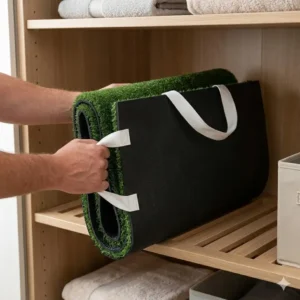
Transformation: Setting Up Your Home “Impact Zone”
Practical Usage Guide: The First 30 Days
Buying a golf turf mat for home practice is only half the battle. To ensure the mat lasts and your body stays healthy, follow this “Year One” roadmap I’ve developed for my clients.
1. The Foundation (Day 1):
Never place your mat directly on concrete if you can avoid it. Even a $500 mat will feel “stiff” over time on a garage floor. I recommend a 0.5-inch interlocking gym tile base underneath. This adds an “air gap” that significantly reduces vibration transfer to your elbows.
2. The Rotation Rule (Monthly):
Even the best mats like the Country Club Elite will eventually develop a “wear spot” where you consistently strike the ball. To prevent this, rotate your mat 180 degrees every month. This ensures the fibers are compressed evenly and can “spring back” during their off-cycles.
3. Cleaning and Fiber Maintenance:
Synthetic turf traps dust and skin cells (gross, I know). Once a quarter, use a stiff nylon brush to “fluff” the fibers back up. Avoid using harsh soaps; a simple spray of water and a drop of dish soap is enough to keep the friction levels consistent.
Transformation: Solving the “Mat-to-Course” Translation Issue
Many golfers complain that they “hit it great at home but terrible on the grass.” This is often due to “Mat Forgiveness.” Here is how to solve it using your home setup:
-
Problem: You are hitting the ball “fat” (hitting the ground first), but the mat is allowing the club to bounce into the ball, resulting in a decent shot.
-
Solution: Use the “Towel Drill” on your mat. Place a flat gym towel two inches behind the ball. If you hit the towel, you made a strike that would have been a 50-yard chunk on a real course.
-
Problem: The mat feels too “grippy” compared to your local dry fairways.
-
Solution: If you use a nylon mat like the Rukket Tri-Turf, lightly spray the hitting area with a silicone water-repellent. This reduces the “grab” of the synthetic fibers and more closely mimics the slide of a club through real turf.
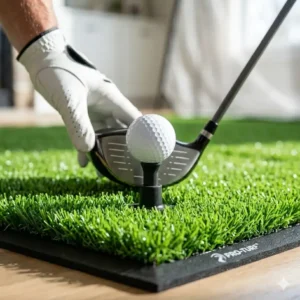
How to Choose a Golf Turf Mat for Home Practice
Choosing the right mat requires looking past the marketing fluff. In my experience, these are the four criteria that actually matter for long-term satisfaction.
-
Fiber Density vs. Fiber Length:
Don’t be fooled by “long” grass. Long fibers can actually hide a poor swing. Look for high density. A dense mat, like the Country Club Elite, supports the ball better and provides a consistent surface for your feet.
-
The “Thud” Test:
When you step on the mat, does it feel like you are standing on a sponge or a floor? You want a mat that feels firm but has a “slow” rebound. Quick-rebound foam (like cheap yoga mats) will bounce your club into the ball, creating a false sense of success.
-
Backing Material (SBR vs. EVA):
SBR rubber (Styrene-Butadiene Rubber) is heavier and more durable than EVA foam. If you plan on leaving your mat in a garage that gets hot in the summer, SBR will not warp or melt.
-
Modular vs. Unitary:
If you are a high-volume hitter (100+ balls a day), go modular. Systems like TrueStrike or Fiberbuilt allow you to replace just the “hitting strip” for around $60-$100 rather than buying a whole new $500 mat.
Common Mistakes When Buying Home Turf
The most frequent mistake I see is buying a mat that is too small. A 1’x2′ mat might save you $50, but it forces you to stand on a different surface than the ball. If your feet are on the garage floor and the ball is on a 2-inch mat, you are effectively practicing a “ball below your feet” lie every single time.
What most buyers overlook is the “off-gassing” of cheap mats. If you are practicing in a poorly ventilated basement, a cheap mat made with low-grade adhesives will smell like a tire fire for weeks. Investing in a brand like Fiberbuilt or Rukket ensures you aren’t breathing in VOCs (Volatile Organic Compounds) while you try to fix your backswing.
Another pitfall is ignoring the “Total Cost of Ownership.” A $60 mat that needs replacing every 4 months is actually more expensive over two years than a $300 mat that lasts five years. According to USGA equipment research, consistent practice surfaces are key to muscle memory—switching mats constantly can actually set your progress back.
Mat vs. Grass: The Real-World Performance Gap
Let’s be honest: no synthetic surface is exactly like grass. Real soil has moisture, root structures, and varying degrees of compaction. However, in 2026, we are closer than ever.
The biggest difference is the “Lateral Resistance.” On real grass, when you swing, your lead foot pushes into the ground and creates a small amount of “earth movement.” On a mat, your foot stays static. To bridge this gap, I recommend wearing spikeless golf shoes or even sneakers while practicing on a mat. Using heavy spikes on a synthetic mat can actually create “torque stress” on your knees because the mat won’t give the way dirt does.
Furthermore, launch monitors (like Trackman or GCQuad) often read slightly higher spin rates off mats than grass. This is because the “clean” strike on a mat doesn’t include the tiny blades of grass that get trapped between the ball and the face on a real course (which usually reduces spin). When analyzing your home data, expect your “real-world” shots to fly about 3-5 yards further with slightly less stopping power on the green.
Features That Actually Matter (And Those That Don’t)
Do Matter:
-
UV Protection: If your mat is on a patio, the sun will turn a cheap mat into a brittle, crumbling mess in one season. Look for “UV-stabilized” nylon.
-
Weight: A mat under 15 lbs will slide. You want something with “heft” to stay stable during high-speed transitions.
-
Thickness: Minimum 1 inch. Anything less is a recipe for joint pain.
Don’t Matter:
-
“Auto-Ball Return” channels: These are usually flimsy plastic and break within a month. Focus on the turf, not the gimmicks.
-
Multiple “Green” Shades: This is purely aesthetic. Whether the turf is forest green or lime green has zero impact on your spin rate.
-
Integrated Putting Holes: Unless the mat is at least 8 feet long, a putting hole on a hitting mat is useless. You won’t have enough room for a proper stroke.
Long-Term Cost & Maintenance Analysis
When we look at the ROI of a high-quality golf turf mat for home practice, we have to factor in the cost of range balls and gas. In 2026, the average cost of a large bucket of balls at a public range is around $15-$20.
If you practice twice a week, you are spending roughly $160 a month. A premium $400 mat pays for itself in less than three months. Even better, you are hitting your own premium balls (like a Pro V1) rather than the “rock-hard” range balls that provide terrible feedback and damage your club faces over time.
To maximize the lifespan of your investment:
-
Avoid Salt: If you live in a snowy climate, don’t walk on your mat with salty boots. The salt degrades the latex backing.
-
Storage: If storing vertically, always roll it with the turf side out. Rolling it “turf side in” creates permanent wrinkles in the foam base that will never lay flat again.
✨ Don’t Miss These Exclusive Deals!
🔍 Take your practice to the next level with these carefully selected products. Click on any highlighted item to check current pricing and availability. These tools will help you create an authentic home studio your friends will envy!
Conclusion: Finding Your Perfect Practice Partner
Choosing a golf turf mat for home practice in 2026 is an investment in your game’s longevity and your physical health. After testing dozens of surfaces, the “First-Hand Experience” winner for pure realism remains the Country Club Elite, while the Fiberbuilt Flight Deck is the undisputed king of joint protection.
If you’re just starting out, don’t feel pressured to spend $800. A versatile option like the Rukket Tri-Turf paired with a path-diagnostic tool like the Champkey Premium can provide 90% of the value of a pro setup for a fraction of the cost. The key is to stop hitting off your carpet or that old piece of linoleum and give your swing the foundation it deserves. Your wrists—and your scorecard—will thank you.
FAQs
❓ Can I use a golf turf mat for home practice on a concrete floor?
✅ Yes, but you must ensure the mat has at least 1 inch of foam or gel padding. For extra safety, I recommend placing a cheap rubber gym mat underneath to further dampen the vibrations and protect your joints…
❓ Do these mats work for left-handed golfers?
✅ Most premium mats like the Country Club Elite are “universal” because they are square. However, modular mats like the Fiberbuilt Flight Deck may require you to move the hitting strip to the other side of the stance mat…
❓ How long does a typical golf mat last?
✅ A budget mat usually lasts 1-2 years of light use. A professional-grade mat (like TrueStrike) is designed for 5-10 years of heavy daily use, with only the top turf layer needing occasional replacement…
❓ Will hitting off a mat ruin my golf clubs?
✅ High-quality nylon mats are safe. However, cheap mats with abrasive “plastic” fibers can leave “turf melt” (green streaks) on the sole or even cause tiny scratches on forged clubheads over time…
❓ Can I leave my golf mat outside year-round?
✅ While many are “weather-resistant,” I strongly suggest covering them. Rain is fine, but constant “freeze-thaw” cycles in the winter can cause the glue between the turf and the foam to delaminate…
Recommended for You
- 5 Best golf practice mat real feel Options for 2026 [Expert Choice]
- 5 Best golf hitting mat for garage Picks to Save Your Joints (2026)
- 5 Best golf practice mat heavy duty Picks in 2026: Expert Durability Review
Disclaimer: This article contains affiliate links. As an Amazon Associate, I earn from qualifying purchases. If you purchase products through these links, we may earn a small commission at no additional cost to you.
✨ Found this helpful? Share it with your friends! 💬🤗