
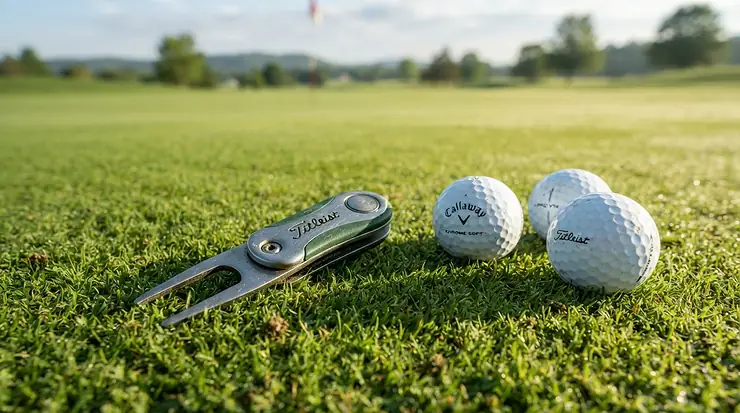
Does a golf club cleaner change anything at impact, or does it only make the bag look better? Care guides such as Takomo Golf’s cleaning guide say the reason to brush out grass and dirt is so the grooves can grip the ball and produce consistent spin. None of the guides I read puts a measured number on that effect, so “cleaner grooves, more spin” is the accepted reasoning, not a lab result.
I haven’t held any of the tools below. This guide is built from published reviews, retailer listings and the R&A and USGA equipment rules, and where a product rests on a single source I say so. If you’re buying for the 2027 season, the routine matters more than the gadget, which is why it comes first.
The short answer: wipe often, scrub rarely, never gouge
A nylon-bristle brush, a soft groove tool, warm water and a microfiber towel handle nearly everything a round throws at an iron. Takomo’s guide ranks groove tools from a free golf tee to a dedicated cleaner, and says the dedicated one is worth it if you play weekly. What it rules out flatly: metal picks, wire or stiff metal brushes, steel wool and hot water.
The rest of this guide covers the routine, the ways cleaning goes wrong, and four tools matched to the steps where golfers most often come up short.
The routine: five steps from the first fairway to the garage shelf
The sequence below follows Takomo’s guide, the most detailed of the care guides I opened, with notes where it contradicts itself.
- Wipe the face and grooves after each shot with the damp side of a towel, then finish with the dry side.
- After the round, rinse the clubheads and dry them completely. Takomo allows up to five minutes for this.
- For a deeper clean, soak only the iron or wedge heads in warm (not hot) water with a few drops of mild dish soap for 5 to 10 minutes, keeping the hosel and shaft above the waterline.
- Scrub the face and back with a soft-bristle brush using firm back-and-forth strokes, and use an old toothbrush for tight grooves. Rinse, then dry with microfiber.
- Run a groove tool heel to toe along each groove, not across it, and check the face under a light to confirm the channels are clear.
Two limits apply. Raw-faced, uncoated steel wedges should soak no longer than five minutes, and woods and drivers never go in the bucket at all: Takomo warns that carbon crowns can delaminate, paint can lift and moisture trapped in the hosel does lasting damage. Woods get a cloth dampened with soapy water, followed at once by a dry one.
Frequency is where the guide disagrees with itself. Its schedule calls for a full soak-and-scrub monthly, while its FAQ says to deep clean every few rounds. Someone playing every weekend, who would otherwise go a month with mud baked into the grooves, has good reason to lean toward the shorter interval. That reading is mine, not Takomo’s.
Groove cleaner golf tools: tee, nylon brush or dedicated pick?
Takomo lays out three options. A golf tee costs nothing and suits casual upkeep. A nylon groove brush is affordable and safe on every finish. A dedicated groove cleaner is the most precise. That’s the whole menu, and it explains why almost every brush in the next section ships with a small pick folded into the handle.
The rules are the reason to be gentle with that pick. Under the R&A’s playing rules for clubs, a club that conformed when new is deemed to conform after wear through normal use, but a player must not make a stroke with a club whose performance characteristics they deliberately changed during the round, for example by physically modifying it. Takomo’s warning is that digging at groove edges, even by accident, can break the rules if it changes groove geometry. Anyone unsure about a club is told to consult the R&A or USGA. The same page permits applying a substance to the clubhead for cleaning, but not to affect how the club performs.
Woods, grips and rust: where the routine changes
Takomo’s guide treats a few parts differently, and they’re worth knowing before you reach for the vinegar.
Surface rust on a head can be treated with a 50/50 white vinegar and water mix for 15 to 20 minutes on the rusted area only, followed by a scrub with a soft brass or nylon brush, a rinse, thorough drying and a thin coat of club oil. Vinegar is safe on carbon steel and raw steel wedges but not on chrome-plated clubs or graphite shafts, and steel wool is never acceptable. Pitting that has eaten through the steel may mean replacement, not restoration.
Rubber and synthetic grips take mild soap and warm water on a dampened cloth, not a wet grip. Leather grips get only a dedicated leather cleaner. Graphite shafts need a soft cloth, damp at most, with no abrasives.
Where cleaning goes wrong, and how to recover
Most damage comes from doing too much, not too little.
A metal pick is the first mistake. If you’ve been digging grooves with a nail or a sharp metal spike, stop, and treat Takomo’s warning about groove geometry seriously. If you honestly can’t say whether a club still conforms, the R&A page’s advice is to ask the R&A or USGA rather than guess.
Hot water and long soaks come next. Takomo lists hot water as a way to loosen ferrules and damage finishes, and says soaking for 30 minutes or more, or leaving clubs wet, invites rust. The rust routine above is the sourced fix for surface spots.
Wire brushes are the third. Takomo recommends nylon or soft bristles and puts wire and stiff metal brushes on its avoid list. Golf.com’s brush roundup makes a narrower point: it recommends nylon bristles for softer forged clubs to avoid scratches or groove damage. Both matter for the product choices below, since several brushes mix nylon with wire.
Last is the damp bag. Takomo says never to store clubs wet, which also means a soaked towel left wrapped around the heads.
What “apps golf club cleaner” searches actually turn up
Type that phrase into an app store and you get GPS and scoring apps, such as Golfshot and TheGrint, whose store pages describe distances, scorecards and handicap tracking. I found no app that cleans, inspects or sharpens a club. The only maintenance use I can offer is my own idea: a recurring phone reminder for the monthly deep clean. Software won’t get mud out of a groove.
The best golf club cleaner depends on which step you skip
Shops list the same tool under “golf cleaning brush cleaner”, “golf club brush cleaner” and “groove cleaner golf”, and people who search accessories cleaning club golf are usually after the same short list: a brush, a pick and something to dry with. So rather than rank them, here’s how each of the four maps to the routine.
| Step in the routine | What handles it | Product |
|---|---|---|
| Wiping between shots | Towel with a clip | HELLAFAR Golf Club Cleaning Kit |
| Scrubbing mud off the course | Water-fed nylon brush | Grooveit Wet Club Scrub Brush |
| Brushing and picking on the course | Brush with folding pick | Champkey Pro Retractable Golf Club Brush, Frogger BrushPro Golf Club Brush |
Only the kit and the two brushes with picks cover step five on their own. The Grooveit Wet Club Scrub Brush needs a tee or a separate groove tool beside it.
1. Grooveit Wet Club Scrub Brush — a water tank in the handle
Mud is the problem this one was built for. Golf.com’s reviewer, who named it the staff favorite, describes a hollow handle that holds water or cleaning solution and squirts it through the brush end, with enough capacity for two to three rounds, a magnetic latch, a mini carabiner and heavy-duty nylon bristles. The brand backs it with a three-year replacement warranty. Nylon also sits well with the golf.com advice about softer forged heads.
A reviewer at Practical Golf used it over several rounds and found the head at least twice the size of others he’d tried, the pump useful on stubborn gunk, and the magnet much stronger than expected. His complaints were the price and an early sell-out. He also admitted he already keeps his grooves clean, so he couldn’t say the brush made his clubs cleaner than before.
Expect to pay around $25, and golf.com files “costs more than most alternatives” as its one drawback. Fairway Jockey’s own listing claims over 2,000 five-star reviews, but that’s the seller talking, not an independent count. There’s no groove pick on this one, so step five means a tee or a separate tool.
2. Champkey Pro Retractable Golf Club Brush — big head, small price
Bulk is the price of the large head. Golf.com picked it as runner-up and lists a retractable groove cleaner, two oversized brush heads on opposite sides, a rubber grip, a clip and nylon-and-wire bristles. The reviewer liked the comfortable grip and noted the head also cleans shoes, but called it bulkier than rivals and said the metal bristles can snag towels or fabric. Golf.com’s review, from 2023, priced it under $10 at Amazon, so check the current listing.
Golfworkoutprogram.com, which rates it 4.5 and calls it its editor’s pick, says the head is 2.5 times larger than most and reports durability complaints about the clip and the retractable cord. The two sources even disagree on colors, four versus three, so confirm what’s offered before ordering.
Because the bristles include wire, owners of soft forged irons have a reason to look at the Frogger BrushPro Golf Club Brush below, which offers an all-nylon head. If budget decides it, golf.com also named the Buddybirdie Golf Cleaning Brush its best value, under $10, with a 31.5-inch retractable line, two heads, a groove cleaner and a clip. Its reviewer’s drawback was a carabiner and groove cleaner that may not last. Golf.com is my only source for that one.
The Champkey Pro Retractable Golf Club Brush covers steps one, two and five from the bag, and golf.com’s roundup ranks it above the Buddybirdie Golf Cleaning Brush despite the price gap.
3. Frogger BrushPro Golf Club Brush — swappable heads and a fold-out pick
Swapping the head is the whole idea here. Golf Galaxy’s listing describes combo bristles, phosphorus bronze inside and nylon outside, plus a 100% nylon head option, a snap-back cord and extendable, retractable groove cleaners. A reviewer on that page mentions one head with wire brushes and one without. BGR lists a 2.5-foot cord and a folding pick.
Golf Galaxy shows 4.5 stars from 67 reviews, with 89% recommending it. MyGolfSpy, which found the brush on Amazon, reported more than 2,500 reviews averaging 4.7 stars at the time, called head changes easy and said the retractable pick made quick work of grime. It put the price at about $20, noticeably above the under-$10 brushes in this guide.
The nylon-head option is the practical advantage for anyone cleaning forged irons. Golfers Authority also describes replaceable parts on this model, so a worn brush head doesn’t send the whole tool to the bin. The page lists no cord length of its own, so rely on BGR’s figure only if the length matters to you.
4. HELLAFAR Golf Club Cleaning Kit — towel, bottle and pick in one set
Some golfers want one purchase, and this kit is built for them. Golfworkoutprogram.com, its only source here, describes a three-piece set: a tri-fold waffle towel with a clip, a bottle that dispenses water or cleaner, and a 3-in-1 groove cleaner. The brush has soft nylon on one side and stiff wire on the other, carabiners are fitted throughout and the cord retracts. It rated the kit 4.3 and named it its best complete kit.
The towel is what separates it from the brushes above, since step one is a damp-then-dry wipe and none of the others bring a towel. The same review calls the total cost “a bit high” for what’s in the box and reports some bottle leaks. No price appears on that page, so check the current price on Amazon.com.
Quick answers on cleaning golf clubs
❓ How often should I clean my golf clubs?
❓ Can I use dish soap on golf clubs?
❓ Can a groove cleaner make a club illegal?
❓ Should I choose a nylon or a wire brush?
❓ Can I soak all my clubs?
A simple way to choose
For most golfers, the right golf club cleaner is a nylon-bristle brush plus a soft groove tool and a towel kept dry in the bag, used after every shot and backed by a monthly soak. The Frogger BrushPro Golf Club Brush is the one to look at first if you play forged irons, because it offers a nylon head. The Champkey Pro Retractable Golf Club Brush is the budget route if you accept wire bristles. Muddy courses make the Grooveit Wet Club Scrub Brush easier to justify, and the HELLAFAR Golf Club Cleaning Kit fits golfers who want the towel included. Whichever you pick, confirm the exact model and head type in the listing, then keep metal off the grooves. Check current availability below.
Recommended for You
- 7 Best Golf Club Cleaner Options For Ultimate Performance in 2025
- Golf Brush: 7 Best Cleaners That Tour Pros Use 2025
- 7 Best Golf Ball Cleaner Options For Ultimate Performance in 2025
Disclaimer: This post contains affiliate links. As an Amazon Associate, I earn from qualifying purchases made through these links, at no additional cost to you.
Forward this routine to the golfer whose wedges still carry last week’s mud.