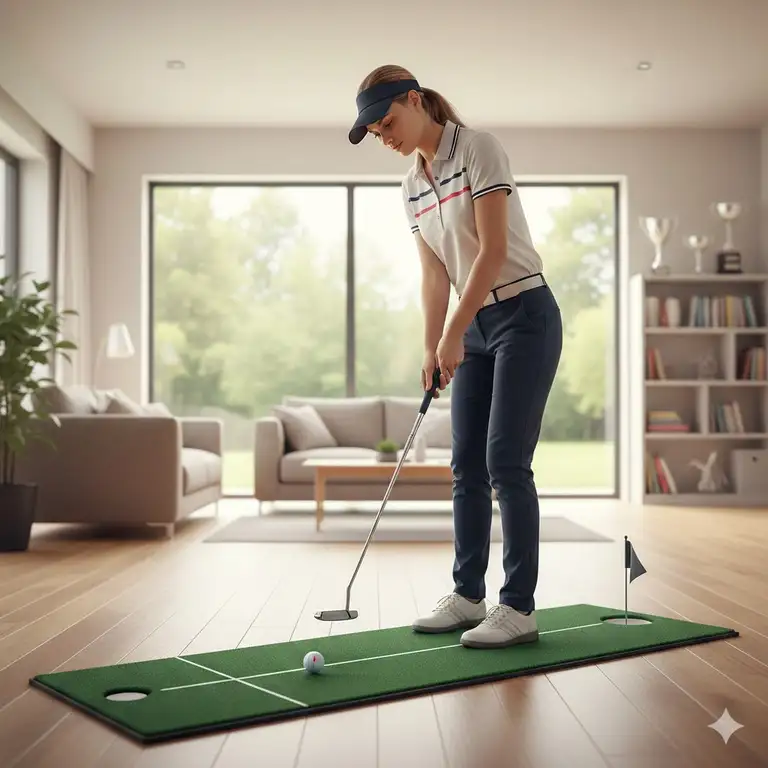
Golf putting aids do not repair a stroke; they report on it, and the report only helps when the aid measures the fault you actually have. That corrects a common buying habit in 2027: grabbing a mirror, a ramp or a wrist brace because it is popular, then wondering why three-footers still lip out. The guide starts from the miss, moves through a four-step method, and only then reaches four golf putting aids, from a putting mirror to a hitting-mat feedback pad.
Reviews from MyGolfSpy, Golf Insider, Plugged In Golf and Golfers Authority, plus one old but revealing instructor-forum thread, carry the evidence here, and since no putter was swung for this guide, every comment on feel belongs to a named source. Prices are ranges drawn from those pages and may look different on Amazon.com.
Start line, pace or wrist break: which miss is yours?
MyGolfSpy’s feature on putting problems sorts misses the same way. It pairs wrists that flip or break down through impact with the Orange Whip Putt Master, a start line that wanders with the Putting Arc T3, and distance control that feels random with the Roll The Rock 8 Footer. Its reasoning for the wrist case is geometric: when the hands add loft or rotate, the face angle changes, and on a six-footer a tiny change is a miss. One reader comment on that page argues that no aid fixes putting alone and points to lessons and a putter fitting, which is a single opinion but fits the cautious tone of the other sources below.
Miss
What the aid gives you
Tool in this guide
Eyes, shoulders or face look off at address
A reflection of your setup and gate slots for start line
EyeLine Golf Putting Alignment Mirror
Wrists flip, add loft or collapse in the follow-through
A physical limit on hand and wrist movement
Orange Whip Putt Master
Speed is random and three-putts pile up
A ramp that shows how far past the hole the ball ran
PuttOUT Premium Pressure Putt Trainer
Full-swing contact is unclear (not a putting miss)
Marks showing where the club entered and left the turf
Cosportic Golf Hitting Mat
The rows differ in how much they interfere with your stroke. A mirror and a ramp leave the stroke alone and only report, while a wrist aid changes the stroke for as long as it is on, which is why it deserves the most care. Only the first three rows address a putter; the fourth is here because shoppers often cart it alongside the others, and its limits are spelled out in its own entry.
Four steps from setup check to a routine you keep
Check the setup before buying anything. Golf Insider’s PGA-qualified reviewer says a poor path often traces back to posture, alignment or grip, and suggests checking those in a mirror before blaming the stroke. His putting-aid roundup also says aids do not cure the yips. A moderator in an instructor forum gave the same advice in a different form: film the stroke so you can compare what you do with what you feel.
Separate start line from speed. Golfer Geeks argues that you cannot putt well without aiming and aligning well, and MyGolfSpy ties the face angle to where the ball starts. Speed is a different job. Practical Golf’s reviewer says the PuttOut trainer reports how far past the hole a putt would have run and says little about line, so use a mirror for the first question and a ramp for the second.
Quiet the wrists only if they are the problem. A wrist aid changes the stroke while it is on, so confirm on video that the hands are really breaking down before you strap one on. The section below covers what each type does.
Keep sessions short and alternate. Orange Whip’s retailer copy tells owners to putt in short sessions and switch between using the device and not using it. Practical Golf’s reviewer found the pressure-trainer packaging suggests games such as 25 makes in a row, adding two feet after each make. The best golf putting aids in these reviews give one immediate signal, and that is easy to read when a session is short.
Golf training aids for wrist break: three ways to quiet the hands
Golf wrist training aids for putting fall into three families, and the cheapest one is not a gadget.
Restraint. The Orange Whip Putt Master uses adjustable pads that, per the maker’s copy on retailer listings, give the feeling of locking the wrists in place. You cannot flip the face without noticing, because the pads stop you.
Click feedback.Plugged In Golf’s review of the WhyGolf Wrist-X describes a strap-on unit that pops against the wrist and clicks when the wrist moves past a set angle. For putting, a near-zero setting means any flexion or extension clicks. The reviewer puts it at around $100, praises its range of drills and calls it highly effective, but warns that you must know the right wrist, angle and purpose for each drill and that its versatility can overwhelm some users. He also notes that its quiet-hands short-game approach is not one every good player uses.
The grip itself. In a Sand Trap forum thread from 2015, a golfer whose wrist collapsed in the follow-through asked for a training aid. A PGA-professional moderator answered with a 1.5-inch grip, which makes breaking the wrists harder, and one-handed putting drills. Another member blamed the arms stopping after impact and suggested swinging through with the shoulders and practicing putts of two to three feet. Nobody named a gadget. The thread is old and small, seven posts, but it shows two free fixes worth trying before spending money.
Where golf putting aids go wrong, and how to recover
Buying for the wrong stroke
Golf Insider says square-to-square strokes suit a rail or mirror while arced strokes suit the Putting Arc, and that neither suits every style. A rail on an arced stroke fights the golfer instead of informing him. Film your stroke first, then choose the aid that matches what you already do.
Practicing on a surface that lies
Practical Golf’s reviewer used the original Pressure Putt Trainer, the model that came before the PuttOUT Premium Pressure Putt Trainer, for a few weeks on a BirdieBall putting mat and says carpet also works but is not ideal. A ramp that reports pace is only as honest as the floor under the ball. Test the surface before trusting a speed reading.
Reading the signal the wrong way
Plugged In Golf’s review of the WhyGolf Wrist-X says the click can mean either a correct or an incorrect move depending on the drill. Decide what a click is supposed to mean before the first rep, or you will train the wrong thing with great confidence.
Treating wear as a defect
Golfers Authority says the velvet insert of a feedback hitting mat wears out in roughly three to four months of daily use, and that the spare in the box stretches that to six to eight. Feedback surfaces are consumables. Budget for the refill, not a refund.
Best golf putting aids for each step of the method
Setup errors hide in plain sight, and a golf putting aid mirror is a cheap way to see them. EyeLine’s own page for its Classic Large version says the mirror shows eye position, shoulder alignment, ball position and putter-face alignment, with a face alignment guide, gate slots for start-line and sweet-spot drills, an optional shoulder mirror and a carry bag, and that it works for either hand. Listing data mirrored on Desertcart puts the Putting Alignment Mirror at 12 by 6 inches and the Classic Large at 17.5 by 9.25 inches.
Golfer Geeks calls the mirror intuitive and light, with slight bulk as its one con, and rated it 4.7 stars, below the 5.0 it gave most of its other picks. Golf Insider’s reviewer says the original yellow rails have given way to tee holes so golfers can build their own path guides, and that build quality trails competitors, naming the PuttOUT Putting Mirror Trainer as the winner on that count (while noting its own rails can be fiddly). Zach, who founded the instruction site The DIY Golfer while playing college golf, rates face alignment as the mirror’s most important job and finds its stroke-length guide short for his longer backstroke. He recommends it but prefers the Dave Pelz Putting Tutor.
Whatever the version, a mirror shows only the setup. It cannot show what the hands do during the stroke, and it carries no ball-return or pace feedback. Check the current price on Amazon.com.
EyeLine Golf Putting Alignment MirrorSee current price, sizes and reviews on Amazon.
Independent coverage of the Orange Whip Putt Master is thin: MyGolfSpy’s putting-problems feature is the one outside voice found, and the rest is maker and retailer copy. MyGolfSpy says it is designed to quiet the hands, support a pendulum stroke and link the arms and torso, makes wrist takeover obvious right away, and suits misses that feel handsy or inconsistent inside 10 feet.
Retailer listings describe adjustable pads, a hook-and-loop strap, no assembly, and fit for conventional, cross-handed, left-hand-low and right-hand-low grips for either handedness. Buyer comments mirrored on a Desertcart page raise grip fit: one says the strap is too short for a thicker putter grip, and another says it fits only smaller grips. That is two comments, a small sample, though both point at the same weak spot. A third buyer there calls it expensive for plastic. No sourced price range turned up, so the Amazon.com listing is the place to look.
Pros:
✅ Physically limits wrist and hand movement, per the maker’s copy
✅ Fits several grip styles and both handedness options, per retailer listings
✅ MyGolfSpy singles it out for wrists that flip or break down
Cons:
❌ Independent testing is sparse
❌ Buyers flag strap length and grip fit
❌ It restrains the stroke, so you must alternate with and without
Orange Whip Putt MasterSee current price, sizes and reviews on Amazon.
Between roughly $30 and $40, depending on version, this is one of the cheaper tools here that actually changes how a practice session feels. Plugged In Golf’s reviewer, Matt Saternus, has used the original since 2017, keeps it on his putting mat and uses it almost daily; he credits it with sales of hundreds of thousands of units, which is his claim. The Premium adds a target that pushes in so it stays visible when down, three small black dots for breaking putts, a taller ramp with a hole that holds an alignment rod and can stand in for a mirror, and a heavier, more stable base.
How it works matters for pace. A ball that rolls over the disc at the bottom of the ramp counts as holed, and to stay in the small secondary target it needs a good line and roughly 15 to 18 inches of speed past the cup, according to that review. Reader comments on the page say the small target is hard and that you must putt a little firmly to reach it. Practical Golf’s reviewer, who used the original for a few weeks, says it measures how far past the hole your putt would have run and that carpet is not the ideal surface.
Golf Insider adds the limit: it gives no direct feedback on stroke mechanics and is confined to direction and pace. Pair it with the mirror above for setup, because it reports results, not causes.
PuttOUT Premium Pressure Putt TrainerSee current price, sizes and reviews on Amazon.
This is not a putting tool, and the sources disagree on how much of a mat it is. Golfers Authority’s roundup lists it as a training aid at about $25, 16 by 12 inches, with a soft velvet surface that shows where the club entered and left the turf, and says you need a second mat to hit balls from. The same site’s standalone review puts it at around $30, describes three turf zones (fairway, rough and a tee area), says one surface handles driver, irons, wedges and chipping, and scores it 4.5 out of 5. Given the 16-by-12-inch footprint, the roundup’s reading looks more plausible, which is my own inference.
The standalone review adds that the turf compresses after 100-plus balls and recovers overnight, and lists “base can slide” as a con even though its body text says the rubber base stayed put on concrete and carpet. The roundup puts velvet life at about three to four months of daily use, with a spare insert extending that to six to eight, and the standalone review doubts the mat would survive years of heavy daily use.
Pros:
✅ Marks show club entry, exit and path, per Golfers Authority
✅ Low price band, between about $25 and $30
✅ Replaceable velvet insert is included
Cons:
❌ Wears out in months of daily use
❌ Small surface; may not replace a full hitting mat
❌ Says nothing about putter-face angle
Read each listing’s grip, size and handedness notes before ordering; they decide whether these tools fit your putter and your floor.
Cosportic Golf Hitting MatSee current price, sizes and reviews on Amazon.
Golf training aids hitting mat: where a feedback pad fits a putting routine
A feedback mat answers a different question than a putting aid. Golfers Authority notes that some mats let the club glide into the ball and hide fat shots, while feedback surfaces show where the club actually enters the ground, with soft velvet wearing faster, plastic boards feeling harder and turf-style mats offering realistic feel plus path marks. That matters for chips, pitches and full swings. A putter, by contrast, sends a ball across a flat surface at low speed, so face angle and pace are what matter, and those belong to the mirror, the wrist aid and the ramp. A hitting mat sits beside a putting routine in the same garage, not inside it.
What golf putting aids reviews agree on, and where they split
The agreement is narrow and consistent. Golf Insider says aids give feedback on specific principles and do not transform a stroke, Plugged In Golf’s wrist-aid review says you must know what you are trying to fix, and MyGolfSpy opens by saying that if you can identify the issue the right aid becomes obvious. Every source treats an aid as a one-signal instrument, which is why one fault and one tool beats a bag of gadgets.
The disagreements are about rank and durability. Golfer Geeks scored the EyeLine mirror 4.7 against 5.0 for most of its other picks, The DIY Golfer ranks it below the Dave Pelz Putting Tutor, and Golf Insider puts a rival mirror ahead on build. On wrists, MyGolfSpy presents quieting the hands as the cure for breakdowns, while the Plugged In Golf reviewer notes that quiet hands are not how every good player putts. My reading is that a wrist aid is a diagnostic first and a permanent fix only if your own stroke wants quiet hands.
Wrist breaks, mirrors, carpet and mats: short answers
❓ Do golf putting aids actually work?
✅ They work as feedback tools, not cures. Golf Insider's PGA reviewer says aids give feedback on specific principles such as alignment and posture, but they do not cure the yips or transform a stroke overnight. Name your fault first, then match the aid.
❓ What is the best putting aid for wrist break?
✅ It depends on the fix you want. MyGolfSpy pairs wrist breakdown with a restraint-style aid, Plugged In Golf reviews a wrist trainer that clicks when the wrist moves past a set angle, and a forum pro suggested a fatter grip first.
❓ Is a putting mirror worth buying?
✅ It is worth it if setup is your problem. Golfer Geeks says a mirror helps with putter, shoulder and eye alignment, while Golf Insider notes poor paths often come from posture, alignment or grip. A mirror reports setup only; it cannot show hand action during the stroke.
❓ Can you use putting aids on carpet?
✅ Some, with care. Practical Golf's reviewer tried a pressure trainer on a BirdieBall mat and says carpet works but is not ideal. Soft pile can slow a roll, so judge speed feedback by the floor before trusting it.
❓ Does a hitting mat help your putting?
✅ Not directly. Golfers Authority describes feedback mats as tools that show where the club enters and leaves the turf, which matters for chips and full swings. A putter strikes a ball on a flat green, so a putting aid or putting mat suits that job better.
One miss, one aid: how to choose
Pick by the miss. If your eyes, shoulders or face look off on video, start with the EyeLine Golf Putting Alignment Mirror. If the putter face twists because the hands take over, try a fatter grip and one-handed drills, then the Orange Whip Putt Master as the physical limit. If speed is the leak, the PuttOUT Premium Pressure Putt Trainer gives the clearest report. Treat the Cosportic Golf Hitting Mat as a full-swing companion, not a putting tool.
The decision rule holds across every source above: film one stroke, name one fault, buy one aid, and use it in short sessions. Golf putting aids reward that order and punish a cart filled with all four at once. Compare the exact model number before buying, since several of these come in more than one version.
Disclaimer: This post contains affiliate links. As an Amazon Associate, I earn from qualifying purchases made through these links, at no additional cost to you.
Film one stroke on your phone tonight, and let the miss you see choose the aid.