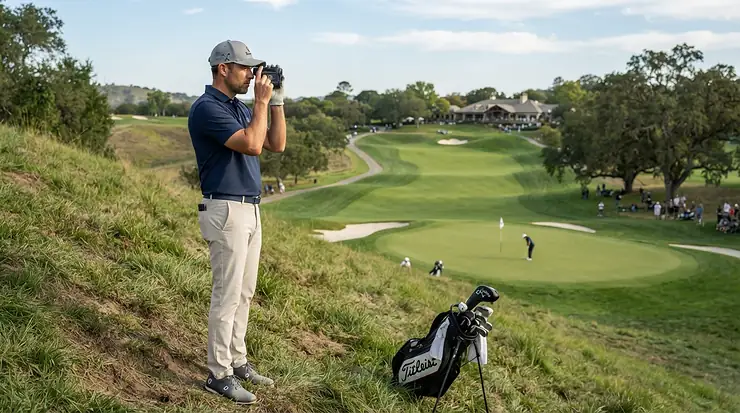
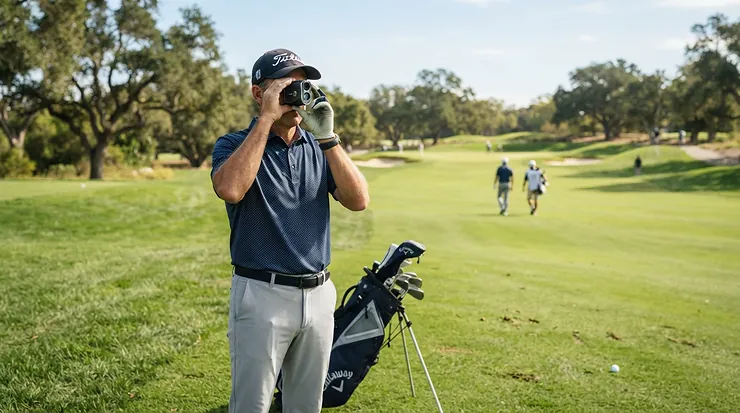
Two rangefinders from one brand show how far golf rangefinders with slope have spread out: the Bushnell Pro X3+ weighs 12 ounces, magnifies 7x and adds wind readings, while the Bushnell Tour V7 Shift weighs 9 ounces, magnifies 6x and costs about a third less (my arithmetic). Neither is the automatic pick for the 2027 season. The right one depends on how hilly your home course is, how often you play in competition and how much weight you want in a cart pocket.
This guide covers six slope models from around $200 to around $600, plus the wind and rules questions that decide whether slope is worth paying for. Specs trace to maker pages and retailer spec sheets, while opinions on speed, glass and feel belong to the named testers, since no unit was handled for the guide itself. Prices appear as ranges that shift week to week, so check the current price on Amazon.com before deciding.
A model without slope reports only straight-line distance, while one with slope also shows an adjusted number for the angle, so PlayBetter’s explainer can say a 140-yard shot plays like 123. Most rangefinders for golf now include that mode, so the choice comes down to which model’s switch, display and extras match the way you play. Every pick below has a slope function that can be turned off, shows up on at least two independent pages and is sold through US retailers.
What separates golf rangefinders with slope: switch, glass, lock-on and wind
Start with the switch, because the rulebook does. Under USGA Rule 4.3a a player may carry a device with a slope function but may not access slope readings during a round (the rules section below has the details), so how easily slope gets switched on by accident matters. Bushnell describes a locking Slope-Switch on the Bushnell Pro X3+ with an interaction lock that reduces the chance of entering slope mode by mistake, and the Garmin Approach Z82 uses a blue light on top to show tournament mode.
Glass and display come next. Magnification splits the field: the Bushnell Pro X3+ and the Blue Tees Series 3 Max+ list 7x, and the other four list 6x. Display design may matter more than the number. The reviewer at Independent Golf Reviews found the Bushnell Tour V7 Shift easy to read at a glance because straight-line yardage shows in red and the slope-adjusted figure in green, while Golfers Authority calls the gray-scale readout on the Callaway 300 Pro Slope hard to see at dusk.
Lock-on separates the tiers. The Precision Pro NX10 Slope gives a vibration pulse but no true flag lock, according to Golfers Authority, and Golf Monthly adds that a naturally shaky hand may struggle with small, distant flags because there is no stabilization. Wind is the rare extra: of the six, only the Bushnell Pro X3+ and the Garmin Approach Z82 list a wind readout, and neither can be used in competition.
In the golf rangefinders with slope reviews opened for this guide, testers mostly agree the lasers read within about a yard. The arguments are about speed, optics and whether the extras are usable. Golf Monthly’s slope roundup is a good cross-check, and it names the Bushnell Pro X3+ its top pick for accuracy.
Best golf rangefinders with slope 2027: weight, magnification and wind support
The table compares what the spec pages print. Where a page gives no figure, the cell says so rather than guessing.
Model
Slope control
Weight
Magnification
Wind data
Price tier
Bushnell Pro X3+
Locking Slope-Switch
12 oz
7x
Speed and direction
Around $600
Bushnell Tour V7 Shift
Side Slope-Switch
9 oz
6x
None listed
Around $400
Garmin Approach Z82
Tournament-mode setting with indicator light
8.2 oz
6x
Indicator, tied to a paired phone
Around $600
Precision Pro NX10 Slope
External on/off switch
Not stated
6x
None listed
$200 to $300
Callaway 300 Pro Slope
Single-press toggle
Listings differ
6x
None listed
Around $250
Blue Tees Series 3 Max+
Side switch
Not stated
7x
None listed
$200 to $290
Two patterns stand out. Wind support belongs to the two most expensive models and nothing else in the table has it, and the Garmin Approach Z82 is also the only one built around GPS course maps. The cheapest three share a plainer toolset: a slope switch, a vibration pulse and a magnet. Those gaps are what the price differences buy, going by the spec sheets.
Six slope rangefinders, matched to the course and the budget
Wind is what the extra money buys. Bushnell’s own page for the Bushnell Pro X3+ lists 7x magnification, a 5-to-1,300-yard range, IPX7 waterproofing, a 12-ounce body, a BITE magnetic mount and wind speed and direction after a one-time calibration that can be done while walking to the ball. Golf Monthly says the unit factors in distance, slope, temperature and barometric pressure, with wind now added.
Golf Monthly’s reviewer found the flag picked out almost immediately from up to 600 yards, confirmed by a flashing red ring and vibration. The same review describes wind setup as pairing with the Bushnell Golf app through a code and then turning the unit around to calibrate, which the reviewer called “a bit of a faff”. Bushnell’s page mentions only the calibration, so the two sources differ on how involved setup is, and this is one reviewer’s experience rather than a consensus. Wind also arrives as a separate number instead of being folded into the plays-like yardage, so a few rounds are needed to learn what a given reading means in clubs.
Pros:
✅ The locking Slope-Switch reduces accidental slope mode, which matters before competition rounds
✅ A dual display helps in dull light, according to Golf Monthly
✅ Bushnell backs it with a two-year limited warranty
Cons:
❌ Golf Monthly’s roundup lists a heavy feel and tricky wind calibration
❌ Its review says the wind and slope extras are expensive for golfers who cannot use them in competition
❌ One buyer review on Bushnell’s page says the magnet is not strong enough
It sits at the top of the category at around $600. Bushnell’s product page labels the current version Bushnell Pro X3+LINK, and the older Bushnell Pro X3 without wind is a separate model, so confirm the exact name on the listing before buying.
Bushnell Pro X3+See current price, sizes and reviews on Amazon.
Launched in February 2026 at around $400, the Bushnell Tour V7 Shift is the cheaper way into Bushnell’s slope and LINK ecosystem. Independent Golf Reviews spent five rounds with it. Its reviewer saw PinSeeker lock onto the flag on the first try and found slope readings accurate on uphill and downhill shots, with the red-and-green OLED making the two numbers easy to tell apart.
The trade-offs are visible in the spec list. It magnifies 6x against 7x on the flagship and lists no wind readout. LINK club suggestions need a compatible Bushnell or Foresight Sports launch monitor plus the Bushnell Golf app, and that reviewer could not test the feature. Plugged In Golf adds that turning slope off also disables the MyBag club recommendations, which is the right behavior for a competition round.
Physically it is a conventional Bushnell: 9 ounces, an IPX6 rating, a replaceable CR2 battery and the BITE magnet carried over from earlier V models. Bushnell lists a two-year limited warranty.
Bushnell Tour V7 ShiftSee current price, sizes and reviews on Amazon.
Range is the first number to check on the Garmin Approach Z82. Scheels’ spec sheet lists 450 yards to a flag, far under the 1,300-yard ceiling Bushnell prints for its lasers. It magnifies 6x through a digital viewfinder, weighs 8.2 ounces, carries an IPX7 rating and runs up to 15 hours per charge in GPS mode.
Slope appears as a PlaysLike figure on the green view. Plugged In Golf’s example shows a flag at 176 yards reading 168 once adjusted, and a blue light on top marks tournament mode. The same review lists more than 41,000 preloaded courses, automatic hole detection, bunker and green views, a wind speed and direction indicator and Find My Garmin, and a retailer listing ties the wind readout to a paired phone. Those extras explain why it lands near the Bushnell Pro X3+, at around $600 in both Plugged In Golf’s review and Scheels’ listing.
Reader comments under that review carry the complaints: one found the image grainy and computer-generated at longer distances, several called the price prohibitive and one reported pin readings landing beyond the back of the green. These are individual comments, not a tally. Scheels’ spec sheet lists no magnet, so cart-bar mounting is not built in.
Garmin Approach Z82See current price, sizes and reviews on Amazon.
No true flag lock is the main compromise on the Precision Pro NX10 Slope, according to Golfers Authority, whose reviewer used it for about three months on municipal, resort and Colorado mountain courses. Acquisition was fast, under a second by that account, and the pulse confirmation was strong enough to feel through a glove, but on courses with trees or hills behind the green the aim has to be careful.
On the mountain course a shot measured 142 yards and read 161 with slope on, and downhill differences were typically 5 to 8 yards, which the reviewer judged more realistic than the 15 to 20 yards some other units show while admitting he could not prove it. Golf Monthly, which gave the model a 2023 Editor’s Choice award, calls it well priced and rock solid. It magnifies 6x, includes a magnetic cart grip and offers 33 optional skins.
Pros:
✅ An external switch makes slope status easy to check before a round, per Golfers Authority
✅ A three-year replacement warranty
Cons:
❌ No flag lock and no stabilization
❌ Water-resistant rather than waterproof, with no official IP rating
Retailer listings on Golf Monthly’s page run between roughly $200 and $300. The sources also disagree on the free battery program: Golfers Authority says it ended in spring 2025, while Golf Monthly and a PlayBetter listing still describe it, so confirm current terms.
Precision Pro NX10 SlopeSee current price, sizes and reviews on Amazon.
Around $250, the Callaway 300 Pro Slope is the plainest of the six: 6x magnification, a claimed 5-to-1,000-yard range, plus-or-minus one yard accuracy and a single press of the mode button to switch slope, per Golfers Authority. That review also notes no Bluetooth or app, a 10-second auto-shutoff the reviewer would stretch to 20 or 30 seconds, and weight figures that run from 5.4 to about 7.6 ounces depending on the page.
Lock-on is where the sources split. Golfers Authority says Pin Acquisition Technology cuts repeat clicks, especially at 150 to 250 yards, and handled tree-lined courses and light rain. A MyGolfSpy forum owner reports the opposite experience: three or four laser attempts, sometimes more, before getting a trustworthy number, with first readings of 100, 120 and 97 yards on a 197-yard par 3, and trouble lasing bunkers. That owner still rates the optics above an older rangefinder and the slope readings as accurate, yet regrets the purchase. One owner’s thread is an anecdote, not a failure rate.
The battery is a single CR2, about $5 to replace, according to Golfers Authority.
Callaway 300 Pro SlopeSee current price, sizes and reviews on Amazon.
One of the cheaper slope models here, the Blue Tees Series 3 Max+ shows listings between about $200 and $290 depending on the page. Golfers Authority tested it for about 40 rounds over three months beside a Bushnell Tour V5, checking readings against course markers, playing partners’ devices and GPS apps, and used it in rain three times. Slope mode added roughly half a second, ranking 12th of 24 for speed with slope on, and optics clarity ranked 14th of 24.
Charging runs through USB-C, and the reviewer got about 15 rounds per charge against a maker claim of up to 12 hours of continuous use. It lists 7x magnification and a 900-yard range on that page, though PlayBetter’s listing says 1,000 yards. A prominent side switch set to OFF makes it tournament legal.
Pros:
✅ A USB-C rechargeable battery with no CR2 cells to buy
✅ A two-year manufacturer warranty, registered through the Blue Tees app
✅ A slope switch that is hard to miss
Cons:
❌ Optics ranked 14th of 24 in Golfers Authority’s clarity tests
❌ Water-resistant, not waterproof
❌ One PlayBetter buyer reports hard-to-lock flags at times, in a 4-out-of-5 review
Golfers Authority says an extra year of coverage costs $25, and wear and accidental damage are excluded unless it is bought.
Does one of these suit your home course? Take a closer look at its current Amazon.com listing.
Blue Tees Series 3 Max+See current price, sizes and reviews on Amazon.
A golf rangefinder with slope and wind: what the extra data is worth
Slope is only one input to a plays-like number. In a dataset Arccos supplied for a MyGolfSpy article covering 3.5 million shots, slope made up 19.9 percent of the total adjustment, sustained wind 35.7 percent, wind gusts 28.2 percent, temperature 12.4 percent, altitude 2.6 percent and humidity 1.1 percent. That article belongs to an Arccos-powered series, gives no methodology and ends by promoting the Arccos Smart Laser, so treat the proportions as a vendor’s claim rather than a neutral measurement.
A 2015 to 2016 forum thread on The Sand Trap points in a similar direction. One member said wind usually matters more than slope on flatter courses, others valued slope on hilly layouts and as a way to learn how elevation changes distance, and another doubted that plays-like formulas can be accurate because ball flight changes how a shot plays. A different member noted that uphill greens still need extra club because the steeper landing angle often makes the ball roll out more.
Three options add weather to slope. The Bushnell Pro X3+ shows wind speed and direction as its own reading. The Garmin Approach Z82 lists a wind indicator that retailers tie to a paired phone. The Arccos Smart Laser folds slope, wind, gusts, temperature, humidity and altitude into its Smart Distances using live weather data sent over Bluetooth, and Arccos describes no onboard wind sensor. Golf Monthly’s testing at Royal County Down found the weather-adjusted yardages reliable, with a third number based on peak gusts. It also lists a $199.99 yearly subscription as a requirement, while Arccos says a first year comes with purchase.
All of this is off-limits during a round, which is why tournament modes exist; Arccos says its toggle disables both slope and weather adjustments. A golfer who plays casual rounds in breezy country may get more from wind data than from slope. On a hilly course without much wind, a slope-only model such as the Bushnell Tour V7 Shift or the Precision Pro NX10 Slope covers the same ground for less.
Rule 4.3a and the slope switch: what the 2027 season allows
USGA’s distance-measuring device guidance says Rule 4.3a allows these devices as long as the player does not access prohibited information, a list that covers slope-based and other plays-like distances, club recommendations, and wind speed or altitude readings. A device with a slope function can still be used if the function is never accessed during the round. The guidance warns that if prohibited information is shown on a readily viewable device, such as a watch, the player counts as having used it. A first breach costs the hole in match play or two strokes in stroke play, a second breach in the same round means disqualification, and a Committee can ban the devices entirely by Local Rule.
Nothing in that framework changes for 2027. The R&A states that the next edition of the Rules of Golf will be published on 1 January 2028, and its page on the model local rules available from 1 January 2026 covers other topics and does not address rangefinders.
For club and handicap events the routine is short: flip the switch before the first tee, confirm the indicator, and read the event sheet for any outright ban. The locking switch on the Bushnell Pro X3+ and the blue tournament light on the Garmin Approach Z82 exist to make that check quick, and Golf Monthly notes the Bushnell Pro X3+ needs its slope and wind modes turned off with the Slope-Switch for competition.
Slope legality, wind data and accuracy: short answers for 2027
❓ Are golf rangefinders with slope allowed in tournaments?
✅ Yes, with slope turned off. Rule 4.3a lets players carry a device with a slope function but bars accessing slope, wind or other plays-like readings during a round. A first breach costs two strokes or the hole, and a Committee can ban devices entirely.
❓ Is slope worth paying extra for on a rangefinder?
✅ It depends on terrain. Slope helps most on hilly courses and for learning how elevation changes distance. A sponsored Arccos dataset puts slope near a fifth of the total plays-like adjustment, and forum members say wind often matters more on flat ground.
❓ Which rangefinders for golf measure wind as well as slope?
✅ Few do. Bushnell's flagship adds wind speed and direction, Garmin's laser-and-GPS unit shows a wind indicator tied to a paired phone, and Arccos's laser pulls live weather through its app on a subscription. All of it must stay off during a round.
❓ How accurate are slope-adjusted yardages?
✅ The angle measurement is precise, but the plays-like number comes from a formula that cannot see your ball flight. Forum members note uphill greens still need extra club because shots roll out more, and one Golfers Authority test saw a 142-yard shot read 161.
❓ Do the 2027 rules change anything for slope rangefinders?
✅ No. The R&A says the next edition of the Rules of Golf is published on 1 January 2028, and its 2026 local-rule updates do not address distance-measuring devices. Rule 4.3a stands through 2027, though your event's local rules still decide whether devices are allowed.
Picking among the best golf rangefinders with slope
For most golfers shopping for golf rangefinders with slope, the Bushnell Tour V7 Shift is a sound middle: a readable red-and-green display, first-try flag pickup in Independent Golf Reviews’ five rounds and a two-year warranty, at around $400. Spend toward $600 only on an extra you will use outside competition, either wind on the Bushnell Pro X3+ or GPS maps on the Garmin Approach Z82. If budget decides, the Precision Pro NX10 Slope, Callaway 300 Pro Slope and Blue Tees Series 3 Max+ each deliver slope with an on/off switch for $200 to $300, and the reports above flag a lock-on compromise on every one. Whatever you choose, rehearse switching slope off before the first tee. Spotted a front-runner? Take a closer look at its Amazon.com listing before the season starts.
Disclaimer: This post contains affiliate links. As an Amazon Associate, I earn from qualifying purchases made through these links, at no additional cost to you.
Found your match among the six? A closer look at its Amazon.com page is one click away. ⛳