
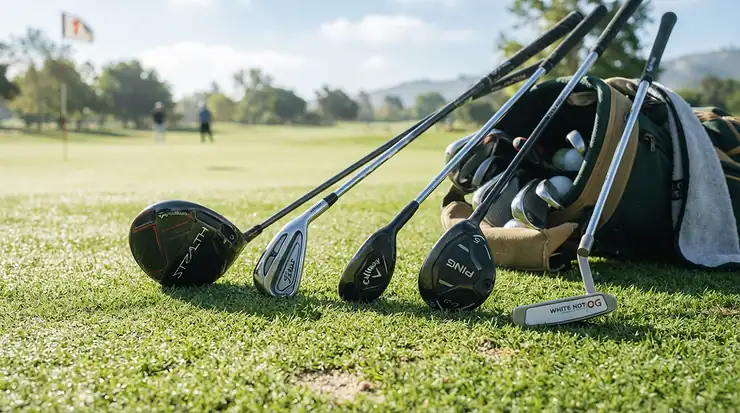
The belief that pricier golf putters roll in more putts does not hold up against the 2026 test data. MyGolfSpy pushed 79 putters through its PuttView system, and a Cleveland mallet that launched at around $150 finished in the top five mallets, level with two Ben Hogan models, while zero-torque designs as a category made 46.9% of putts against 41.9% for blades and 43.8% for mallets. That makes stroke, length and grip better starting points than a logo. Five picks follow, each tied to a specific putting problem, along with lefty and ladies options, extension costs and a grip walk-through; for anyone shopping golf putters in 2027, that is the order of decisions that pays off.
No club in this piece was rolled by the author. The findings rest on MyGolfSpy’s 2026 putter test data, National Club Golfer and Today’s Golfer panels, maker and retailer spec pages, and owner threads, and where two sources disagree the text says so. Prices appear as ranges only.
Arc, length and head type: what separates one putter from the next
A putter has to answer a question your stroke has already asked. If the path swings slightly inside and back, the head needs to open and close with it. If the stroke goes straight back and straight through, a head that stays put is the better match. Cleveland’s spec table pairs moderate toe hang with a slight arc and face-balanced heads with a straight stroke, and PING sorts its heads the same way: the PING G Le4 Anser 2D for a slight arc, the PING Scottsdale Anser 4 for a strong arc.
Zero-torque designs sit outside that sorting. They are built to hold the face square on their own, which helps explain why MyGolfSpy found that the top 15 putters across its three categories, ranked by PuttView handicap, were all zero-torque.
Length is the quieter variable. Off-the-rack putters run 33 to 35 inches, and a fitter quoted by Golf Digest says one that is too long lifts the toe and shuts the face, so putts miss left while the golfer blames a pull. Feel closes the list: Today’s Golfer marked the TaylorMade Spider Tour down on feedback, and Breaking Eighty’s reviewer found the L.A.B. Golf DF3 firm off the face. Sound and feel are personal, as Today’s Golfer puts it, so neither is a flaw for everyone.
| Pick | Fits this problem | Head type | Detail worth knowing |
|---|---|---|---|
| L.A.B. Golf DF3 | Short putts that slide offline | Zero-torque mallet | Balanced for a fitted length and lie |
| TaylorMade Spider Tour | A stable, confident mallet | Mallet, slant hosel | 34″ to 35″ stock, 70° lie, 3° loft |
| PING Scottsdale Anser 4 | Strong-arc strokes, blade fans | Blade, 3/4-shaft offset | 345 g head, PEBAX insert |
| Cleveland HB Soft 2 Retreve | A tight budget, straight stroke | Face-balanced mallet | Center hole lifts the ball from the cup |
| PING G Le4 Anser 2D | Shorter golfers, lefty options | Perimeter-weighted blade | 33″ stock, 31″ to 35″ options |
The table splits cleanly by price tier. The L.A.B. Golf DF3 sits at the top, the Cleveland HB Soft 2 Retreve at the bottom, and the three in between differ more by stroke than by cost. Read the first column before the last: a head that fits your arc beats a spec that looks impressive.
Matching a putter to the miss you keep making
1. L.A.B. Golf DF3 — zero-torque help for short misses
Golfers who keep pushing and pulling three-footers are the audience for this one. L.A.B. stands for Lie Angle Balanced: weight is placed so the face stays square to the lie angle instead of twisting, and each putter is built to a specified length and lie. Breaking Eighty’s reviewer says it suits players who miss short putts and will “trade aesthetics for results,” and calls it the maximum-forgiveness option in the line. Today’s Golfer lists the L.A.B. Golf DF3 with lie angles from 63 to 79.5 degrees, lengths from 28 to 38 inches and a built-in forward press.
The price is the obstacle at around $450 per Breaking Eighty’s rundown, before any custom options. The adjustment period is the other. Breaking Eighty reports that short-putt confidence arrived quickly but distance control took more conscious effort over several months. A MyGolfSpy forum tester who rolled the older L.A.B. Golf DF2.1 saw putts per hole from five feet and in fall from 1.19 to 0.94, yet struggled with distance beyond 15 feet. That is one tester on a sibling model, so it shows a pattern without proving it. Today’s Golfer adds that the design of the L.A.B. Golf DF3 is not to everyone’s liking.
The same maker’s L.A.B. Golf OZ.1 topped National Club Golfer’s test of 35 putters at 82.8 out of 100, although the panel scored it only 27 out of 50 on value.
2. TaylorMade Spider Tour — mallet roll that builds confidence
Today’s Golfer reports that over 85 percent of players in the men’s top 50 rankings use mallet putters, and its roundup of 37 mallets ranked the TaylorMade Spider Tour second at 85.71%, behind only the TaylorMade Spider Tour X L-Neck at 86.29%. The reviewer praised its roll and alignment. The weak spot was feedback, where the reviewer felt the putter fell short.
Stock specs on that page are a 3-degree loft, 70-degree lie and 34 to 35 inch length, with a short slant hosel carrying 29 degrees of toe hang, True Path alignment lines and a TPU Pure Roll insert. A slant hosel with that much toe hang is not face-balanced, so a dead-straight stroke may suit a different head. National Club Golfer’s panel ranked the TaylorMade Spider Tour X Torched second of 35 at 81 out of 100, so the family keeps turning up near the top across separate tests. Check the current price on Amazon.com.
Pros:
- ✅ Roll and alignment praised by Today’s Golfer’s testers
- ✅ A stock length of 34 to 35 inches matches what most men’s retail putters run
Cons:
- ❌ Feedback was its weakest area in the same test
- ❌ Toe hang means it is not built for a perfectly straight stroke
3. PING Scottsdale Anser 4 — a blade for strong-arc strokes
Blades carry a reputation for punishing mishits, and MyGolfSpy’s numbers push back. The PING Scottsdale Anser 4 placed second among 2026 blades at a PuttView handicap of -4.5, with its best result on short putts (-6.3) and its weakest in the middle distance (0.3). The PING Scottsdale Anser 2D took third. National Club Golfer’s panel ranked the standard PING Scottsdale Anser third of 35 at 80.4, called it very reasonably priced for its results, and took points off only because just the length is adjustable.
Retailer listings describe a 17-4 stainless steel head of 345 grams with a one-piece PEBAX face insert, a 3/4-shaft offset hosel, a 20-degree lie (plus or minus four) and 3 degrees of loft, built for a strong arc. Stock length is where listings disagree: most say 35 inches, while one US spec table shows 37.75. Compare the exact model number before buying, since the Scottsdale heads share a family name but are sorted by stroke type. Check the current price on Amazon.com.
4. Cleveland HB Soft 2 Retreve — tested-well mallet at a modest price
Cheaper does not mean weaker here. Golf.com put the HB Soft 2 line at around $150 at launch, and MyGolfSpy’s PuttView data placed the black-finish Cleveland HB Soft 2 Retreve fifth among mallets at -5.7, with a long-putt score of -9.3 that was second-best in that top five. Cleveland’s face milling, which it calls Speed Optimized Face Technology, is meant to limit distance loss on heel and toe mishits, and the pattern is tailored to each head shape.
This head is a full mallet with a center hole that lets you lift the ball out of the cup without bending down. Cleveland’s spec table for the women’s version lists a single-bend, face-balanced head built for straight strokes, so the arc golfer is better served by a different shape in the range. Golf.com notes that builds at 35 inches and longer get a 20-gram counterweight in the butt end, which is useful context for the extension section below.
Pros:
- ✅ Top-five mallet in MyGolfSpy’s 2026 PuttView results
- ✅ Counterweight added on 35-inch and longer builds, per Golf.com
Cons:
- ❌ Face-balanced head is aimed at straight strokes, not arcs
- ❌ Cleveland’s European page contradicts itself on left-handed availability for this head
5. PING G Le4 Anser 2D — women’s build with lefty options
Length is the first problem for many women shopping for a putter, and Golf Digest’s reporting says women are often fitted with putters that are too long. This model arrives at a 33-inch standard length with 31 to 35 inch options on one left-handed specialist’s listing, plus a 20-degree lie range and 3 degrees of loft. Shorter golfers have real choices here that a stock 35-inch blade would not offer.
PING describes the head as a deeper, perimeter-weighted blade with mid-mallet forgiveness, a one-piece PEBAX insert and a plumber’s neck hosel for slight-arc strokes. A TGW listing adds a lighter women’s-specific build and grip. A UK specialist’s left-handed listing shows a left-hand selector and a head weight of 350 grams, so US buyers should confirm hand availability with a US dealer. Look up current pricing on Amazon.com.
What the 2026 golf putters reviews agree on, and where they split
Three outlets, three methods. National Club Golfer had five testers hit 15 putts each on one practice green across 35 putters, a little over 2,500 putts. MyGolfSpy ran 79 putters through PuttView. Today’s Golfer scored 37 mallets on looks, alignment, stability, feedback and roll. Unsurprisingly, the winners differ: the L.A.B. Golf OZ.1 at National Club Golfer, the Odyssey Ai-Dual S2S #7 as MyGolfSpy’s zero-torque leader at -8.1, the Mizuno M.Craft Osaka as its best blade, and the TaylorMade Spider Tour X L-Neck among Today’s Golfer’s mallets. Any list of the best golf putters reflects its own testing conditions as much as the clubs.
The overlap is more useful than the winners. Zero-torque and high-MOI shapes score well everywhere, and the price gap does not track performance cleanly. MyGolfSpy notes that the Sub 70 011-SQ, Vice Golf and Wilson zero-torque models deliver that performance without the roughly $400 price of some rivals, and the Sub 70 011-SQ posted the best make percentage in the zero-torque group at 50.5%. National Club Golfer’s value column tells the same story: 40 out of 50 for the PING Scottsdale Anser, 35 for the TaylorMade Spider Tour X Torched and 27 for the L.A.B. Golf OZ.1.
L.A.B. does not appear among the five zero-torque names MyGolfSpy lists, which is worth knowing before assuming it wins every ranking.
Lab golf putters: what lie angle balance asks of you
Lab golf putters earn their reputation on one trick: the weighting lets the face return to square without the hands doing the work. The trade is a fitting step and an adjustment period.
Fit comes first. MyGolfSpy’s forum testers were fitted through L.A.B.’s remote video process, which returns specifications within about 48 hours. One tester’s remote fit of 35 inches and 70 degrees matched his in-store result, another had his fit adjusted after the review period, and a third was told his setup was poor for a good strike and changed it. Breaking Eighty’s reviewer says remote fitting gets most golfers 85 to 90 percent of the way there, and that a putter like this is not magic.
Then comes the adjustment. A 20-plus handicap tester on the same forum dropped from 43 putts to 36 in his first round with the L.A.B. Golf Mezz.1 Max, but called pace control on longer putts inconsistent. That matches the L.A.B. Golf DF2.1 report earlier: a sharp gain inside five feet, a slower one on lag putts. Golfers who lose strokes to a twisting face stand to gain most. Golfers who rely on feedback to judge long-putt speed should try one before committing, in a fitting if a shop offers it.
Ladies left hand putter golf club options and what to check
Searching for a ladies left hand putter golf club narrows the field fast, because most women’s lines are stocked right-handed first. Two families show up with lefty options on the pages checked.
Cleveland’s European spec table for the women’s HB Soft 2 lists Models 1 and 11 as right- or left-handed, at 32 inches, a 70-degree lie, 3 degrees of loft and head weights of 355 and 365 grams. The same page’s description says the Retreve is right-handed only, so treat that head as unconfirmed for lefties. The Cleveland Women’s HB Soft 2 is the budget route in this group.
The PING G Le4 Anser 2D is available left-handed through a specialist retailer, as covered in the fifth pick. Left-handed availability for L.A.B. putters is not addressed on the pages opened, so ask the maker directly.
Length matters more than the brand. Golf Digest’s fitting guide quotes a club fitter saying most women suit a 32-inch putter, and those under 5 feet 3 inches may need 31 or even 30. Three checks work without a fitter. Stand comfortably, neither tall nor hunched. Hold a ball at the bridge of your nose and drop it; it should land on a ball placed in front of the face. Then check the sole sits flush. The article adds that shorter putters need a heavier head to keep swing weight, and that shorter lengths can be ordered online when stores have none. That heavier-head point explains why Cleveland’s women’s heads run 355 to 365 grams while the PING Scottsdale Anser 4 runs 345.
The cost to extend golf putter shafts, and what changes when you do
The cost to extend golf putter shafts is small. Golf Galaxy’s service page lists lengthening a shaft without regripping and installing a standard grip as separate fees, which together land at roughly $8 to $12 in labor, with the new grip priced on top. Keeping the old grip is a separate fee, and a putter lie adjustment lists at about $6. Lengthening is a quick shop job; the expense is the new grip.
The cost that does not show on a receipt is balance. Golf Digest’s fitter ties length to head weight, noting that shorter putters need heavier heads, so the reverse holds as a reasoned conclusion: a longer putter will usually feel lighter at the head. Cleveland’s 20-gram counterweight on builds of 35 inches and longer is one maker’s answer to that, and it is the kind of fix a shop can add under the grip.
Two limits apply. First, a putter that is too long is more often the problem than one that is too short, as the ladies section shows, so shortening after a fitting is the commoner job; ask the shop for that quote. Second, because L.A.B. builds balance to a specified length and lie, extending one afterward is a question for the maker; that is analysis rather than a maker statement. The USGA’s anchoring rule is not an equipment rule, so conforming mid-length and long putters stay legal as long as they are not anchored, a point covered in the grip section below.
Golf putter how to grip: the holds worth trying
Golf putter how to grip questions have a default answer: the conventional grip with a reverse overlap. Golf Monthly’s coaches Andrew Jones and Katie Dawkins describe it as the standard right-hand-below-left hold, kept in the palms so the hands stay quiet, and it suits most golfers because it feels closest to an iron grip. Stan Utley’s version, reported by Golf.com, breaks it into setup points:
- Place the lifeline of the lead hand down the left-center of the grip, with the lead thumb straight on top.
- Bring the trail hand to the grip with its palm facing the putter face squarely, in line with the lead hand.
- Rest the trail hand’s lifeline on the last knuckle of the lead middle finger, and lay the lead index finger over the trail fingers; all other fingers stay on the grip.
- Check that forearm, wrist and hand sit on the shaft plane, so the forearms stay level and in line with the shaft when you tilt over the ball.
Left-handers mirror those instructions. Golf.com’s takeaway from Utley is that golfers who already putt well do not need to switch, and that the best grip is the one that feels most coordinated.
When the conventional hold fails, Golf Monthly’s grip guide lists the alternatives. Left hand low locks hands and arms together and targets golfers who struggle with the conventional grip or the yips. The claw rests the grip between thumb and forefinger of the trail hand, another yips remedy that can take time to feel comfortable. The pencil grip lightens the trail hand and tucks the elbow, the saw grip pulls the elbow out for a straighter pendulum, and the armlock suits longer putters and tends to de-loft the face. A two-thumb hold on an oversize grip can work on faster greens but may be harder from long range on slow ones.
Legality is simple. The USGA’s guide to Rule 10.1b lists the traditional, claw and cross-handed grips as allowed, and bans anchoring: holding the club or a gripping hand against the body, or a forearm against the body to create an anchor point. The penalty is two strokes in stroke play and loss of the hole in match play.
Three ways a putter ends up in the closet
The first is length. A putter that is too long tilts the face and pulls putts left, a problem Golf Digest’s fitter says hits women hardest, and no head shape fixes it.
The second is expecting an instant result from a premium design. One MyGolfSpy forum tester who saw gains inside five feet said he was unsure the putter would stay in his bag because of the distance-control struggle, while Breaking Eighty’s reviewer spent months adjusting before lag putts settled. A premium zero-torque model rewards patience and a fitting.
The third is skipping the hand and lie on the listing. Cleveland’s own page disagrees with itself on the Cleveland HB Soft 2 Retreve, and retailers disagree on the stock length of the PING Scottsdale Anser 4. Read the specification rows, not just the title.
Length, lefties, LAB and grip: quick answers
❓ What length golf putter should I use?
❓ Are L.A.B. putters worth the money?
❓ How much does it cost to lengthen a putter?
❓ Is a mallet or a blade better for most golfers?
❓ Are the claw and cross-handed grips legal?
Which putter belongs in your bag first
Start with the miss. If short putts slide offline, the L.A.B. Golf DF3 is the most direct fix and the most expensive one. A stable mallet that testers keep ranking near the top points to the TaylorMade Spider Tour. Strong-arc strokes belong with the PING Scottsdale Anser 4, tight budgets with the Cleveland HB Soft 2 Retreve, and shorter or left-handed women with the PING G Le4 Anser 2D or the Cleveland Women’s HB Soft 2. Whatever you choose among golf putters this year, settle length and hand before head shape, because a fitted length is the one spec every source here agrees on.
Read the hand, length and lie on the listing before you order.
Recommended for You
- Custom golf shoes: What Suits Your Budget and Style
- Golf hitting mat: What Suits Your Budget and Space
- Inflatable golf simulator: What Suits Your Budget and Space
Disclaimer: This post contains affiliate links. As an Amazon Associate, I earn from qualifying purchases made through these links, at no additional cost to you.
Know your stroke and your length first, and the shortlist nearly writes itself. ⛳