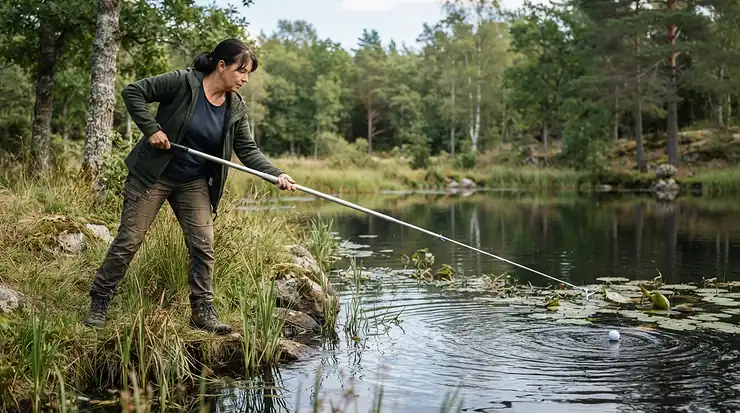
A golfer whose home course has an island green on the 7th and a lined retention pond behind the 14th needs more from golf ball retrievers than a long stick with a cup on the end. The first hole rewards reach, the second rewards a light touch, and a cart rider, a walker and a player with a sore back each want something different again. This 2027 guide matches four retrievers to those situations instead of ranking them on one scale, because the published tests behind them score reach, ball security, sturdiness, handle and storage separately, and the winner changes with the weighting.
Findings here are assembled from MyGolfSpy’s and GOLF.com’s published tests, retailer review pages, a 2026 product review and an old Sand Trap thread, so every durability claim belongs to those sources and none comes from a hands-on test by this site. Prices are ranges, and the current price on Amazon.com is the one that counts.
Reach, locks and cups: what separates one retriever from another
Length is the first decision, and the sources pull in two directions. GOLF.com’s 2023 guide to the best retrievers calls six feet the practical minimum and 14 feet the ideal maximum, since a 14-footer is the most stable and an 18-footer gives up some control for extra reach. Caddie HQ’s pond-retrieval guide leans the other way, noting that longer models let you reach farther without stepping onto unstable ground. The two views describe one trade-off: extra length keeps your feet on safer footing on a steep, muddy bank, while a shorter pole is steadier on a flat one.
The second decision is how the head holds a ball. MyGolfSpy’s 2022 head-to-head says scoop designs suit soft mud but can drop the ball when turned upside down, and advises a lock mechanism if you worry about the ball falling out on the way back. The same test says the top-scoring I Gotcha model holds balls well but can struggle on softer ground.
Materials and joints decide how long any of this lasts. GOLF.com points to stainless steel and anodized aluminum as the rust-resistant choices and says the ball trap should be strong plastic or nylon that will not crack. Its price survey runs from about $10 to $60.
Here is how the four picks below compare on the numbers the sources agree on, with the disagreements marked.
Pick
Reach
Collapsed length
Weight
Price tier
Built for
I GOTCHA Jawz Golf Ball Retriever
14 ft in GOLF.com and MyGolfSpy’s 2022 test
17.5 to 21 in, depending on the source
10 oz to 1.2 lb, depending on the source
Around $40
Regular water play, bag pocket
Callaway 15-Foot Golf Ball Retriever
15 ft
About 45 to 48 in
16 oz to 1.5 lb, depending on the source
Around $40 to $50
Long banks, rough, bushes
Player Supreme 9-Foot Orange Golf Ball Retriever
9 ft
43 in
Not listed
Around $20 to $26
Occasional use, tight budgets
Water Weasel 12-Foot Golf Ball Retriever
12 ft
About 4 ft
Not listed
Around $60
Water-heavy courses, multiple balls
The weight and collapsed-length splits are real: GOLF.com and MyGolfSpy measured the same I GOTCHA Jawz and Callaway 15-Foot names differently, so read the specifications on the exact listing before ordering. Prices stretch from around $20 to around $60, which turns the choice into one question: is length, a compact fold or multi-ball capture worth the difference?
Best golf ball retrievers by situation
For the best golf ball retriever 2027 has to offer, there is no single winner across the table’s rows. These four map to four common situations, and each entry says what it trades away.
Spotted one that fits your course? Take a closer look at the current listing on Amazon.com before deciding.
A walker who plays a water-heavy course every week and keeps the retriever in a side pocket is the buyer this model was reviewed for. GOLF.com named the 14-foot version its staff favorite, listing it at 17.5 inches collapsed, 10 ounces, with a stainless steel single-piece head that has gripping teeth and little sag at full extension. MyGolfSpy named the I GOTCHA Jawz its best retriever of 2023, scoring it 9.7 overall, and its earlier 2022 table put it at 83 points, first for handle, third for extension and storage, fourth for ball security and sixth for sturdiness.
Sources disagree on details. MyGolfSpy’s 2023 page describes a silicone grabbing mechanism and lists only 6-foot and 15-foot versions, while GOLF.com describes stainless steel and a 14-foot reach. That spread suggests several generations and sizes under one name, so confirm length and head type on the page you buy from. A Golf Galaxy listing for the separate Jawz Compact model says its head grips the ball from either side.
Pros:
✅ Fits a side pocket at 17.5 inches, according to GOLF.com
✅ Ranked first for handle comfort in MyGolfSpy’s 2022 test
Cons:
❌ Sixth of ten for sturdiness in that same test
❌ One MyGolfSpy reader wrote that his came apart after a year or so
GOLF.com lists it near $40 at PGA Tour Superstore and calls it pricier than the alternatives it tested.
I GOTCHA Jawz Golf Ball RetrieverSee current price, sizes and reviews on Amazon.
Fifteen feet of aluminum telescoping arm comes with a storage problem: GOLF.com lists the Callaway 15-Foot Golf Ball Retriever at 45 inches collapsed and 16 ounces, and says it does not stow in a bag saddle, so it occupies a club slot. A dual-zip headcover is included, which hides it as an extra club and protects the others, and the ball-grabbing mechanism is stainless steel.
Test results are mixed. In MyGolfSpy’s 2022 table it was first for extension but fifth for ball security, seventh for handle and ninth for sturdiness, for 78.5 points. Its 2023 review scored it 9 out of 10, called it a sturdy choice for people who are hard on a retriever and named it the most durable of that year, yet flagged a weakness in the extension locking mechanism. Both results come from the same publication a year apart, and they do not fully agree. GOLF.com’s verdict was that durability can be unreliable.
Owners who left reviews on a Golf Galaxy page give it 3.9 out of 5 across 66 reviews, with 68 percent recommending it, and the complaint that keeps appearing is a plastic part that snaps, including after a drop onto grass, with no replacement parts offered. A reviewer originally posted on Callaway’s site said the plastic pin holding the ball catcher broke when the headcover zipper caught it, a failure tied to storage and not to water. Prices run around $40 to $50 across Amazon and Target listings.
Callaway 15-Foot Golf Ball RetrieverSee current price, sizes and reviews on Amazon.
Budget tier first: GOLF.com’s pick for best budget sits near $26 at Amazon, and retailers such as Carl’s Golfland and Dunham’s list the 9-foot Player Supreme around $20, which makes it the cheapest entry here. It extends to 9 feet, collapses to 43 inches, locks the shaft and uses an orange cup that GOLF.com says shows up in murky water.
GOLF.com is the only expert test of this model among the sources found, and its writers say the build is less durable and stable than stainless steel or aluminum retrievers. At 43 inches it will not slip into a side pocket, and 9 feet is short next to the 14-footers.
Pros:
✅ Locking shaft keeps it from collapsing mid-reach
✅ High-visibility orange cup helps in cloudy water
Cons:
❌ Does not collapse small enough for a bag pocket
❌ Shorter reach than most golf ball retrievers on this list
GOLF.com counts the 9-foot reach as shorter than most retrievers when extended, so steep banks and wide ponds are where the 14- and 15-footers earn their extra weight.
Player Supreme 9-Foot Orange Golf Ball RetrieverSee current price, sizes and reviews on Amazon.
Two rotating discs with a rubber insert grip the ball as you roll over it, which means you do not have to judge depth and slide a cup underneath, as Golf Aficionado’s Rob Spellman explains in his April 2026 review. The telescopic shaft reaches 12 feet and folds to about four feet, per launch coverage in Golf Business News, and the head can hold up to four balls in a single pass. The maker’s CEO told that outlet it was launched at the 2026 PGA Show.
The tool is made and assembled in the USA and carries a one-year limited warranty, according to the review. Spellman lists no drawbacks and does not describe how he tested it, so his verdict is opinion and not measured data, and as the newest design here it has no long-term durability reports yet.
It does a different job than the other three. Someone fishing a pond with several balls on the bottom gains the most from collecting four in a pass, while a golfer who wants one ball back is paying for capacity he will not use. GolfWorks and the launch coverage both put it near $60, the highest price of the four.
Water Weasel 12-Foot Golf Ball RetrieverSee current price, sizes and reviews on Amazon.
Golf ball retrievers reviews: what testers and owners keep reporting
The tests behind these reviews date from 2022 and 2023, so current production may differ, but across the sources plastic parts and locks fail before the shaft does. Callaway owners on the Golf Galaxy page report a snapped plastic piece with no replacement available, a Dick’s Sporting Goods reviewer of a Search N’ Rescue 15-footer said the plastic head broke after three months, and MyGolfSpy’s 2023 review of the Callaway names the extension lock as its weak point. Three separate retailers and testers, one pattern, though each report is small.
Droop and rust show up in the longer-lived complaints. MyGolfSpy’s 2022 test says lightweight models tend to bend more, and a reader of its 2019 test page wrote that an I Gotcha 14-footer he had owned about two years rusted and broke, which is one owner’s account, not a rate. Another reader on the 2022 page claims the internal spring in the I Gotcha can break and cannot be replaced, again a single comment.
Cost-versus-value is where owners split. In a Sand Trap thread from April 2010, one member said a retriever bought for roughly $5 about 20 years earlier had paid for itself many times over, another called it absolutely worth it for the 10 to 12 balls he finds a round on an island-green hole, and two members said expensive models do not recover more balls than cheap ones. That thread is old enough that current models differ, but the logic holds for budget buyers: spend more only for a feature you will use, such as length, a lock or a compact fold.
Liners, minutes and manners: what to check before extending the pole
Many courses line their ponds with thin rubber, and Caddie HQ’s pond guide warns that a retriever or rake can puncture one and leave you liable for thousands of dollars in damage. The same guide recommends a stable footing on the bank, extending the pole a foot or two longer than you think you need so the sections lock, and capturing the ball by scooping under or pressing down, depending on the head, without jabbing at it. It says to skip steep, muddy or rock-lined banks entirely and never wade in.
Time and pace matter next. Caddie HQ says a search of about a minute is generally acceptable and that longer ones should let the group behind play through. Golf Digest’s July 2026 rules review notes that you have three minutes to get lucky when you need a retriever to identify a ball in a penalty area, and that without roughly 95 percent certainty it went in, the ball counts as lost under Rule 18.2. On etiquette the Sand Trap thread is blunt: one poster does not want to wait while others fish in hazards, another is fine with retrievers as long as play does not slow, and a third uses his while waiting on the group ahead. Check your course’s own posted policy as well, since Caddie HQ notes some courses forbid entering hazards or searching during play.
Sorting the haul: a golf ball compression chart for 2027 and the golf ball markers worth carrying
A retriever pays back in mixed balls, and a golf ball compression chart 2027 readers can trust helps you decide which to play and which to practice with. MyGolfSpy’s compression guide defines compression as how much a ball deforms under load and lists every ball its Ball Lab has measured on the same gauge, but the page carries no 2026 or 2027 date, so treat the chart as a lab reference and not a new yearly release. The page calls the idea that each swing speed has a right compression a pervasive myth, says the real risk is faster swingers compressing a softer core too much, and says distance losses from softer balls are probably not worth worrying about at swing speeds in the low 80s mph and below. Firm balls such as the Titleist Pro V1x, Bridgestone Tour B X and Callaway Chrome Soft X sit at one end of its examples, and the Callaway Supersoft, Wilson Duo and Srixon Soft Feel at the other.
Two small tools round out the bag. Golf ball markers are the discs you place on the green, and magnetic hat-clip versions keep one in reach; a Maxfli set at Golf Galaxy, for example, pairs two metal markers with a clip, and its reviewers like not searching their pockets for a coin. For the other direction, GOLF.com’s best putter-grip option is the Nickel Putter Ball Pick-Up at around $21, a polycarbonate three-prong clasp that lets you lift a ball from the cup without bending, though it does not fit round putter grips and its arms can break if they are not folded down. That is a cup-and-green accessory, not a substitute for the pond tool.
Reach, cost, liners and search time: straight answers
❓ How long should a golf ball retriever be?
✅ GOLF.com calls six feet the minimum and 14 feet the practical ceiling, because longer poles give up some control. Caddie HQ adds that extra length keeps your feet on solid ground, which matters on steep or muddy banks.
❓ Are golf ball retrievers worth the money?
✅ Opinions split. In a 2010 Sand Trap thread, one member said a roughly $5 retriever paid for itself many times over, while another found 10 to 12 balls a round at an island green. Others said pricey models recover no more balls.
❓ Can you use a retriever in a lined pond?
✅ Only with care. Caddie HQ warns that thin rubber liners can be punctured by retrievers or rakes, with repair bills reaching thousands of dollars that you could be liable for. If you cannot tell whether a pond is lined, ask the pro shop first.
❓ Will a golf ball retriever fit in a golf bag?
✅ Depends on the model. Compact designs collapse to about 17 to 21 inches and slip into a side pocket, while longer or cheaper telescoping models fold only to between 43 and 48 inches, which usually means giving up a club slot.
❓ How long can you search for a ball in a penalty area?
✅ Golf Digest's July 2026 rules review says you have three minutes to get lucky when identifying a ball in a penalty area with a retriever. Without 95 percent certainty it went in, the ball counts as lost under Rule 18.2, so stroke-and-distance applies.
Match the retriever to your water
For most golfers who play water holes weekly, the right golf ball retrievers are the 14-foot class, and the I GOTCHA Jawz Golf Ball Retriever is the one both GOLF.com and MyGolfSpy rated highly, with the caveat that its sturdiness score was middling and sizes vary by listing. If your bank is long and steep, the Callaway 15-Foot Golf Ball Retriever gives the most reach, provided you protect the plastic parts and accept a club slot. The Player Supreme 9-Foot Orange Golf Ball Retriever covers occasional use at the lowest price here, and the Water Weasel 12-Foot Golf Ball Retriever is the one to watch if you fish several balls at a time.
Whichever you pick, check the pond for a liner, keep the search short and let faster groups through. Found a length that suits your bank? Take a closer look on Amazon.com.
Disclaimer: This post contains affiliate links. As an Amazon Associate, I earn from qualifying purchases made through these links, at no additional cost to you.
Found a pond worth fishing? Tell the group behind you it will take one minute. ⛳