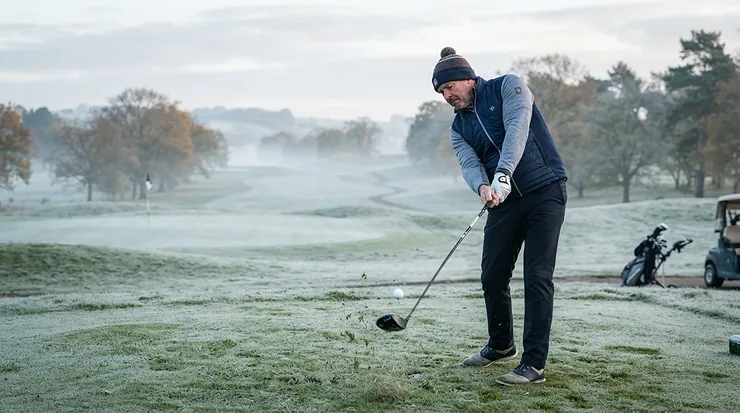
For most golfers, the smart plan for winter golf balls is to keep playing the ball you trust, keep it warm, and test a softer one only when your driver speed sits under roughly 90 mph. The numbers explain why. Titleist’s temperature notes put the cost of cold air alone at about 1.5 percent of distance for every 20°F drop, while a ball chilled in a freezer lost far more speed in MyGolfSpy’s robot test. This 2027 guide gives the method in six steps, then four pieces of gear tied to those steps: the TaylorMade Tour Response, the Callaway Supersoft, a pair of winter trousers and a beanie.
The findings rest on MyGolfSpy’s lab and robot work, Titleist’s research notes, panel tests from Golf Monthly and National Club Golfer, and threads from golfers who play through the cold; no ball was hit and no garment worn for this piece, and where two sources disagree, both readings appear.
Six steps for a cold round: air, ball, warmth, cover, color, clothing
Price the cold before changing anything. Titleist’s rule of thumb is roughly 3 yards lost on a 200-yard shot between a 70°F day and a 50°F one. Missouri’s January average high is about 40°F per the National Weather Service, so against a 70°F day that is a 30°F drop, or around 2.25 percent: roughly 5 yards on a 230-yard drive (my arithmetic from Titleist’s rule). Air density is out of your hands. The ball’s own temperature is not. In MyGolfSpy’s freezer test, balls chilled for about six hours lost more than 6 mph of ball speed and over 21 yards off a 100 mph driver swing, though their compression moved only 2 to 3 points. A six-hour freezer is harsher than any round, so read 21 yards as a ceiling and the lesson as “start warm.”
Decide whether to change balls at all. Titleist calls the switch to a lower-compression ball a misconception when balls are stored at room temperature, and notes that modern models do not come in a choice of compressions, so a switch means a different ball. Forum golfers split. One Minnesota member of the Team Titleist forum, who plays over 100 rounds a year, reports that a softer Titleist ball made a difference in the low 40s, while a member of a separate thread carried a Titleist Pro V1, a Titleist AVX and a Titleist Tour Soft and could not feel any difference. BallCaddie lists ignoring the cold as a common mid-handicap mistake and says it costs the most ball speed at higher swing speeds. A fair reading: a change pays only when your regular ball is firm and your swing is slow.
Keep the ball warm, inside the rules. Store balls indoors, never in a car trunk, and let an exposed ball return to room temperature gradually. On the course, carry two and alternate them, with the idle one in a warm pocket. A chemical hand warmer is another matter. Under Rule 4.2a(2) you must not hit a ball whose performance has been deliberately altered, heating included, and National Club Golfer’s rules expert says the penalty is disqualification. Keep ball and warmer apart; if they shared a pocket between holes, swapping the ball before your next stroke avoids the penalty.
Match the cover to your short game, not the thermometer. BallCaddie says urethane earns its price once you get up and down from inside 50 yards 35 to 40 percent of the time. Its reading of MyGolfSpy’s 2026 test adds a wet-weather angle: on a wet full wedge, ionomer balls lost nearly a third of their spin and urethane about a tenth, and on a 35-yard shot urethane averaged over 1,200 rpm more.
Make the ball findable. Golf Monthly points out that visibility matters in gloomy weather and frost. Some soft balls come in yellow or matte orange, and MyGolfSpy’s 2026 test, which compared yellow and white versions of only one ball, found those two came from different factories, with the yellow spinning about 80 rpm more off a fast driver and the two nearly identical at slow speed. Check which version you are buying.
Dress so the swing does not change. A swing that has to push through a stiff jacket loses what the warm ball gained, so the clothing sections below favor stretch, wind protection and a mid layer you can shed.
Where winter ball plans go wrong, and how to recover
The first slip is choosing by the number on the box. Compression figures vary by source and even by ball: MyGolfSpy’s Ball Lab measured 13.5 points of spread across a 36-ball sample of the Callaway Supersoft, so the ball you carry may not match a review. Compare balls from the same box, and retire one that flies differently from its siblings.
The second is storage. A dozen left in a freezing trunk starts the round cold, and Titleist’s fix is simple patience: bring them inside and let them warm gradually rather than rushing them with a heat source.
Third, switching every round. BallCaddie counts that among the mistakes mid handicappers make because it forces a relearn of distances each time. Commit to one winter ball for a month, note carry with the 7-iron, and judge it against your usual numbers adjusted for the cold.
Last, buying a tour-level ball for spin you cannot use. BallCaddie puts the cutoff at an up-and-down rate under about 30 percent from inside 50 yards, below which cheaper ionomer is the better value.
Best winter golf balls for mid handicappers, sorted by driver speed
The best winter golf balls for a mid handicapper depend on driver speed first, because BallCaddie says firm tour balls feel firm under 90 mph and cost more than most players need. Its under-90 picks are the Callaway Chrome Soft, Srixon Q-Star Tour and Srixon Soft Feel; at 90 to 95 mph it calls tour balls a good fit, says urethane’s greenside spin pays off, and names the TaylorMade Tour Response as the value option.
Ball
Compression, per BallCaddie
Dozen price range
TaylorMade Tour Response
about 74
around $40 to $45
Titleist Tour Soft
about 88
around $35 to $40
Srixon Q-Star Tour
about 70 to 75
around $35 to $40
Srixon Soft Feel
about 55 to 62
around $22 to $27
Callaway Supersoft
44 average in Ball Lab’s sample
around $25 to $35
Those numbers come from different sources, so treat the compression column as a guide. MyGolfSpy’s 2026 data adds detail: the Titleist Tour Soft was second-longest off the slow driver and a top-10 spinner through the 7-iron at every speed, yet ranked 42nd of 48 for 35-yard wedge spin. Cost matters too. At about 85 mph, the Titleist Pro V1 (roughly $55 to $60 a dozen) finished less than a yard ahead of the longest ball at around $25, per BallCaddie’s summary, so the extra $30 or so buys little distance at a slow swing.
For a swing near 85 to 90 mph the Srixon Soft Feel is the cheapest entry. Near 95 mph, urethane’s wet-weather spin retention starts to justify the price, which is why the TaylorMade Tour Response sits first below.
Best clothes for winter golf in Missouri: wind decides, then the thermometer
The National Weather Service’s 1991–2020 figures put St. Louis’s January average high at 40.4°F and low at 23.8°F, with Columbia at 39.5°F and 22.5°F. The NWS counts 19 days a winter at or below 32°F for St. Louis and 24 for Columbia, with about 16.5 inches of seasonal snow at each. A Missouri member of a Team Titleist thread says cold golf is a habit there from November to April, and a Missouri golfer commenting on GolfPass says wind matters more to him than the number: 38°F, sunny and calm is pleasant, while 50°F, cloudy and 20 mph is a no-go.
So the best clothes for winter golf in Missouri are built for wind first. GolfPass writer Tim Gavrich’s own cold-weather setup is a ColdGear compression base layer, a thin quilted mid layer, all-weather pants whenever temperatures fall below 50°F, air-activated hand warmers rated for up to 10 hours, and a rain jacket. He also prefers walking, since moving keeps him warmer than a cart. Golf Monthly’s test of 162 winter items singled out mid layers and wind shells; its notes on the Under Armour Drive Midlayer Crew call the fit a standout, with stretchy, quick-drying fabric.
Winter golf balls reviews: two balls worth a test round
Published winter golf balls reviews lean toward distance models. Golf Monthly’s cold-weather guide names the Srixon Distance for cold, windy conditions at 80-plus mph, the Bridgestone e12 Straight for less sidespin, and the TaylorMade Distance+ for its low-drag pattern, all priced around $20 to $35. Those suit a budget dozen for rounds that do not count. For a mid handicapper who wants to keep a normal feel, two balls cover the main decisions in steps 2 to 5.
A mid handicapper swinging the driver in the low-to-mid 90s who still wants bite on a 35-yard pitch is the target buyer for the TaylorMade Tour Response. BallCaddie lists it at about 74 compression and around $40 to $45 a dozen, and recommends it as the value urethane at 90 to 95 mph. MyGolfSpy’s 2026 data gives it the least spin of the 48 balls off a fast 7-iron and the longest 7-iron at that speed, and it tied for fastest off the mid-speed 7-iron.
Low spin keeps a driver flight penetrating, and it also means approaches release. MyGolfSpy’s data cards do not list the ball as a pick at low or mid swing speeds, which fits BallCaddie pointing slower swings toward the Srixon Soft Feel and Srixon Q-Star Tour instead.
Check the Amazon.com listing for the current dozen price.
TaylorMade Tour ResponseSee current price, sizes and reviews on Amazon.
Start with the lab report. MyGolfSpy’s Ball Lab measured the 2026 Callaway Supersoft at an average compression of 44, with individual balls running from 40.3 to 53.8, graded C-minus for consistency. Three of 36 balls were bad, the Quality Score was 74, and the verdict was Not Recommended, though Ball Lab stresses that soft compression is not itself the fault. It sells around $25 to $35 a dozen.
Reviewers see the upside. Golf Monthly credits very low compression, durability over several rounds, softness around the greens and high launch, and notes six colors including yellow, matte orange and pink. MyGolfSpy’s 2026 test called it the softest ball in the field, second-fastest off the mid-speed 7-iron, and among the highest-flying with very little spin.
Pros:
✅ Softest ball in MyGolfSpy’s 2026 test, with high launch
✅ Visible colors available
Cons:
❌ Ball Lab flagged 3 of 36 balls as bad
❌ Slowest off the high-speed driver; Golf Monthly says it will not suit faster swings
Look at the colors offered on the Amazon.com page before ordering.
Callaway SupersoftSee current price, sizes and reviews on Amazon.
Best winter golf trousers reviews: what the testers found
National Club Golfer’s thermal trouser tests show how much the details differ.
Trouser
Lining, wind and water, as the review states
Main caveat
Callaway Winter Thermal Trousers
Wind and water resistant
None listed
Under Armour ColdGear Infrared Showdown Tapered Golf Pants
Not stated
None listed
Abacus Druids Windvent
Brushed lining, wind-resistant, water repellent
Can overheat; hard to layer under waterproofs
Ping SensorWarm Winter Trouser
Brushed lining, wind and water resistant
Not for off-course wear
Glenmuir Ashurst
Brushed fleece lining, windproof, DWR
Quite slim fitting
ProQuip Pro Tech Winter Tech Trousers
Water repellent
Feel like waterproofs; noisy indoors
Across these best winter golf trousers reviews, a brushed or fleece lining is the common thread, and the cons are about fit and noise rather than warmth. Given the wind complaints from Missouri golfers above, a wind-resistant model looks like the safer pick, but the Abacus Druids Windvent overheating warning shows that warmer is not always better on a walking round.
National Club Golfer’s reviewer calls them an ideal golf trouser, praising the fit, the comfort and a classy look. The same publication lists Under Armour’s tapered golf pants at around $85 to $100 depending on the model. Its page does not state lining, wind or water details for this pair, so the nearest comparison with documented warmth is a fleece-lined alternative: Golf Monthly’s reviewer found the Adidas Frostguard Insulated Trousers warm but not bulky, with ankle zips and stretchy 92 percent recycled polyester, and disliked the lack of back pockets, while a Golf Locker listing for a previous-season Frostguard lists two. Versions evidently differ.
Pros:
✅ Fit and comfort praised by National Club Golfer
✅ A dressier look than most thermal trousers, per the same review
Cons:
❌ Lining and weather ratings not stated on the review page
Check current sizes on the Amazon.com listing.
Under Armour ColdGear Infrared Showdown Tapered Golf PantsSee current price, sizes and reviews on Amazon.
Best winter golf hat: warm under a cap or on its own
The best winter golf hat is the one that stays put on your ears in wind. National Club Golfer’s US page reviews more than 20 beanies and buckets, and the beanies with dollar prices on it run roughly $15 to $50.
The reviewer gave it 4.5 stars for a soft lining that stays warm and is not itchy, and the only con is that the styling will not suit everyone. It sits in the $25 to $30 range. Its sibling, the Under Armour Drive Pom, earned five stars for stretch and warmth in wind.
Others in the same test are close. The TaylorMade Ribbed Knit Beanie scored five stars as warm but breathable and stayed put in wind, and the Galvin Green Insulating Hat was very warm and light and held up in rain, though it costs more. For rain, the ProQuip Waterproof Bucket Hat has a wide brim and chinstrap that keeps the neck dry.
Fit varies: the Farah Ross Bobble Hat ran tight on a big head in the same test, so try any beanie with your cap if you plan to layer.
Under Armour Halftime Pom BeanieSee current price, sizes and reviews on Amazon.
Cold-round answers on distance, compression, hand warmers and color
❓ Do golf balls go shorter in cold weather?
✅ Yes, in two ways. Titleist puts air-density loss at about 1.5 percent per 20°F drop, and a ball that itself gets cold gives up some speed off the face. Carrying a second ball in a warm pocket and rotating them each hole limits the second effect.
❓ Should I use a lower compression ball in winter?
✅ Titleist calls that a misconception when balls are kept at room temperature, and says staying with a familiar model matters more. Forum golfers split: one Minnesota member reports a softer Titleist ball helped in the low 40s, while another could not feel any difference between three Titleist models.
❓ Can I use a hand warmer to warm my golf ball?
✅ No. Rule 4.2a(2) bars a stroke with a ball whose performance was deliberately altered, such as by heating, and National Club Golfer's rules expert says breaking it means disqualification. Keep the warmer in a separate pocket, and swap the ball before your next stroke if they mixed.
❓ What color golf ball is best for winter?
✅ Golf Monthly notes visibility matters in gloomy weather and frost, and some soft balls come in yellow or matte orange. MyGolfSpy's only yellow-versus-white comparison in its 2026 test covered one ball and showed little difference at slow swing speeds.
❓ What temperature is too cold to play golf?
✅ There is no fixed cutoff. A GolfPass writer plays in any two of cold, wind and rain but not all three, and a Missouri golfer on that page finds 38°F, sunny and calm pleasant but 50°F, cloudy with a 20 mph wind a no-go.
Which ball and which layers to settle on this season
Settle the ball first, then the clothes. For most mid handicappers, the plan for winter golf balls is to hold one model all season, rotate two between pockets, and move to a softer ball only when a firm tour ball is being slowed by a driver speed under about 90 mph. The TaylorMade Tour Response is the urethane test for swings of 90 to 95 mph, and the Callaway Supersoft is the cheap soft option, provided you inspect the dozen. On the body, warm winter trousers such as the Under Armour ColdGear Infrared Showdown Tapered Golf Pants, plus a lined beanie such as the Under Armour Halftime Pom Beanie, cover most Missouri January days, and wind decides the rest. Compare each ball over the same nine holes before buying a second dozen. Check the Amazon.com listings for current sizes and colors.
Disclaimer: This post contains affiliate links. As an Amazon Associate, I earn from qualifying purchases made through these links, at no additional cost to you.
Keep two balls in rotation and the cold stops being the excuse.