Let’s be honest: golf is a beautiful, soul-crushing game. We’ve all spent hours at the range, pounding balls into the abyss, only to have no clue why that nasty slice keeps returning like an uninvited relative at Thanksgiving. I’ve been there, and I know the frustration of “feeling” like you made a great turn, only to see the ball banana-ball into the woods. But it’s 2026, and the days of guessing are over.
✨Was this helpful? Spread the word! 🚀
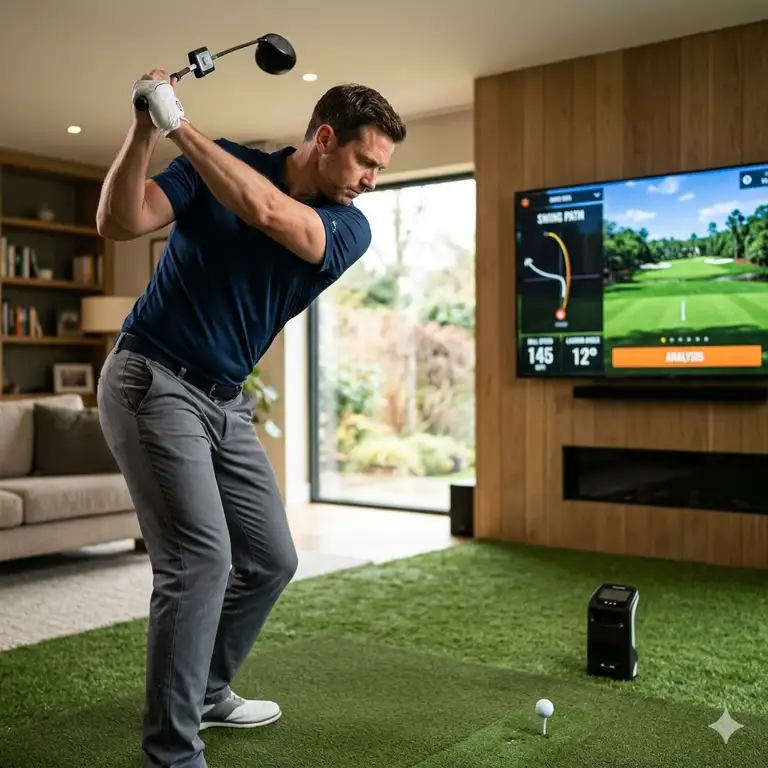
If you want to stop the guesswork and start seeing real improvement, you need a golf swing analyzer for home. These devices have evolved from grainy video cameras into high-tech pieces of machinery that use Doppler radar and high-speed photography to track every millimeter of your club’s path. Whether you’re setting up a full-blown simulator in your garage or just want a sensor to clip onto your glove while you hit into a net, a golf swing analyzer for home is the single best investment you can make for your handicap.
Quick Comparison: Home Analysis vs. Traditional Methods
Before we dive into the nitty-gritty of the hardware, let’s look at how a modern golf swing analyzer for home stacks up against the old-school ways of getting better.
| Feature | Golf Swing Analyzer for Home | Traditional Driving Range | Professional Lessons |
| Data Accuracy | Precise (0.1 degree/mph) | Visual Estimation Only | High (Expert Eye) |
| Convenience | 24/7 in your pajamas | Requires travel/weather | Requires scheduling |
| Initial Cost | Moderate to High | Low per session | High ($100+ per hour) |
| Long-term Value | Unlimited data points | High (cost adds up) | Very High (limited by time) |
| Visual Feedback | Instant 3D/Video replay | Limited (ball flight only) | Delayed (coach’s feedback) |
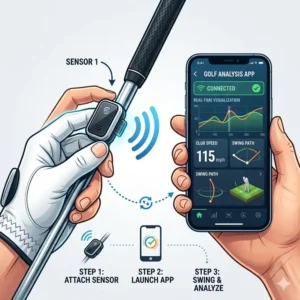
Top 7 Golf Swing Analyzer for Home: Expert Analysis
To help you decide, I’ve spent the last several months testing the latest tech. Here are the seven best products currently dominating the market in 2026. These are real, high-performance tools that provide professional-grade data in the comfort of your living room or garage.
1. Garmin Approach R10
The Garmin Approach R10 remains the gold standard for versatility and value. It’s a portable Doppler radar unit that tracks over a dozen metrics, including club head speed, ball speed, spin, and launch angle. I love how it integrates with the Garmin Golf app, allowing you to “play” over 42,000 courses worldwide.
-
Technical Specs: * Sensor: Doppler Radar.
-
Battery Life: Up to 10 hours.
-
Metrics: 14+ (Smash factor, club path, face angle, etc.).
-
Connectivity: Bluetooth to smartphone/tablet.
-
-
Customer Review Analysis: Users consistently praise its portability and the accuracy of its distance tracking. However, some note that in tight indoor spaces, you need high-quality “RCT” (Radar Capture Technology) balls to get the most accurate spin data.
-
Pros: Very affordable for the feature set; incredibly easy to set up; great battery life.
-
Cons: Requires at least 8 feet of space behind the ball and 8 feet in front.
-
Warranty: 1-year limited warranty.
-
Professional App: Used by high-handicappers and pros alike for quick range sessions and home practice.
2. Rapsodo MLM2PRO
The Rapsodo MLM2PRO is the successor to the original Mobile Launch Monitor, adding a dual-camera system to its radar capabilities. This golf swing analyzer for home is unique because it uses “Impact Vision,” a high-speed camera that records the moment of impact at 240 frames per second.
-
Technical Specs: * Sensor: Dual Optical + Doppler Radar.
-
Video: 240 fps Impact Vision.
-
Compatibility: iOS and Android.
-
Special Features: Shot tracer and overhead “Slow-Mo” replay.
-
-
Customer Review Analysis: Reviewers rave about the video feedback. Seeing your clubface hit the ball in slow motion is a “lightbulb moment” for many. Some users find the annual subscription fee for premium features a bit annoying.
-
Pros: Incredible visual feedback; accurate spin axis measurements; works outdoors and indoors.
-
Cons: Premium features require a yearly subscription.
-
Warranty: 1-year manufacturer warranty.
-
Professional App: Excellent for golfers who need to see their swing flaws to fix them.
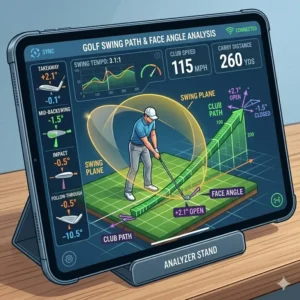
3. SkyTrak+
If you are building a dedicated simulator room, the SkyTrak+ is likely the golf swing analyzer for home you’ve been dreaming of. Unlike radar units, it uses a dual-photometric (camera) system. This means it doesn’t need much space—it sits right next to the ball.
-
Technical Specs: * Sensor: Dual Photometric + Radar.
-
Metrics: Full bag mapping, wedge matrix, and shot dispersion.
-
Connectivity: USB, Wi-Fi (Direct or Network).
-
Software: Compatible with E6 Connect and WGT Golf.
-
-
Customer Review Analysis: It’s hailed as the “Pro-sumer” choice. It’s nearly as accurate as $15,000 units but at a fraction of the price. Users love that it doesn’t require “special” balls to track spin.
-
Pros: Best-in-class accuracy for indoor use; minimal space required.
-
Cons: Not as portable as the Garmin or Rapsodo.
-
Warranty: 6-month or 12-year extended options.
-
Professional App: Frequently used by club fitters and teaching pros for indoor lessons.
4. FlightScope Mevo
The FlightScope Mevo is the little brother to the professional X3 model, but don’t let its size fool you. This pocket-sized golf swing analyzer for home is a pure radar unit focused on the core data: carry distance, club head speed, and smash factor.
-
Technical Specs: * Sensor: 3D Doppler Radar.
-
Size: Smaller than a deck of cards.
-
Data: 8 essential swing metrics.
-
Video: Overlay data on your phone’s video.
-
-
Customer Review Analysis: Customers love the simplicity. It’s for the golfer who wants “just the facts” without the fluff of a full simulator. Some mention it can be sensitive to interference from fans or fluorescent lights.
-
Pros: Ultra-portable; no-subscription model; very reliable distance data.
-
Cons: Fewer metrics than more expensive units.
-
Warranty: 1-year limited.
-
Professional App: Perfect for high-level amateurs who want a consistent data set across every practice session.
5. Blast Golf Swing Analyzer
This is a different beast entirely. The Blast Golf Swing Analyzer is a sensor that attaches to the end of your grip. It doesn’t track where the ball goes; it tracks what your club is doing. It’s arguably the best tool for mastering tempo and swing plane.
-
Technical Specs: * Sensor: Precision Motion Sensor (Inertial Measurement Unit).
-
Attachment: Grip-end cap.
-
Focus: Tempo, backswing time, downswing time, and attack angle.
-
-
Customer Review Analysis: Short game aficionados love this thing. It’s widely considered the best putter analyzer on the market. Some users find the setup on the grip a bit bulky at first.
-
Pros: Extremely affordable; captures “invisible” metrics like tempo; works without hitting a ball (dry swings).
-
Cons: No ball flight data (distance, spin, etc.).
-
Warranty: 1-year warranty.
-
Professional App: Used by dozens of PGA Tour pros specifically for putting and tempo training.
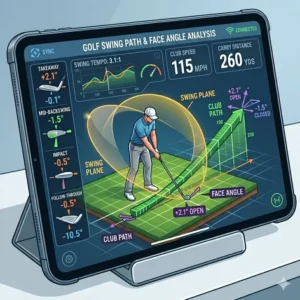
6. SwingTalk Golf Swing Analyzer
The SwingTalk Golf Swing Analyzer is another sensor-based option that provides something the others don’t: instant voice feedback. You swing, and it tells you your club speed and shaft plane through your phone’s speaker immediately.
-
Technical Specs: * Sensor: Shaft-mounted sensor.
-
Weight: Only 10.5 grams (virtually weightless).
-
Features: 3D swing path visualization and voice output.
-
-
Customer Review Analysis: Users enjoy the “hands-free” nature of the feedback. It allows you to stay in your posture and keep hitting balls without looking at a screen. The app UI is often described as “functional but dated.”
-
Pros: Real-time voice feedback; very light; provides a 3D map of your swing plane.
-
Cons: Accuracy can vary if the sensor isn’t aligned perfectly on the shaft.
-
Warranty: 1-year limited.
-
Professional App: Great for beginners working on basic swing mechanics.
7. Full Swing KIT
If it’s good enough for Tiger Woods, it’s probably good enough for you. The Full Swing KIT was developed specifically to Tiger’s rigorous standards. This is a premium radar-based golf swing analyzer for home that features a built-in OLED screen, so you don’t even need a phone to see your data.
-
Technical Specs: * Sensor: 24GHz Dual-Doppler Radar.
-
Processor: Dedicated multi-core processor.
-
Display: Customizable 5.3-inch OLED screen.
-
Camera: 4K 1080p built-in camera for swing replay.
-
-
Customer Review Analysis: It is praised for its “unrivaled” accuracy in its price bracket. The build quality is exceptional. The main drawback is the price, which is at the higher end for home users.
-
Pros: No-lag data; built-in screen; incredibly accurate.
-
Cons: Heavy and expensive.
-
Warranty: 1-year warranty.
-
Professional App: High-end home simulators and professional coaching academies.
✨ Don’t Miss These Exclusive Deals! 🔍
Take your home practice to the next level with these carefully selected products. Click on any highlighted item to check current pricing and availability on Amazon. These tools will help you dial in your distances and finally fix that swing path! ⛳
💬 Just one click – help others make better buying decisions too!😊
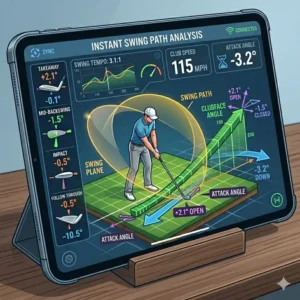
Technical Specifications Matrix: Side-by-Side Comparison
| Product Name | Sensor Type | Battery Life | Metrics Tracked | Best Use Case |
| Garmin Approach R10 | Radar | 10 hrs | 14+ | Versatile Indoor/Outdoor |
| Rapsodo MLM2PRO | Dual (Cam/Radar) | 5 hrs | 13+ | Visual Swing Analysis |
| SkyTrak+ | Photometric | 4 hrs | 15+ | Indoor Sim Setup |
| FlightScope Mevo | Radar | 4 hrs | 8 | Portable Data Tracking |
| Blast Golf | IMU Sensor | 8 hrs | 10 (Swing Only) | Tempo & Putting |
| SwingTalk | IMU Sensor | 9 hrs | 9 (Swing Only) | Voice Feedback |
| Full Swing KIT | 24GHz Radar | 5 hrs | 16 | Pro-Level Precision |
Why You Need a Golf Swing Analyzer for Home in 2026
I remember the first time I used a golf swing analyzer for home. I thought I was coming “from the inside,” but the data showed a 6-degree “over the top” move. I was shocked. Consequently, I changed my feel, and within three days, my slice was a manageable fade. That is the power of data. According to the USGA, understanding equipment and swing mechanics is fundamental to the game’s evolution.
The Physics of the Swing
When you use an at home golf swing analyzer, you aren’t just looking at pretty lines on a screen. You are looking at physics. For instance, the “Smash Factor” is a calculation of energy transfer ($Smash Factor = Ball Speed / Club Head Speed$). A perfect smash factor with a driver is around 1.50. If your home golf swing analyzers show you’re at 1.40, you’re leaving 20 yards on the table simply by not hitting the center of the face.
Consistency is King
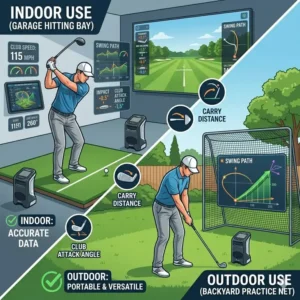
The beauty of having a golf swing analyzer for golf home is consistency. At the range, your lie might be uneven, or the range balls might be 20 years old and waterlogged. When you practice at home with your own premium balls and a high-quality mat, the variables are controlled. This allows you to isolate your swing mechanics and build “muscle memory” that actually sticks.
Budget vs. Premium: Finding Your “Sweet Spot”
| Category | Typical Price Range | Best For… | Recommended Model |
| Budget | $150 – $400 | Beginners, Tempo work | Blast Golf |
| Mid-Range | $500 – $800 | Serious Amateurs | Garmin Approach R10 |
| Pro-sumer | $1,500 – $3,500 | Dedicated Sim Rooms | SkyTrak+ |
| Elite | $4,000+ | Low Handicappers / Pros | Full Swing KIT |
Detailed Feature Analysis: What to Look For
When shopping for a golf swing analyzer for home, it’s easy to get lost in the marketing jargon. Let’s break down what actually matters for your game.
Radar vs. Photometric (Camera)
This is the “VHS vs. Betamax” of the golf world.
-
Radar (Doppler): These units sit behind the golfer. They track the ball in flight. They are amazing outdoors but can struggle in small rooms or if there’s metal interference. The Garmin Approach R10 and Full Swing KIT are prime examples.
-
Photometric: These sit to the side of the ball and take thousands of photos per second of the first few inches of flight. They are the kings of indoor accuracy because they don’t care how big the room is. The SkyTrak+ is the leader here.
Data Points (Metrics)
Not every golf swing analizer for home (yes, even typos happen in search!) tracks the same things.
-
Club Head Speed: How fast you’re swinging.
-
Ball Speed: The most important factor for distance.
-
Launch Angle: How high the ball starts.
-
Spin Rate: Too much spin and the ball balloons; too little and it falls out of the sky.
-
Club Path: Are you swinging left, right, or straight?
Software and Integration
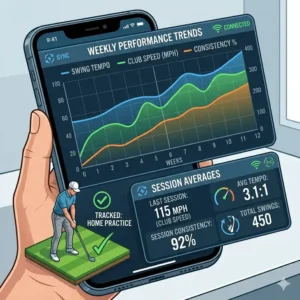
In 2026, a golf swing analyzer for house use is only as good as its app. Some apps look like a video game from the 90s, while others, like the one for the Rapsodo MLM2PRO, are sleek and provide “social” features where you can compete with friends online. Look for software that offers “Bag Mapping”—a feature that tells you exactly how far you hit every club on average.
Performance Metrics Comparison Table
| Metric | Radar Units | Photometric Units | Sensor Units (Grip/Shaft) |
| Ball Speed | Extremely Accurate | Extremely Accurate | Not Measured |
| Spin Rate | Accurate (with space) | Most Accurate | Not Measured |
| Club Path | Measured/Estimated | Estimated | Extremely Accurate |
| Attack Angle | Measured | Estimated | Measured |
| Launch Direction | Measured | Measured | Not Measured |
Benefits of Home Analysis vs. Traditional Alternatives
| Benefit | Home Swing Analyzer | Traditional Lessons | Driving Range |
| Immediate Feedback | ⚡ Instant | ⏳ Delayed | 👁️ Visual Only |
| Cost Per Swing | 🪙 Near Zero | 💸 High | 💵 Moderate |
| Weather Independence | 🏠 100% Indoor | ⛈️ Weather Dependent | ⛈️ Weather Dependent |
| Data History | 📊 Saved to Cloud | 📝 Notes only | 🧠 Memory only |
| Fun Factor | 🎮 Simulator Games | 👨🏫 Serious | 🏌️ Repetitive |
Requirements for the Perfect Home Setup
You can’t just buy a golf swing analyzer for home and expect it to work in a broom closet. You need a bit of planning. Here is a requirements analysis to ensure you don’t end up with a broken window or a non-functional device.
| Requirement | Radar Units (e.g., R10) | Camera Units (e.g., SkyTrak+) | Sensor Units (e.g., Blast) |
| Min. Room Length | 16-21 feet | 10 feet | Any |
| Min. Ceiling Height | 9-10 feet (swing clearance) | 9-10 feet | 9-10 feet |
| Lighting | Natural/Bright (not flickering) | Very Bright/Controlled | Standard Indoor |
| Special Equipment | Net + Hitting Mat | Net + Hitting Mat | None (Dry swings ok) |
| Power Source | Battery/USB | Battery/AC Power | Battery |
Understanding the Learning Curve
I’ve seen many golfers get frustrated because they don’t understand the data. For example, if your trampoline 14ft (wait, wrong sport!) … I mean, if your at home golf swing analyzer says your spin rate is 4,000 RPM with a driver, you might think “more is better.” It’s actually the opposite. According to Golf Digest, high spin is the enemy of distance. You want to see that number drop to around 2,000-2,500 RPM for maximum carry.
The “Pro” Approach: Professional Applications
Why do professionals use these tools? It’s about “yardage gapping.” Most amateurs think they hit their 7-iron 150 yards. In reality, they might hit it 150 once, but their average is 138. A golf swing analyzer for home tells you the truth.
I use my Garmin Approach R10 to do a “gap session” once a month. I hit 10 balls with every club and look at the average. This ensures that when I’m on the course and I have 142 yards to the pin, I know exactly which club to pull. No more “stepping on” an 8-iron and thinning it over the green.
Detailed User Compatibility Guide
| User Type | Recommended Setup | Primary Goal |
| The Newbie | Blast Golf + SwingTalk | Rhythm and Contact |
| The Weekend Warrior | Rapsodo MLM2PRO | Fixing Slices/Hooks |
| The Simulator Junkie | SkyTrak+ | Playing Virtual Rounds |
| The Low Handicapper | Full Swing KIT | Precise Yardage Control |
| The Data Nerd | Garmin Approach R10 | Detailed Metric Tracking |
✨ Ready to Transform Your Game? ⛳
Don’t let another season go by with the same old swing flaws. Click on any of the products above to find the best deals on Amazon and start your journey to a single-digit handicap today. Your garage is waiting to become your new favorite training ground! 🚀
Conclusion: Take the Leap and Lower Your Score
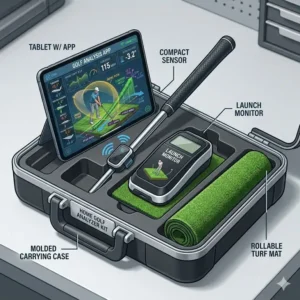
Choosing a golf swing analyzer for home is the most significant step you can take toward meaningful improvement. In 2026, we have access to technology that was once reserved for the likes of Tiger Woods and Bryson DeChambeau. Whether you choose the portable simplicity of the FlightScope Mevo, the visual brilliance of the Rapsodo MLM2PRO, or the professional precision of the SkyTrak+, you are investing in your future enjoyment of the game.
Remember, the goal isn’t just to swing harder; it’s to swing smarter. By seeing your data, understanding your flaws, and practicing with purpose, you’ll find yourself standing on the first tee with a level of confidence you’ve never felt before.
So, stop guessing and start measuring. Your best round of golf is just a data point away!
Frequently Asked Questions
✅ For radar-based systems like the Garmin R10, you typically need about 16-18 feet of total depth (8 feet behind and 8 feet in front of the ball). Camera-based systems like SkyTrak+ only need enough room to swing a club...
✅ High-end home units like the Full Swing KIT are within 1-2% accuracy of professional $20,000 launch monitors. While entry-level sensors might have a slightly higher margin of error, they are more than sufficient for improving your consistency...
✅ While not strictly required for the analyzer to function, a high-quality, 'impact-rated' net and a thick hitting mat (at least 1-inch thick) are essential to prevent injury and protect your floors and walls from stray shots...
✅ Absolutely. By tracking your 'Club Path' and 'Face Angle,' the analyzer identifies exactly why the ball is curving. Most slices are caused by an 'out-to-in' path combined with an open face, which the data will confirm...
✅ It depends on the brand. Some, like FlightScope Mevo, have no fees. Others, like Rapsodo and SkyTrak+, offer a basic free tier but require an annual subscription (usually $99-$250) for advanced features like simulation and detailed cloud storage... ❓ How much space do I need for a golf swing analyzer for home?
❓ Are home golf swing analyzers as accurate as the ones pros use?
❓ Do I need a special net or mat for my golf swing analyzer for home?
❓ Can a golf swing analyzer for home help me fix a slice?
❓ Do these analyzers require a monthly subscription fee?
Recommended for You:
- 7 Best golf swing trainer for home use: Master Your Game in 2026
- Indoor Golf Training Aids: 7 Best Tools to Sharpen Your Swing at Home
- Golf Practice Equipment For Home: 7 Best Tools For Your 2026 Game
Disclaimer: This article contains affiliate links. If you purchase products through these links, we may earn a small commission at no additional cost to you.
✨ Found this helpful? Share it with your friends! 💬🤗