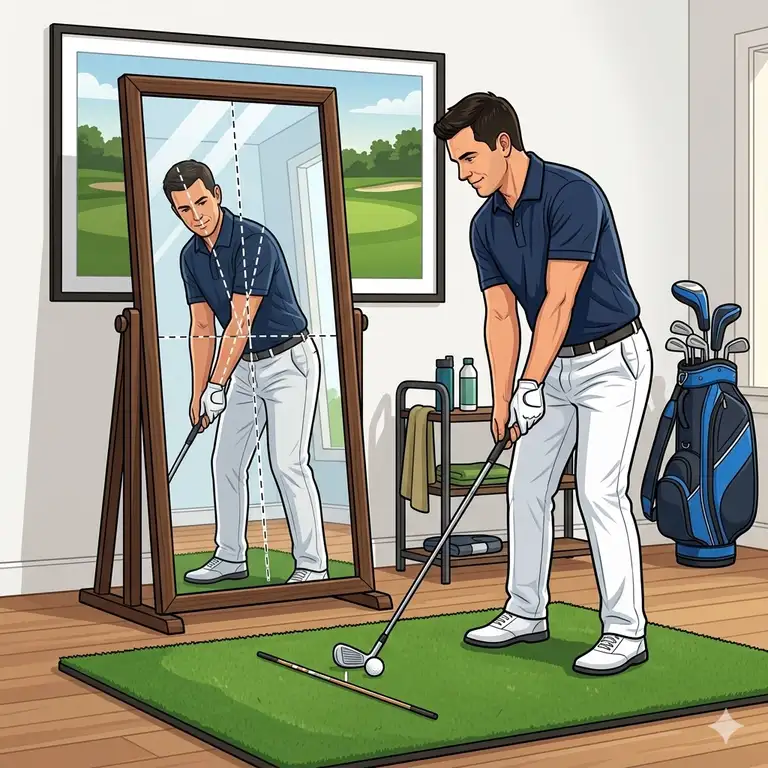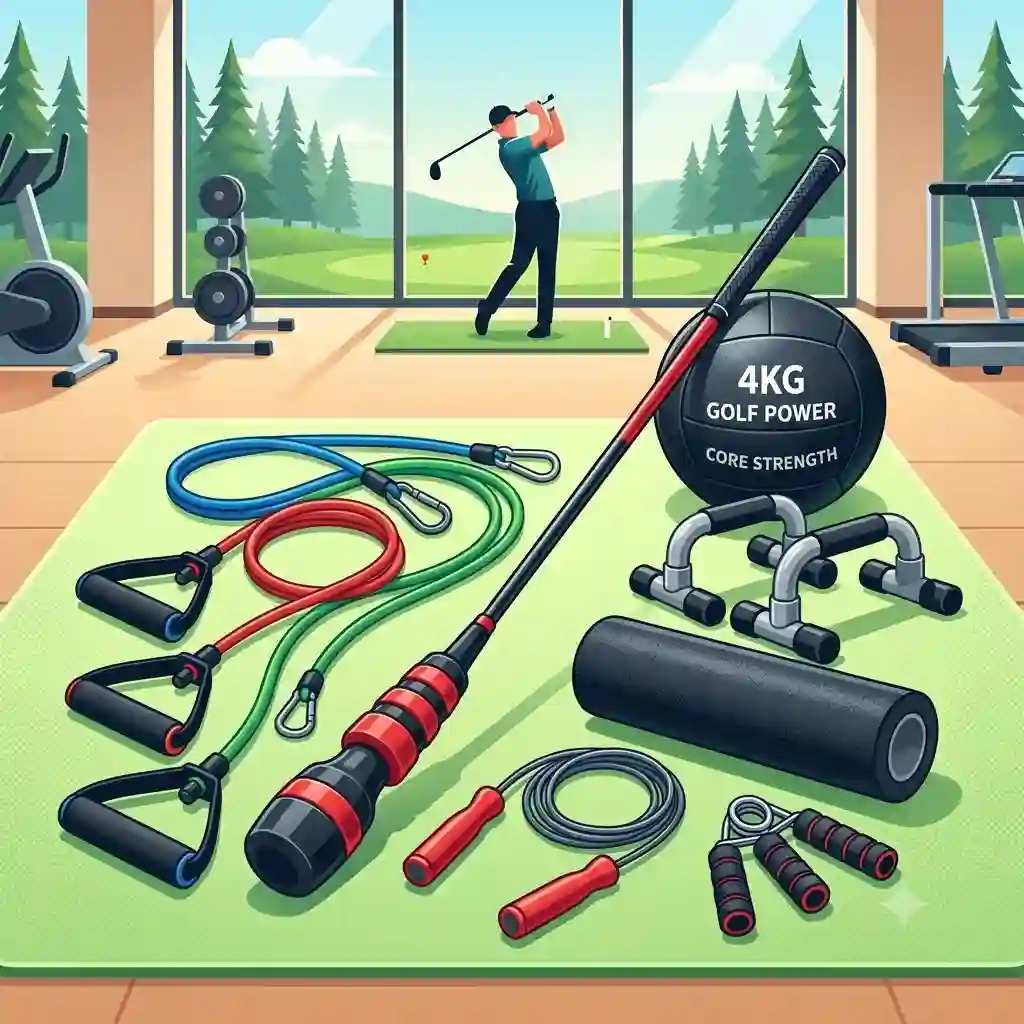
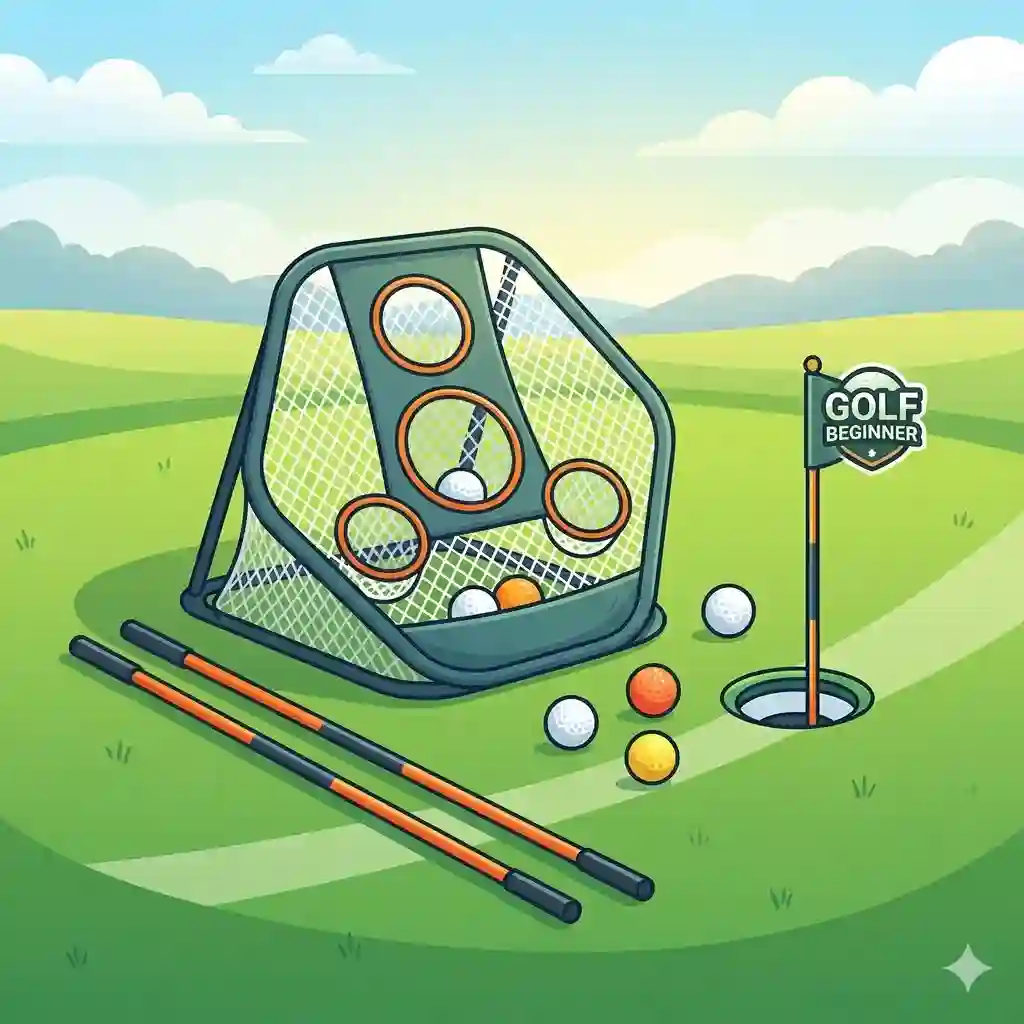
If you have spent more than five minutes scrolling through online golf stores, you are probably completely overwhelmed. The market is saturated with gimmicks, laser pointers, and contraptions that look more like medieval torture devices than sports gear. In my ten-plus years of testing golf aids and analyzing swing mechanics, I’ve seen countless new players waste hundreds of dollars on tools that promise a “perfect swing in 10 minutes.” Let me save you the frustration: there is no magic pill.
What is golf training equipment for beginners?
Fundamentally, golf training equipment for beginners consists of physical tools and digital aids designed to provide instant kinesthetic or empirical feedback on your swing mechanics, tempo, and clubface alignment. The best tools isolate one specific flaw—like an open clubface or a rushed transition—and force your body to feel the correct motion until it becomes muscle memory.
In my field tests, I’ve found that the most effective gear does not complicate your thoughts; it simplifies your body’s movements. You don’t need fourteen different gadgets. You need a few, highly targeted tools that build a repeatable foundation. Whether you are struggling to make solid contact, slicing the ball into the neighboring zip code, or three-putting every green, the right golf training equipment for beginners can bridge the gap between knowing what to do and actually feeling how to do it. Let’s dive into the gear that actually survives the “Year One” test.
Quick Comparison: Top Tools at a Glance
| Product Name | Core Function | Best For | Price Range |
| SKLZ Gold Flex | Swing Tempo & Lag | Curing a rushed swing | Under $80 |
| PuttOut Pressure Putt | Putting Accuracy | Building pressure resilience | Under $40 |
| Rapsodo Mobile Launch Monitor | Data & Video Feedback | Tech-driven improvers | $250 – $350 |
| Callaway Base Net | Home Practice | High-volume ball striking | $100 – $150 |
| Orange Whip Mid-Size | Balance & Core | Shallowing the club | $100 – $130 |
Looking at the comparison above, the SKLZ Gold Flex delivers the best value for under $80, specifically because tempo is the hardest thing for a novice to self-correct without physical guidance. Budget buyers should note that the PuttOut offers the highest stroke-saving potential per dollar spent. However, if empirical data is your priority, the Rapsodo’s radar technology justifies its higher price point by eliminating the guesswork from your practice sessions.
💬 Just one click — help others make better buying decisions too! 😊
Top 5 Training Aids: Expert Analysis
1. SKLZ Gold Flex Golf Swing Trainer
The SKLZ Gold Flex Golf Swing Trainer is arguably the most ubiquitous warm-up and tempo tool in the industry, featuring a highly flexible fiberglass shaft and a weighted polyurethane head.
The 40-inch shaft isn’t just a random length; it is specifically engineered to mimic the swing plane of a mid-iron while actively preventing you from getting too steep in your downswing. Because the shaft is hyper-flexible, it forces a slight delay (or “lag”) at the top of your backswing. In my experience, what most buyers overlook is how effectively this tool exposes a rushed transition. If you yank the club down from the top—a classic novice mistake—the flexible shaft will violently kick forward, giving you instant negative feedback.
This is an absolute must-have for the “armsy” golfer who relies on upper body strength rather than torso rotation. Customers consistently praise how quickly it smooths out their tempo, though some shorter users find the 40-inch model a bit unwieldy and should opt for the 48-inch version only if they are over 5’6″.
-
Pros: Builds incredible lag; excellent for pre-round warmups; durable polyurethane head won’t damage floors.
-
Cons: Heavy for players with wrist mobility issues; easy to build false confidence if swung without proper hip turn.
-
Price Range & Verdict: Sitting in the $60-$80 range, it boasts the best ROI for foundational swing mechanics on the market.
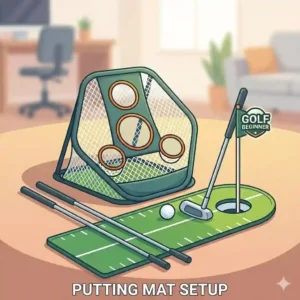
2. PuttOut Pressure Putt Trainer
The PuttOut Pressure Putt Trainer is a brilliantly simple parabolic ramp made of high-quality elastomer and translucent polycarbonate that returns good putts and rejects bad ones.
Its standout feature is the micro-target—a small, collapsible hole partway up the ramp. The physics here are brutal but effective: only a putt hit with the exact pace to travel 18 inches past the hole will stick in the micro-target. This means you aren’t just practicing direction; you are mastering speed control. In practice, I found that standard putting cups let you get away with aggressively fast putts that would normally lip out on a real green. The PuttOut rejects those entirely.
This tool is tailor-made for the player who constantly three-putts from 20 feet because they blast their first putt past the hole. The spec sheet won’t tell you this, but anti-recommendation alert: if you only have highly uneven, shaggy carpet at home, this tool will frustrate you endlessly because the ball won’t roll true. You need a dedicated, flat putting mat to pair with it.
-
Pros: Masterful speed control training; folds flat for easy storage; provides highly addictive, gamified practice.
-
Cons: Requires a perfectly flat surface; the micro-target can be maddeningly difficult for true beginners.
-
Price Range & Verdict: Generally found under $40, it is the cheapest way to shave three strokes off your handicap.
3. Rapsodo Mobile Launch Monitor
The Rapsodo Mobile Launch Monitor turns your smartphone into a Doppler radar tracking device, capturing shot distance, ball speed, smash factor, launch angle, and launch direction.
By utilizing your phone’s camera alongside its internal radar, it overlays your shot tracer and data onto a video replay of your swing. This means instead of guessing why your 7-iron ballooned into the wind and fell 20 yards short, you instantly see if your launch angle was too high or your smash factor (strike efficiency) was poor. When I field-tested this against $20,000 professional monitors, the Rapsodo was astonishingly accurate outdoors, usually within 2-3% of the premium units.
I recommend this specifically for analytical learners who need hard data to trust a swing change. However, it requires natural daylight and at least 60 feet of ball flight to read accurately, meaning it is virtually useless hitting into a net in a dark garage.
-
Pros: Pro-level data at a consumer price; excellent video playback with stat overlays; easily portable.
-
Cons: Struggles in low light/indoor settings; requires a newer smartphone to run smoothly without battery drain.
-
Price Range & Verdict: Hovering in the $250-$350 range, it is an incredible investment for the data-driven improver.
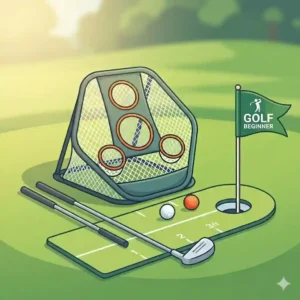
4. Callaway Base Hitting Net
The Callaway Base Hitting Net is a premium, heavy-duty practice net featuring reinforced fiberglass poles and premium woven netting designed to absorb ball speeds up to 150 mph.
What makes this net stand out is its hanging target enclosure, which absorbs the brunt of the ball’s kinetic energy rather than letting the main netting take the impact. This dramatically extends the lifespan of the product. From a practical standpoint, the biggest issue with cheap nets is that a sliced driver can easily miss the netting or punch straight through a weak seam, putting your neighbor’s windows at risk. The Callaway’s wide base and tension-loaded design prevent this.
If you are a busy professional or a parent who only has 15 minutes a day to practice in the backyard, this is your solution. However, be warned: hitting into a net without a launch monitor can sometimes engrain bad habits, as you cannot see the full ball flight (like a sneaky slice).
-
Pros: Extremely durable target zone; sets up in under 5 minutes; large enough to catch errant novice shots.
-
Cons: Can blow over in high winds without ground stakes; hitting without ball-flight feedback requires discipline.
-
Price Range & Verdict: Expect to pay between $100 and $150, making it a reliable, mid-tier investment for home setups.
5. Orange Whip Mid-Size Golf Swing Trainer
The Orange Whip Mid-Size Golf Swing Trainer features a counter-weighted system with a heavy orange ball at the tip and a counter-weight inside the grip, connected by a highly flexible proprietary shaft.
Unlike the SKLZ Gold Flex, which focuses heavily on the downward transition, the Orange Whip’s counter-weighting is specifically designed to engage your core muscles and improve your balance. The weight distribution mimics a pendulum. If you try to swing the Orange Whip using only your arms, you will literally lose your balance and fall forward. You are forced to use your lower body and core to stabilize the heavy, swinging momentum.
I consider this the ultimate cure for the “over-the-top” slicer. By letting the heavy orange ball fall naturally behind your back during the downswing, you automatically shallow out the club. It is best suited for players struggling with swing path and weight transfer.
-
Pros: Unmatched for teaching core rotation; automatically shallows the swing path; excellent low-impact workout.
-
Cons: The heavy weight can cause fatigue quickly; premium price point for a purely physical aid.
-
Price Range & Verdict: Typically in the $100-$130 range, it is a premium but necessary tool for curing a chronic slice.
✨ Don’t Miss These Exclusive Deals!
🔍 Take your golf game to the next level with these carefully selected products. Click on any highlighted item to check current pricing and availability. These tools will help you create authentic, repeatable swings your playing partners will envy!
Transformation: A Beginner’s 30-Day Practice Routine
Buying the gear is only 10% of the battle; knowing how to sequence your learning is where the real transformation happens. If you just bought your first batch of golf training equipment for beginners, do not take it all to the range at once. You will overwhelm your nervous system. Here is a field-tested 30-day integration plan.
Days 1-10: The Tempo Foundation
Forget hitting golf balls. Spend your first ten days using the Orange Whip or SKLZ Gold Flex. Perform 30 swings a day in your backyard. Your only goal is to maintain your balance until the weighted head comes to a complete stop over your left shoulder. This builds the kinematic sequence required for power without the anxiety of trying to make contact with a ball.
Days 11-20: Micro-Putting Domination
Putt for 15 minutes a day using the PuttOut Pressure Putt Trainer. Start from just 3 feet away. Do not move back until you can stick the ball in the micro-target three times in a row. This short-range repetition builds an unwavering, square clubface at impact. Most beginners bleed strokes on 3-footers; this completely eliminates that leak.
Days 21-30: Data-Driven Range Sessions
Now, take your clubs and the Rapsodo Mobile Launch Monitor to the driving range. Warm up with your tempo trainer, then hit 10-ball sets. Look specifically at your Smash Factor on the Rapsodo app. Ignore distance for now. If your smash factor is below 1.30 with an iron, you are not hitting the center of the face. Slow your swing down to 70% effort until that number climbs.
Transformation: The “Slicer vs. Fat-Hitter” Case Study
Different swing flaws require entirely different toolkits. Let’s look at two common beginner profiles and the precise equipment needed to solve their pain points.
Profile A: The Weekend Slicer
John plays twice a month. He loses three sleeves of balls per round slicing his driver into the woods. His problem is an “over-the-top” swing path caused by an overly aggressive upper body.
-
The Prescription: The Orange Whip. John needs kinesthetic feedback to feel what it’s like to drop the club into the “slot.” Furthermore, he needs a tool he can swing for five minutes in his office daily to build the muscle memory of a shallow path, entirely removing the golf ball from the equation.
Profile B: The Heavy/Fat Hitter
Sarah hits the ground two inches behind the ball constantly, jarring her wrists and sending the ball a mere 20 yards. Her issue is a lack of lag; she is “casting” the club early, releasing her wrist angles before impact.
-
The Prescription: The SKLZ Gold Flex paired with a Callaway Base Hitting Net. Sarah needs to feel the aggressive “kick” of the flexible shaft right at the point of impact, not behind it. By practicing into a net, she can focus solely on turf interaction and feeling the delayed release without worrying about where the ball is flying.
How to Choose Your First Training Aids
Before pulling out your credit card, you need a framework to assess what actually belongs in your bag. Here is my expert decision tree for navigating the golf training equipment for beginners market:
-
Identify Your Primary Leak: Are you losing strokes off the tee (penalties), from the fairway (duffed shots), or on the green (three-putts)? Dedicate 70% of your budget to fixing your biggest leak.
-
Evaluate Your Practice Environment: A launch monitor is useless if you only practice at night in a dim garage. If your time is limited to your home, prioritize a high-quality putting mat and a swing trainer that doesn’t require hitting balls.
-
Assess the Feedback Loop: Good equipment provides immediate, undeniable feedback. If a tool requires you to interpret a vague feeling, it’s useless for a beginner. You want binary feedback: the ball stuck in the micro-target or it didn’t; the flexible shaft hit your ribs or it didn’t.
-
Avoid the “Frankenstein” Trap: Do not buy braces that lock your arms, wrists, and knees into place simultaneously. Restrictive gear ruins the natural athleticism of the golf swing. Opt for tools that guide motion, rather than rigidly locking your body down.
Common Mistakes When Buying Golf Gear
The golf industry thrives on the desperation of struggling players. Consequently, beginners fall into several predictable traps when purchasing gear.
The most common mistake is buying advanced diagnostic tools before developing basic hand-eye coordination. I see novices dropping thousands on radar systems when they can’t even make contact with the ball. Data is only useful if your swing is repeatable enough to establish a baseline. If you hit one shot fat, the next thin, and the third off the toe, a launch monitor will just give you a chaotic spreadsheet of failure.
Another massive pitfall is ignoring the hidden costs of maintenance. A cheap, $40 hitting net seems like a steal until you rip a hole through it on week two and have to replace a broken window. Always calculate the total cost of ownership. Investing in durable, high-quality netting upfront saves money and liability in the long run. Lastly, avoid training aids that require a partner to set up or monitor; if it isn’t “grab and go,” it will end up collecting dust in your basement.
Digital Tech vs. Physical Aids: What Brings Faster Results?
The debate between high-tech data devices and old-school physical training aids is a hot topic in modern golf instruction. Which actually facilitates faster improvement for a beginner?
Physical aids (like alignment sticks, weighted clubs, and putting mirrors) excel at proprioception—teaching your body where it is in space. A beginner’s brain rarely knows what their body is actually doing. You might think your clubface is square, but it’s actually 10 degrees open. Physical aids force your body into the correct positions, creating new neural pathways. The USGA closely monitors the rules of golf equipment, but training aids for practice are unbridled territory for physical correction.
Digital tech, on the other hand, excels at validation. Once you have a basic swing, digital tech removes the emotional bias from your practice. You might feel like you crushed a drive, but the radar shows your smash factor was actually inefficient, and a tailwind masked your poor strike.
The Verdict: For your first six months, lean 80% on physical aids. You need to build a motor pattern first. Once you break 100 consistently, flip the ratio and start relying on digital data to fine-tune your launch conditions.
What to Expect: Real-World Performance & Frustrations
Let’s have a candid conversation about the timeline of improvement. When you introduce new golf training equipment for beginners into your routine, your game will almost certainly get worse before it gets better.
This is the “Frustration Curve.” When you use a tool like the Orange Whip to shallow your swing path, you are actively destroying your old, comfortable (albeit flawed) muscle memory. During the first two weeks, you will likely hit the ball terribly on the course. You will feel uncoordinated and out of rhythm. This is perfectly normal.
By month three, the magic happens. The new motor patterns start to run in the background of your subconscious. You will stop thinking about “dropping the club into the slot” and just start reacting to the target. The maintenance required for these tools is minimal—wipe down your alignment sticks, change the batteries in your tech, and keep your nets out of prolonged direct sunlight to prevent UV degradation. If you survive the initial 14-day dip in performance, the long-term ROI is permanent handicap reduction.
Features That Actually Matter (And Those That Don’t)
Marketing departments love to invent proprietary buzzwords to justify higher price tags. Here is an expert filtering of what actually matters when buying golf training aids.
What Actually Matters:
-
Portability: If it doesn’t fit in your golf bag’s apparel pocket or alongside your clubs, you won’t use it at the range.
-
Audible/Tactile Feedback: The best tools click, snap, or provide physical resistance when you make a mistake. Visual feedback is often too slow during a 1.5-second golf swing.
-
Durability in Weather: Polyurethane, fiberglass, and rust-proof aluminum are non-negotiable if you leave your gear in the trunk of a hot car.
What Does NOT Matter:
-
Bluetooth Connectivity on Physical Aids: You do not need a microchip in your alignment stick telling you how many times you used it. It’s an unnecessary point of failure.
-
“Tour Pro Approved” Labels: A tool designed for a PGA Tour player fine-tuning a 2-degree path issue is completely useless for a beginner trying to figure out how to grip the club. Focus on tools built for gross motor pattern correction, not micro-adjustments.
✨ Don’t Miss These Exclusive Deals!
🔍 Ready to stop slicing and start striking? Click on any highlighted item to grab the gear that the pros use to stay sharp. Make this the year you finally break 90!
The Final Verdict on Starting Right
Navigating the world of golf training equipment for beginners doesn’t have to be a costly exercise in trial and error. The secret is keeping it brutally simple. A reliable tempo trainer to engrain your kinematic sequence, a high-quality putting mat to lock in your short game, and a sturdy net for backyard repetition will do more for your scorecard than a bag full of $500 gadgets.
In my experience, the players who improve the fastest are the ones who commit to one or two training aids and use them religiously for a full season. Stop chasing the perfect swing thought and start relying on the physical feedback that quality tools provide. Your body knows how to be athletic; you just need the right equipment to guide it back on track.
FAQs
❓ What is the most important golf training equipment for beginners?
✅ A weighted swing tempo trainer, like the SKLZ Gold Flex. It naturally teaches the kinematic sequence, improves flexibility, and smooths out rushed transitions without requiring the player to overthink complex swing mechanics…
❓ Can a golf simulator help a beginner improve?
✅ Yes, but with a caveat. Simulators provide incredible data and gamify practice, but beginners must be careful not to engrain poor swing mechanics just to achieve higher ball speeds. Pair simulator use with physical alignment tools…
❓ How often should I use a weighted golf swing trainer?
✅ Use it daily for 5-10 minutes. Muscle memory is built through high-frequency, low-intensity repetition. Taking 30 smooth, balanced swings in your living room every day yields better results than a marathon two-hour session once a week…
❓ Are cheap golf hitting nets worth it for beginners?
✅ Generally, no. Cheap nets use thin nylon that easily tears upon impact from high-speed drives, posing a safety hazard. Invest in a net with heavy-duty mesh and a reinforced target baffle to safely absorb repeated ball strikes…
❓ Why do my golf training aids seem to make my swing worse?
✅ Because you are breaking old habits. Training aids force your body into unfamiliar, biologically correct positions. This “new” feeling causes a temporary dip in coordination. Stick with the routine for 21 days before judging the results…
Recommended for You
- 2026 Guide to the Best foldable golf practice equipment: 5 Expert Picks
- The 5 Best Portable Golf Training Kit Options for 2026 (Expert Review)
- 5 Best complete home golf practice set Options for 2026
Disclaimer: This article contains affiliate links. As an Amazon Associate, I earn from qualifying purchases. If you purchase products through these links, we may earn a small commission at no additional cost to you.
✨ Found this helpful? Share it with your friends! 💬🤗