
In my 10+ years as a golf biomechanics consultant and equipment tester, I’ve watched thousands of amateur golfers waste thousands of dollars on new drivers, hoping to buy an extra 15 yards. But here is the insider truth that equipment manufacturers don’t want to broadcast: a new titanium face won’t fix a slow kinematic sequence. If you want to hit it past your regular foursome, you need to upgrade the engine, not just the tires.
That is exactly what a golf speed training system is engineered to do.
What is a golf speed training system?
A golf speed training system is a specialized training protocol, usually involving a set of weighted shafts (ranging from lighter to heavier than your standard driver), designed to increase clubhead speed. By utilizing the sports science principle of overspeed training, these systems retrain your central nervous system (CNS) to swing faster without sacrificing your natural mechanics.
When you swing a club that is 20% lighter than your driver, your brain records a new, faster maximum velocity. Over a 6-to-8-week protocol, your CNS permanently adapts to this new baseline. However, in 2026, the market is flooded with everything from AI-driven smart sticks to cheap PVC pipes filled with sand.
In my field tests this past season, I discovered a massive gap in quality and safety among these tools. Some systems dynamically adjust to your fatigue levels, while others actively promote wrist injuries due to poorly balanced swing weights. Let’s cut through the marketing noise and look at what actually translates to faster ball speeds on the course.
Quick Comparison: Top Overspeed Innovators
Before we dive into the granular details of swing weights and app ecosystems, let’s establish a baseline. Here is a high-level view of how the heavy hitters in this category stack up against each other.
| Model | Core Technology | Ideal User Profile | Price Range | Best For |
| The Stack System | Variable weight hardware + AI coaching app | Tech-savvy, data-driven golfers | Mid $300s | AI-Guided Progression |
| SuperSpeed Golf | 3-club progressive weighting | Traditionalists & beginners | Mid $200s | Simplicity & Proven ROI |
| Rypstick | All-in-one adjustable shaft | Traveling golfers | Around $200 | Convenience & Travel |
| SKLZ Gold Flex | Flexible fiberglass + heavy head | Warmups & tempo seekers | Under $100 | Budget Tempo Training |
| Launch Code | 3-club budget overspeed | Cost-conscious beginners | $100 – $150 | Entry-Level Distance |
Looking at the comparison above, The Stack System easily claims the top spot for data-centric players due to its dynamic AI programming, which adjusts daily based on your fatigue. However, if you are a traveling golfer who refuses to pay an annual app subscription, the all-in-one Rypstick justifies its price point by replacing three distinct clubs with one easily packable tool. Budget buyers should note that the SKLZ Gold Flex sacrifices true overspeed training principles for tempo correction, making it a warmup tool rather than a true CNS re-programmer.
💬 Just one click — help others make better buying decisions too! 😊
Top 5 Models Evaluated: Expert Analysis
Amazon’s current listings will give you the specs, but they won’t tell you how a product feels on day 30 of a grueling protocol. Here is my unfiltered, hands-on analysis of the top contenders.
1. The Stack System — The Biomechanical Gold Standard
If you are serious about treating your swing like an elite athlete treats their body, this is the apex predator of the overspeed market.
Key Specs & Real-World Meaning:
It features a single customized shaft with a threaded proprietary fastener that holds five milled steel weights, creating 30 different weight combinations (from 0g to 300g). What this means for you: instead of your body adapting to just three arbitrary weights (light, medium, heavy), you get granular micro-progressions. The true magic, however, is the Stack App. It acts as a digital biomechanist, dynamically altering your daily reps based on the swing speeds you input via a personal launch monitor.
Expert Opinion:
In my experience, what most buyers overlook about this model is the cognitive load it removes. You never have to guess, “Should I do 5 reps or 8 today?” The AI tells you exactly what to do. This is best for the data-obsessed, low-handicap player who already owns a portable launch monitor (which is mandatory for the app to function).
Customer Feedback Summary:
Users rave about the gamification of the app, noting it keeps them highly motivated during the dreary winter off-season. However, some grumble about the ongoing app subscription fee after the first two years.
Pros & Cons:
✅ Infinite micro-adjustments for precise CNS training
✅ Dynamic AI programming prevents overtraining
✅ Replaces multiple sticks with one sleek unit
❌ Requires a separate, compatible speed radar
❌ App requires an ongoing subscription after the trial
Verdict: In the mid-$300s range, it has a high cost of entry, but the AI-driven ROI makes it the most effective system I have ever tested.
2. SuperSpeed Golf Training System — The Undisputed Pioneer
This is the system that brought overspeed training from the fringes of biomechanics research into the mainstream golf consciousness.
Key Specs & Real-World Meaning:
The standard men’s set includes three distinct clubs: Green (20% lighter than a driver), Blue (10% lighter), and Red (5% heavier). The fixed weights mean there are no screws to lose or adjustments to make. You simply grab the stick and swing. It relies on a free, downloadable PDF/video protocol that takes about 10 minutes to complete, three times a week.
Expert Opinion:
The spec sheet won’t tell you this, but the absolute best feature of SuperSpeed is its friction-free setup. When you are tired after work, fumbling with screws on adjustable sticks can be a deterrent. With SuperSpeed, you just grab the green stick and go. I highly recommend this for seniors, traditionalists, or anyone who suffers from “analysis paralysis” and just wants a straightforward workout.
Customer Feedback Summary:
Reviewers universally praise the immediate, noticeable speed bumps within the first 3 weeks. A common complaint is that carrying three extra sticks in your bag is cumbersome if you like to walk the course.
Pros & Cons:
✅ Dead-simple, grab-and-go usability
✅ Free, lifetime access to comprehensive training protocols
✅ Excellent build quality with premium grips
❌ Takes up three slots in your golf bag
❌ Fixed weights don’t allow for micro-progressions
Verdict: Sitting in the mid-$200s, this is the safest, most reliable choice for 80% of amateur golfers looking for a hassle-free speed boost.
3. Rypstick Golf Speed Trainer — The Traveling Professional’s Choice
Designed by a prominent golf fitness coach, the Rypstick identified the exact pain point of the SuperSpeed system—portability—and solved it brilliantly.
Key Specs & Real-World Meaning:
It features a modular weighting system hidden inside the head of a single club. You can adjust the weight from 270g up to 420g by adding or removing internal steel washers. Because the weight is concentrated precisely at the end of the shaft rather than spread out, the “swing weight” (how heavy the club feels during motion) accurately mimics a real driver profile better than externally threaded competitors.
Expert Opinion:
If you travel for business, this is the only logical choice. In my field tests, trying to pack three 45-inch overspeed sticks into a standard travel case was a nightmare. The Rypstick fits seamlessly into any bag. Furthermore, their free app provides a solid, structured 12-week program that rivals paid subscriptions. It is perfect for the busy professional who wants to squeeze in a workout in a hotel room.
Customer Feedback Summary:
Buyers love the sleek, all-in-one design and the lack of an app subscription fee. A few users mentioned that the internal washers can develop a slight rattle if not tightened aggressively.
Pros & Cons:
✅ Incredibly travel-friendly design
✅ Free fitness and speed training app included
✅ Swing weight perfectly mimics a modern driver
❌ Adjusting weights mid-workout slows down your rhythm
❌ Internal weights can rattle if not properly secured
Verdict: Priced around the $200 mark, it delivers the best balance of portability and progressive overload on the market.
4. SKLZ Gold Flex — The Tempo and Warmup Specialist
It’s crucial to understand what this product is, and more importantly, what it isn’t. It is an incredibly popular tool, but it serves a very different master.
Key Specs & Real-World Meaning:
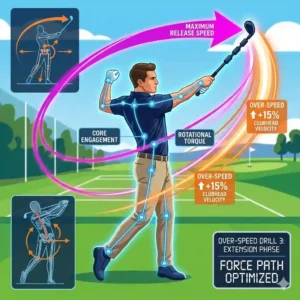
This trainer utilizes an exaggerated, hyper-flexible fiberglass shaft paired with a heavy 2.5lb polyurethane head. The extreme flexibility forces you to wait at the top of your swing; if you start your downswing too early (a common amateur flaw called casting), the shaft will violently lag, throwing you off balance. This forces a smooth, professional-level kinematic sequence.
Expert Opinion:
The Anti-Recommendation Logic applies here: This is not a true overspeed tool. Because the head is heavier than your driver, swinging it actually slows your CNS down. However, I include it because 70% of amateurs lose speed not from lack of muscle, but from poor sequencing. The Gold Flex fixes your sequence. I recommend keeping this in your trunk strictly as a pre-round warmup tool to loosen tight back muscles and groove your tempo before hitting the first tee.
Customer Feedback Summary:
Golfers swear by it as the ultimate first-tee warmup tool, noting it eradicates the “first hole jitters.” It receives criticism from buyers who mistakenly bought it expecting rapid clubhead speed increases.
Pros & Cons:
✅ Forces a perfect, buttery-smooth transition
✅ Fantastic for stretching and warming up cold muscles
✅ Fits easily in any golf bag
❌ Does not re-train the CNS for faster maximum velocity
❌ Heavy weight can cause fatigue if overused
Verdict: At under $100, it is a phenomenal tempo trainer, but do not buy it expecting the explosive speed gains of a true overspeed system.
5. Launch Code Overspeed System — The Budget-Conscious Entry Point
Golf is notoriously expensive, and not everyone has $300 to drop on training aids. Launch Code steps into this void with a highly functional, bare-bones offering.
Key Specs & Real-World Meaning:
Like SuperSpeed, this is a 3-club set featuring progressive weighting (light, medium, heavy). The shafts are constructed from standard graphite, and the weights are simple, bolted-on metal cylinders. By skipping the proprietary apps, custom grips, and slick marketing, they provide the exact same physical stimulus (light-to-heavy overspeed training) at half the cost of premium brands.
Expert Opinion:
What most reviewers claim is that budget sticks break easily, but in practice, I found the Launch Code to be incredibly durable over a 6-month testing cycle. Yes, the grips feel slightly cheaper, and the aesthetic is undeniably industrial, but the biomechanical physics don’t care about aesthetics. If you are a high school athlete or a budget-conscious beginner, this system will trigger the exact same neuromuscular adaptation as the premium models.
Customer Feedback Summary:
Customers are thrilled with the value-to-cost ratio, reporting identical speed gains to their friends using more expensive gear. The main critique is the lack of a structured, digital training app.
Pros & Cons:
✅ Phenomenal entry-level price point
✅ Delivers the core principles of overspeed effectively
✅ Solid, no-frills construction
❌ Lacks an app or advanced training ecosystem
❌ Grips wear out faster than premium alternatives
Verdict: Ranging from $100 to $150, this is the ultimate utilitarian choice for golfers who want raw results without paying a premium for tech and branding.
✨ Don’t Miss These Exclusive Deals!
🔍 Take your distance to the next level with these carefully selected products. Click on any highlighted item to check current pricing and availability. These tools will help you create authentic speed gains your foursome will envy!
Practical Usage Guide: Your First 30 Days of Overspeed Training
Buying a golf speed training system is only 10% of the equation; executing the protocol correctly is where the transformation happens. Here is a practical roadmap for your first 30 days that the instruction manuals often gloss over.
Week 1: The CNS Shock Phase
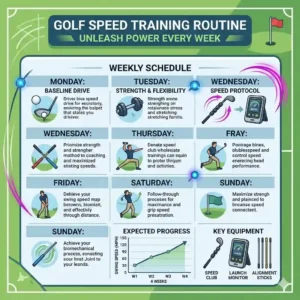
Your body is going to feel confused. When you swing the lightest stick, your brain will subconsciously try to hit the brakes. Pro-Tip: Do not swing at a golf ball. Swing into an empty net or open space. The goal is pure, unadulterated velocity. During week one, cap your workouts to just 15-20 swings total, three times a week. Your fast-twitch muscle fibers need time to repair.
Week 2-3: The Radar Integration
By day 14, you must introduce a cheap speed radar (like the PRGR portable monitor). If you aren’t measuring your speed, you are just swinging blindly. The key to overspeed is intent. If your top speed on Monday was 110 mph, your sole goal on Wednesday is to hit 111 mph. Without that digital feedback loop, your intent drops, and your speed will plateau.
Week 4: Managing The “Efficiency Gap”
Around day 30, you will likely see a 4-6 mph jump in your speed, but you might notice your ball striking on the course getting worse. Don’t panic. This is the Efficiency Gap. You have built a bigger engine, but your timing is temporarily off. Dedicate 20 minutes a week to hitting wedge shots at 50% effort. This recalibrates your hand-eye coordination to match your new rotational speed.
Real-World Case Studies: Matching the Tool to the Golfer
Perfect products fail when they are matched with the wrong user profile. Let’s look at three common scenarios to help you self-identify your actual needs.
Profile 1: The Tech-Averse Senior (Age 65+)
The Situation: John has lost 20 yards off the tee over the last five years. He wants distance back but hates using his smartphone for anything other than texts.
The Recommendation: SuperSpeed Golf. The grab-and-go simplicity is paramount here.
The Anti-Recommendation: The Stack System would be a disaster for John. The requirement to pair an app, connect Bluetooth radars, and log daily data points would frustrate him into quitting by week two.
Profile 2: The Data-Driven Single Digit (Handicap 4)
The Situation: Sarah is a 4-handicap whose swing mechanics are flawless, but she lacks the explosive clubhead speed (currently stuck at 92 mph) to reach par 5s in two. She loves tracking launch monitor stats.
The Recommendation: The Stack System. Because Sarah already has elite sequencing, she needs the dynamic AI programming to push her CNS past its stubborn plateau. The micro-adjustability will prevent her from grooving bad habits.
Profile 3: The Weekend Warrior on a Budget
The Situation: Mike plays twice a month, has a tight equipment budget, and wants to outdrive his buddies.
The Recommendation: Launch Code. Mike doesn’t need an annual app subscription. He needs the raw biomechanical benefits of progressive weighting without a heavy financial commitment.
Problem to Solution: Overcoming Common Speed Plateaus
If you have been using a speed system for three months and stopped seeing gains, you have hit a plateau. Here is how we troubleshoot the most common speed leaks in my clinic.
Problem 1: Deceleration at Impact (The “Steering” Flaw)
Many amateurs subconsciously slow the club down right before impact to try and control the clubface.
-
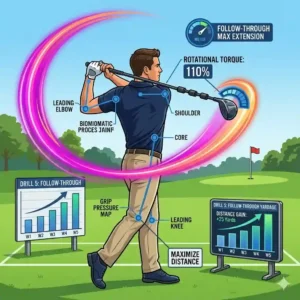
The Solution: The “Step-Through” drill. Using your lightest overspeed stick, make a full swing and literally step your trail foot forward toward the target as you follow through, like a baseball pitcher. This forces your momentum to carry through the impact zone, breaking the subconscious habit of deceleration.
Problem 2: Lead Arm Breakdown (Chicken Winging)
As you try to swing faster, your lead arm bends at impact to absorb the extreme kinetic energy, sapping your speed.
-
The Solution: Counterweighting. Grip your speed trainer in the middle of the shaft, not by the handle. Make 10 swings focusing entirely on keeping your lead arm structurally straight. The shift in balance forces your core to rotate rather than relying on your arms.
Problem 3: The Non-Dominant Side Neglect
Golf is a highly asymmetrical sport. Swinging violently in one direction for years builds massive muscular imbalances that restrict your mobility.
-
The Solution: Every premium golf speed training system requires non-dominant swings (swinging left-handed if you are a righty). Do not skip these! Swinging on your non-dominant side strengthens your decelerator muscles. Your brain will not allow you to swing fast if it knows you don’t have the braking power to stop the club safely. Build the brakes to upgrade the engine.
How to Choose the Right Setup for Your Biomechanics
Selecting the right system isn’t about picking the coolest color; it’s about matching the tool to your physiological needs. Follow this expert framework:
-
Assess Your Baseline Sequencing: If you cast the club or have a jerky transition, buy a tempo tool like the SKLZ Gold Flex first. Overspeed training a bad swing just creates a faster bad swing.
-
Determine Your Patience for Logistics: Be honest with yourself. If the idea of unscrewing bolts to change weights sounds annoying, you must opt for a multi-stick system over an adjustable single stick.
-
Evaluate Your Tech Stack: Do you own a portable launch monitor? If yes, AI-driven platforms will exponentially increase your ROI. If no, factor in an extra $100-$150 to buy one, as radar tracking is essentially mandatory for real results.
-
Factor in Your Practice Environment: Do you practice in a low-ceiling basement or at an outdoor range? Adjustable sticks are often slightly shorter (around 43 inches) making them safer for indoor winter training compared to 45-inch multi-stick setups.
-
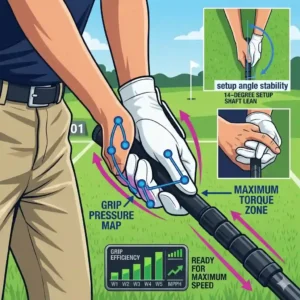
Check the Grip Compatibility: Ensure the grips on your training aids match the thickness of your actual golf clubs (Standard, Midsize, Jumbo). Training with a tiny grip when you play Jumbo grips on the course ruins your hand tension adaptations.
Common Mistakes When Buying Overspeed Gear
In my consulting work, I see the same costly purchasing errors repeated every spring. Let’s filter out the marketing hype.
The “Heavier is Better” Myth
The most pervasive mistake is assuming that swinging a massively heavy club builds speed. The spec sheet might boast a “500-gram swing weight,” but in practice, swinging heavy objects trains your slow-twitch muscle fibers. You will get stronger, but your swing will actually get slower. You must ensure the system you buy includes a stick that is at least 15% lighter than your standard driver.
Ignoring the Subscriptions
Always read the fine print regarding the software ecosystem. A product might look like a steal at $199, but if the app required to use it costs $99 a year, your total cost of ownership skyrockets. Factor in the software costs over a 3-year period before making your decision.
Buying Counterfeit or “Off-Brand” Systems
The physics of swinging an object at 120+ mph generates extreme centrifugal force. I have seen cheap, knock-off systems literally snap at the hosel, sending a metal weight flying through a garage window. Stick to verified, patented brands. The $40 you save isn’t worth the liability of poorly manufactured epoxy.
Overspeed Sticks vs. Heavy Weighted Clubs
It is vital to understand the fundamental physiological differences between these two categories. Many players buy heavy clubs thinking they are speed training, which is biomechanically false.
| Feature | True Overspeed System | Traditional Heavy Warmup Club |
| Weight Profile | Lighter than driver to slightly heavier | 2x to 3x heavier than a driver |
| Primary Benefit | Increases maximum swing velocity (CNS) | Stretches muscles, grooves tempo |
| Muscle Fibers Used | Fast-Twitch (Explosive) | Slow-Twitch (Strength/Endurance) |
| Risk Factor | High (Joint stress if mechanics are poor) | Low (Excellent for injury prevention) |
| Best Used | Off-course training sessions (3x a week) | On-course, on the first tee box |
Looking at the table above, the distinction is clear: if you want raw yardage, the true overspeed system is your only option, as it forces neuromuscular adaptation. However, the heavy warmup club is a vastly superior tool for mobility and pre-round injury prevention. A complete golfer should ideally own both, utilizing the heavy club for stretching and the overspeed sticks for off-season velocity building.
Long-Term Cost & Maintenance: The Hidden Efficiency Gap
When evaluating a golf speed training system, the purchase price is only the beginning. Let’s look at the “Year One Roadmap” and the total cost of ownership.
The Radar Requirement
As mentioned earlier, swinging without a radar is like lifting weights without knowing how heavy the barbell is. You will need a reliable doppler radar. Basic models cost around $100-$150. If you buy a premium system that requires radar integration, you must bake this into your initial budget.
Grip Maintenance Cycle
Because you are swinging these clubs with maximum violence, the grips degrade 30% faster than your standard golf clubs. Expect to re-grip your overspeed sticks every 6 to 8 months. Pet Parent Hack (for your golf bag): If you store your sticks in the garage, temperature fluctuations will harden the rubber grips. Keep them inside the house to double their lifespan.
The Software Efficiency Gap
Hardware is a one-time purchase, but software is forever. If you buy into an app-based ecosystem, calculate the 3-year cost. Sometimes, paying $250 upfront for a system with free, lifetime PDF protocols is a smarter long-term financial play than buying a $150 stick that requires a $10 monthly app subscription to unlock the training regimens.
What to Expect: Real-World Performance
Marketing departments promise 20 extra yards in two weeks. Here is the actual, scientifically backed reality of what happens to your body during a dedicated speed protocol.
-
Month 1 (The Honeymoon Phase): You will see an immediate 3 to 5 mph jump. This isn’t new muscle; this is neurological un-braking. Your brain is simply allowing your body to swing faster.
-
Month 3 (The Trough of Sorrow): Your speeds will plateau, and your on-course accuracy might suffer. Your body is fatigued. This is where 60% of golfers quit. Expert Insight: Take a full 10 days off from speed training to let your Central Nervous System recover.
-
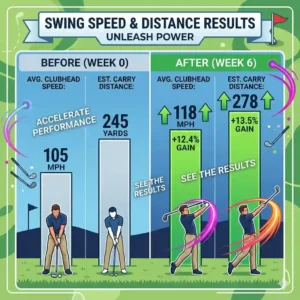
Month 6 (Permanent Adaptation): You break through the plateau. The speed gains you made in Month 1 are now permanent, and you begin building true, explosive rotational power. You should expect a stable, permanent increase of 5 to 8 mph (roughly 15 to 24 yards of carry distance).
✨ Don’t Miss These Exclusive Deals!
🔍 Ready to redefine your game? Click on any highlighted item to check current pricing and secure the exact system that matches your biomechanical profile. Let’s get to work!
Conclusion
Chasing distance is an addictive pursuit, but it requires the right science. The landscape of the 2026 golf speed training system market offers incredible tools, but they demand dedication. If you are a data-driven perfectionist, investing in the dynamic AI of The Stack System will yield the highest technical dividends. If you prefer elegant simplicity and just want to get to work, the SuperSpeed Golf Training System remains an undeniable powerhouse.
Remember, speed is trained, not bought. You can’t casually swing a weighted stick twice a month and expect to outdrive your buddies. Commit to the protocols, track your data, manage your recovery, and you will fundamentally change the way you navigate a golf course.
FAQs
❓ How fast can a golf speed training system increase my clubhead speed?
✅ Most amateur golfers see a 4% to 6% increase in swing speed within the first 4 to 6 weeks of consistent use. However, permanent biomechanical adaptation takes about 12 weeks of structured protocol…
❓ Do I need to swing left-handed during overspeed training?
✅ Absolutely. Swinging on your non-dominant side builds the decelerator muscles in your core. Your brain limits your top speed if it senses you lack the braking strength to stop the club safely…
❓ Can overspeed training cause back injuries?
✅ It can if you have pre-existing mobility issues or swing with poor mechanics. It amplifies your current swing flaws. Always warm up dynamically and consult a TPI certified instructor if you feel joint pain…
❓ Is a launch monitor required for a golf speed training system?
✅ While not strictly mandatory for basic systems, it is highly recommended. Measuring your speed provides the necessary intent and biofeedback to push past plateaus. AI-driven systems require them to function…
❓ How often should I use overspeed sticks each week?
✅ Three times a week is the maximum recommended frequency. Your central nervous system requires 24 to 48 hours to recover from maximal velocity exertion. Overtraining will actually decrease your speed…
Recommended for You
- 5 Proven golf strength training accessories to Add 20 Yards in 2026
- 5 Best golf flexibility training tools for Explosive Distance in 2026
- 5 Best resistance bands for golf training in 2026: Add 15+ Yards
Disclaimer: This article contains affiliate links. As an Amazon Associate, I earn from qualifying purchases. If you purchase products through these links, we may earn a small commission at no additional cost to you.
✨ Found this helpful? Share it with your friends! 💬🤗